

Beyond the Buzzwords: Why Accurate Environmental Claims Matter
I was recently gifted a reusable, insulated travel mug. The box and informational leaflet included numerous claims of “sustainable,” and “eco-friendly.” Excited and curious, I wondered what made it more sustainable. Were the materials sourced differently than traditional travel mugs?

This article is the first in a series on accurate environmental claims. All articles in this series include:
Part 1: Beyond the Buzzwords: Why Accurate Environmental Claims Matter
Part 3: Lifecycle Thinking: The Best Tool to Help Brands Master Sustainability
Part 4: Navigating the Green Guides: Valuable Principles for Marketing Claims
Part 1: Why Accurate Environmental Claims Matter
I was recently gifted a reusable, insulated travel mug. The box and informational leaflet included numerous claims of “sustainable,” and “eco-friendly.” Excited and curious, I wondered what made it more sustainable. Were the materials sourced differently than traditional travel mugs? Was reusable energy used to manufacture it? Could it be recycled? Was it made with fewer harmful chemicals?
I eventually found an asterisk in small print: “Compared to disposable coffee cups.” Disappointment sunk in. The mission was worthy—to help reduce waste—but without clearly specifying how it was more sustainable, I initially made my own assumptions, namely that its environmental benefits were compared to other reusable mugs, not disposable coffee cups.
Many brands make environmental claims, but they frequently lack specificity, clear comparisons, or validated data. The result is that consumers have become increasingly distrustful of companies that claim to be sustainable. In this article, the first in a four-part series on environmental claims, I explain the importance of accuracy, why business leaders and communicators need to become more educated on the topic of sustainability, and where to begin.
Environmental Claims are Advertising Claims
It’s easy to forget that environmental claims are merely a subset of advertising claims, which are regulated and required to be truthful. The Federal Trade Commission (FTC), which is the legislative body in the U.S. responsible for overseeing marketing and advertising, states:
“Claims must be truthful, cannot be deceptive or unfair, and must be evidence-based.”
Just as we can’t make a false or deceptive claim about product performance, we can’t make one about environmental attributes.
One reason we see so many misleading environmental claims is that it is a complex and technical topic. Those responsible for crafting content (agencies, marketers, business leaders) are rarely well-educated on the topic of sustainability. While most businesses have product experts such as engineers, designers, or scientists to research and validate product performance, companies often lack professionals with sustainability expertise. Even if experts do exist, their knowledge is infrequently translated to those making external claims. The culprit is a lack of knowledge among communicators — not an intentional effort to deceive. But it’s a knowledge gap that’s critical we close.
Pitfalls and Consequences of Green Claims
One consequence of inaccurate environmental claims is that companies are accused of greenwashing—misleading an audience by creating the perception of a better environmental profile than reality.
Examples include advertising an environmental attribute that is vague or unsubstantiated or promoting a part of the business that has environmental improvements when the majority of the business has a huge negative footprint.
Greenwashing is often perceived as intentional, even when it’s not. Consequences range from reputational damage to lawsuits, which can lead to fines and having to remove deceptive advertising. In the second article in this series, we’ll more deeply explore the topic of greenwashing and share examples.
Why Brands Are Jumping On Board
Consumers are becoming more conscious of their role in improving the environment and desire products that have less packaging, are sourced sustainably, and use renewable energy. According to studies by McKinsey and Nielsen IQ, 78% of respondents said they placed importance on a sustainable lifestyle and more than 60% of U.S. consumers said they were willing to spend more money on a product packaged sustainably. When it comes to actual spending, products that made Environmental, Social, and Governance (ESG)-related claims showed stronger cumulative growth from 2018-2022 than those without (28 percent vs. 20 percent cumulative growth, respectively). The chart below shows the difference in compound annual growth rate (CAGR) over this 5-year time period.

Source: McKinsey& Company
Additionally, according to the NYU Stern Center for Sustainable Business’s 2022 Sustainable Market Share Index, “products marketed as sustainable grew ~2x faster than products not marketed as sustainable.” As such, more brands are including environmental attributes in brand communication to capture reputational benefit, address customer desires, and increase sales.
Consumers Increasingly Distrust Environmental Claims
However, with the proliferation of “green” brands and sustainable claims, distrust is growing. According to GreenPrint’s 2022 Business of Sustainability Index, “only 38% believe companies when they make claims on environmental friendliness,” compared to 47 percent in 2021. Interestingly, corporate statements by CEOs and Sustainability Reports are considered particularly untrustworthy at 2% and 14%, respectively.

What’s more, executives agree there’s reason for distrust. Notably, in a global survey of executives by The Harris Poll for Google Cloud, 58% of business leaders said their organizations have “overstated their sustainability efforts.” Clearly, this is an issue we need to address. But how?
To build consumer trust, we need to ensure we are accurate and transparent in the ways in which our products and services improve or reduce environmental harm.
Moreover, to actually improve the environment and reduce our negative impact, we need to ensure that we are making meaningful improvements rather than simply capitalizing on perceived impact.
Where to Begin: No Product is “More Sustainable”
As a business leader and consumer, you may be surprised to learn that brands can’t claim a product is more sustainable. Sustainability attributes are specific, complex, and relative. Think of it this way: More sustainable compared to what?
Consider the claim that a product is “better.” We all know to ask: Better how? Is it cheaper? Faster? More Durable? Easier to use? Safer? Better is so broad and vague—and at this point, overused—that it’s essentially unhelpful because it doesn’t give customers the information they need to make an informed purchase decision.
Similarly, “more sustainable” is broad and vague. Is it less energy? Less waste? Less water? Fewer materials? And compared to what? Most brands rely on the customer perception that sustainability is a linear spectrum that ranges from “bad for the environment” to “good for the environment,” where the latter equals “sustainable.” The reality is that sustainability is a complex matrix of attributes that constantly changes based on the frame of reference. A foundational concept to help understand the environmental impact of a product is life cycle thinking. In the third article in this series, I’ll explain this concept and how it can help you understand the nuances of communicating sustainability clearly.
Because there is no simple answer on what is “more sustainable” and consumers don’t realize this, the FTC prohibits companies from making general environmental claims like “sustainable” or “better for the environment” without clearly specifying a particular attribute supported by science-based evidence.” The FTC states: “It is deceptive to misrepresent, directly or by implication, that a product, package, or service offers a general environmental benefit. In the fourth article in this series, we’ll dive into the “Green Guides,” the FTC’s guidance on environmental claims.
Future Articles in this Series will focus on:
Part 2: Unmasking Greenwashing: Explore the concept, learn from real examples, and discover strategies to steer clear of deceptive environmental claims
Part 3: Embracing Life-Cycle Thinking: Explore how to evaluate a product’s environmental impacts across its entire life cycle, empowering you to make informed and transparent sustainability claims
Part 4: Navigating FTC's Green Guides: Uncover the essentials of the Federal Trade Commission’s guidelines, ensuring your business crafts truthful and transparent environmental claims while sidestepping potential pitfalls.
Stay Tuned for Next Month’s Article on Unmasking Greenwashing!


Creating Conscious Messages Part 4: Taking Accountability Beyond Words
"I'm sorry. It was my fault."
I have come to learn these are among the six most powerful words I can speak as a parent or spouse. Unexpected, disarming, humble, effective, and yet, even with frequent practice, difficult to say.

This is the final article in a 4-part series on how to craft conscious marketing messages without manipulation. Each piece shows you successful ways to communicate that respect customers, build trust, and create long-term value that grows your business. Additional articles in the series include:
PART 4: Take Accountability Beyond Words
"I'm sorry. It was my fault."
I have come to learn these are among the six most powerful words I can speak as a parent or spouse. Unexpected, disarming, humble, effective, and yet, even with frequent practice, difficult to say.
Taking accountability starts with acknowledging one’s contribution to the circumstances, but it doesn’t end there. In the business world, this idea has become synonymous with apologizing. Apologies are necessary—and there are still far too many circumstances where companies delay apologizing or don’t at all—but an apology itself is often insufficient. True conscious marketing requires taking action to prevent the situation from happening again and clearly communicating those actions with integrity.
We have become accustomed to grand corporate announcements, delivered by the CEO, but taking accountability need not always be so public. Businesses frequently make mistakes in daily operations creating numerous opportunities to acknowledge and rectify the situation. Whether poor customer service, lower than expected product performance, or instances of environmental pollution, each circumstance of unmet expectations offers an opportunity to demonstrate leadership through clear messaging and purposeful action.
There are three components to taking accountability:
1) Understand and acknowledge the issue
2) Take the necessary steps to make amends
3) Put in place systems to avoid reoccurrence
Without these, businesses risk losing customer trust and loyalty. Let’s take a look at some examples.
Accountability Gone Wrong
Here are some examples of companies that initially, or have never, taken accountability. In all three, you will observe that the initial response 1) Did not understand or acknowledge the issue, 2) Did not remedy the situation, or 3) Did not put in place the necessary steps to prevent reoccurrence.
1) Ticketmaster Blames Swift’s Popularity for Ticketing Fiasco
When Taylor Swift’s Eras Tour concert tickets went on sale in late ’22, fans waited hours with millions unable to purchase tickets. Initially, Ticketmaster’s parent company Live Nation issued a statement blaming unprecedented demand, emphasizing those fans who did receive tickets. Live Nation Chairman Greg Maffei said to CNBC, “Reality is it’s a function of the massive demand that Taylor Swift has. And despite all the challenges and the breakdowns, we did sell over 2 million tickets that day. We could have filled 900 stadiums.” After fans and Swift, herself found the response unacceptable, with lawsuits and anti-trust issues looming, Ticketmaster took down its initial statement and issued a formal apology.
While demand for Swift’s concert was unprecedented, Ticketmaster could have avoided further backlash by immediately apologizing and stating how it planned to improve future service. Denial, shifting blame to Swift’s popularity, and gaslighting fan’s complaints inflamed discontent.
2) Meta Denies Responsibility for teenage Mental Health Deterioration
In 2021, Meta (formerly Facebook) whistleblower Frances Hagen leaked hundreds of internal documents and appeared on “60 Minutes” discussing Meta’s knowledge that Instagram exacerbated eating disorders and mental health issues among teenage girls. Here is Meta’s response to the leaked documents:
”It is not accurate that leaked internal research demonstrates Instagram is ’toxic’ for teen girls. The research actually demonstrated that many teens we heard from feel that using Instagram helps them when they are struggling with the kinds of hard moments and issues teenagers have always faced. This research, like external research on these issues, found teens report having both positive and negative experiences with social media.”
Dismissing the severity of the issue, Meta tried to portray a more balanced picture. If the consequences were less dire—such as customers not liking a particular flavor—this response might be reasonable. However, with accusations of suicide and severe illness caused by eating disorders, Meta’s response lacked an understanding of the magnitude of harm, and its denial rejected accountability, implying that it has no role in mitigating its platform’s negative impacts.
3) Wayfair Continues Doing Business with Border Detention Center Contractor
In 2019, Wayfair sold $200,000 worth of beds to a contractor who was using them to furnish detention centers for migrant children at the US/Mexico border. After employees communicated their disagreement, Wayfair responded via an employee email that it would continue doing business with the contractor:
“As a retailer, it is standard practice to fulfill orders for all customers and we believe it is our business to sell to any customer who is acting within the laws of the countries within which we operate.”
In response to the statement, employees staged a walkout of Wayfair’s Boston headquarters. While the company correctly stated its right to make this business decision, as it was not breaking any laws, leadership did not take the concerns of its employees seriously. Wayfair’s response lacked empathy and an understanding of customer and employee expectations of doing business ethically. Employees staged the walkout only after the company’s response, indicating that Wayfair had an opportunity to repair trust with employees—and potentially avoid national coverage and product boycotts—but failed.
Why We Don’t Take Accountability
We often forget that companies are made up of people. When people are accused of something, it’s our natural instinct to defend ourselves and point blame. I need only ask my children who broke the toy to observe this instinct. Within an organization, the decision of when and how to respond—especially in crisis—is nearly always a person or group of people reacting emotionally.
Accountability is a willingness to accept responsibility for one’s actions and contributions. It does not mean that one is wholly to blame, but it acknowledges one’s role in bringing about the result.
While there are many recent examples of companies taking accountability, many still do not. So often, we hear backpedaling, defensive language, ambiguous statements, blame of systems, processes, or external circumstances, or simply a lack of response.
Following are some common reasons brands don’t take accountability. The company:
doesn’t agree with the criticism or doesn’t think it was in the wrong.
believes circumstances were out of its control, and therefore isn’t accountable.
thinks apologizing looks weak and reduces customer confidence.
believes an apology will hurt the company’s reputation.
assumes taking accountability will lower the stock price or cause a loss of investor confidence.
doesn’t want the expense of the time and resources required to make amends.
fears lawsuits or increased regulation associated with any admission of accountability.
doesn’t know how to apologize or what taking accountability looks like.
has already apologized and believes it doesn’t need to do anything else.
The Business Case for Accountability
Initial denials are often met with an even more forceful response from those harmed or upset. Intuitively we know that taking responsibility is the right thing to do, but it can be extremely difficult in the moment, particularly when there is incomplete information. Companies often end up being forced or pressured to apologize. Acknowledging responsibility at the outset causes less reputational damage and can reduce customer discontent. One study by CRISP shows that 90% of customers are likely to shop with a brand again if it responds well to a crisis.
Another study from the University of Missouri found that companies can actually benefit when publicly accepting blame for poor financial performance. Companies that blamed their performance on other factors, such as the economy, competitors or the government, continued to see low stock prices for a year following their announcement. On the other hand, when companies took responsibility for their performance and communicated a plan to address the issue, their announcement stemmed stock price declines.
Customers appreciate honesty, especially when the message may be difficult for leadership to share, says study author Stephen Ferris, professor and senior associate dean at the University of Missouri Robert J. Trulaske, Sr. College of Business. “Investors will accept a forthright recognition of an honest mistake, expecting that corrective actions are likely to follow. When firms explain a negative event as due to an external cause, company leaders can appear powerless or dishonest to shareholders.”
Accountability Done Right
Let's look at a few examples of companies illustrating the three key elements of taking accountability well.
1) NETFLIX: Acknowledge the Issue
In 2011, Netflix made the decision to increase prices and separate its DVD business from its streaming business. After a few botched explanations, CEO Reed Hastings wrote a blog post (see its opening below). Beginning with “I messed up. I owe everyone an explanation,” he owns the mistake. He then demonstrates an understanding of customers’ concerns: “We lacked respect and humility.” The post was hailed as an example of empathy and humility.

2) ZOCDOC: Take the Necessary Steps to Make Amends
ZocDoc makes appointments on behalf of patients by logging into medical scheduling systems. Occasionally the systems don’t sync, resulting in a patient showing up for an appointment that ZocDoc failed to book. The begin by outlining the standard of service their customer can expect. Taking responsibility for the error, ZocDoc offers an Amazon gift card and, in the process, attempts to learn more about what happened so they can improve.

Source: Pipedrive
3) AIRBNB: Put in Place Systems to Avoid Reoccurrence
In 2014, Airbnb faced increasing complaints of discrimination among guests and hosts; an apology would not be enough. The company needed to take action to change its policies and operations to reduce discrimination. CEO Brian Chesky issued a formal apology stating Airbnb’s core beliefs and its failure to live up to them.
“Discrimination is the opposite of belonging, and its existence on our platform jeopardizes this core mission,” Chesky wrote. “Bias and discrimination have no place on Airbnb, and we have zero tolerance for them. Unfortunately, we have been slow to address these problems, and for this I am sorry. I take responsibility for any pain or frustration this has caused members of our community. We will not only make this right; we will work to set an example that other companies can follow.”
Beyond the apology, Airbnb took action by asking Laura Murphy, former ACLU head, to evaluate all of its policies and operations, and implemented the following changes based on her findings:
Updating and strengthening its anti-discrimination policy
Creating a policy to quickly rebook guests who experience discrimination
Increasing “instant book,” which reduces instances of discriminatory bookings
Voluntary anti-bias training for the Airbnb community
While these efforts likely did not end instances of discrimination, they illustrate the importance of taking action beyond communications—within policies, operations, and employee and customer training.
Tips For Taking Accountability
Whenever a crisis arises, it presents an opportunity to rebuild trust. Even if circumstances were out of your control, there is always something your business can do to empathize with customers and clearly communicate your actions. Here are a few guiding principles:
1) Understand and humbly acknowledge the issue
Respond quickly: Even without all the information, a fast response is critical. Sometimes this requires communicating the issue before many customers or stakeholders are aware, but it’s always better for your audience to hear your message from you.
Understand the issue: Troubleshoot to find the root cause. If you don’t understand why critics are upset, talk to them. If a system broke down, uncover the source.
Communicate with empathy: Be heartfelt and genuine. Demonstrate concern for customer, employee and stakeholder needs and criticisms. Avoid defensiveness.
Own it: Use the active voice and don’t blame external factors or systems. This doesn’t require taking full blame, but it does mean clarifying your role in the matter.
2) Take the necessary steps to make amends
Outline a standard: Explain your mission and values and declare what you stand for, what you aspire to, and what your audience should expect, even if the status quo is imperfect.
Provide restitution: Identify who has been impacted and whether anything beyond an apology is needed to repair damage and rebuild trust. Some examples are a discount, product replacement, a non-profit donation, or the reversal of a business decision.
3) Put in place systems to avoid reoccurrence
Take action: Consider what improvements are needed to reduce or prevent the situation from happening again. This may require a third-party review, as in the Airbnb example, or it may require overhauling systems, processes, products, or policies.
As guardians of our brands, we need to ensure that taking accountability is delivered consciously. This requires understanding the issue and communicating it back to the customer in an empathetic way. Brands must also honestly give assurance that, to the best of its ability, it won’t happen again by actually taking restorative action. Our words must line up with our actions.
Just like we have frequent opportunities to apologize to those in our life, so too do companies. Taking accountability is a sign of strength and courage. When brands build that muscle, we trust them more, knowing they will be humble enough to admit fault and make a change for the better.
Stay Tuned for Next Month’s Article!

Creating Conscious Messages Part 3: Shift from Aspirational to Achievable Marketing
Effective marketing that influences viewers can, on a larger scale, influence culture. Therefore, the way we communicate—the words we use, the images we select, the values we implicitly or explicitly endorse—all have more power than we realize to shape cultural norms.

This is the third article in a 4-part series on how to craft conscious marketing messages without manipulation. Each piece shows you successful ways to communicate that respect customers, build trust, and create long-term value that grows your business. Prior articles in the series include:
Part 1: Replace Fear with Value
PART 3: Shift from Aspirational to Achievable Marketing
Effective marketing that influences viewers can, on a larger scale, influence culture. Therefore, the way we communicate—the words we use, the images we select, the values we implicitly or explicitly endorse—all have more power than we realize to shape cultural norms. That influence can be positive or negative, giving us the opportunity—and responsibility—to consider how our messaging negatively impacts the individual and our culture.
Most marketing insights research focuses on identifying customers' needs and wants. In this article series, I have argued that our messages should address a meaningful customer need that is specific and solvable. I have intentionally avoided the language of “wants” because there are two types: those which can be satisfied and those which cannot. I find it less critical to distinguish between whether a specific, solvable solution is needed versus wanted (I might not need a fancy dinner, but I want to experience a unique, memorable occasion) and more critical to distinguish between what a brand can deliver on vs. what it can’t.
Marketing messages that target desires that can never be fully satisfied are commonly referred to as “Aspirational Marketing.” The aim is to tap into customers’ deep desires and longing, rather than their current realities, to create an emotional connection with the brand. However, marketing that appeals to image, power, beauty, and wealth takes advantage of the most vulnerable and insatiable aspects of human desire, creating a never-ending hamster wheel of longing for a reality that’s never achievable.
Because this strategy has become so pervasive, it’s worth examining its impacts. Let’s dive deeper.
The Problem with Aspirational Marketing
Most aspirational marketing emphasizes the importance of wealth, possessions, physical beauty, and external perception. Research shows that this type of marketing:
Increases feelings of negative body image and contributes to eating disorders
Encourages materialism and materialistic values, which has been shown to produce more negative emotions, lower self-esteem, symptoms of depression and anxiety, and even poorer physical health
Prioritizes external appearances over internal traits, which can reduce happiness, and increase anxiety and depression (Kasser, Tim. The High Price of Materialism. MIT Press, 2002)
Even if a person does not suffer from these specific emotions or compulsions, we are all exposed to a daily onslaught of messages that create an image- and consumption-focused culture. We have come to accept, mostly without question, that what we buy determines who we are. That it is normal to endlessly desire more: more power, more money, more youth, more admiration from others.
All this communication encourages us to buy more to satisfy our insatiable desires. By appealing to and reinforcing those desires, aspirational marketing creates unrealistic standards that we aspire to. When we cannot achieve these standards, we experience lower self-esteem and discontent with our current situation. As a result, we further overconsume, which creates clutter in our lives and disaster for our planet.
How Did We Get Here?
Our current “more” culture has not always been. During the US Industrial Revolution in the late 1800s and early 1900s, advertising was not yet an industry, and most product messages were entirely focused on functional needs and product benefits. In the 1920s, Edward Bernays, now known as the father of PR and notably the nephew of Sigmund Freud, introduced a new method of portraying products as a means to fulfill consumers’ subconscious desires. With A-list clients like P&G and General Electric, Bernays popularized this approach and it began to spread.
Around the same time after WWI, corporations and banks were concerned that the economy would stop growing unless people bought more goods. Lehman Brothers executive Paul Mazur wrote, “The community that can be trained to desire change, to want new things even before the old have been entirely consumed, yields a market to be measured more by desires than by needs. And man’s desires can be developed so that they will greatly overshadow his needs.” (Mazur, Paul. American Prosperity: Its Causes and Consequences. 1928)
The confluence of these ideas gave rise to what has become our modern consumerist culture. Harnessing human desires that can never be fully realized—being admired, desired, wealthy, or powerful—creates seemingly endless opportunities to create demand for one’s products and services.
Here are a few examples of this approach—you will recognize that these themes remain pervasive today:

Image Source: © GM; © Saadia Group; © Emirates; © BMW
As consumers, our choices and decisions naturally reinforce or shift how we perceive ourselves. A brand that sells sporting goods inherently instills in its buyers a sense of being active and sporty. But there is a difference between portraying who your customer is, and showing them who they want to be, particularly when who they want to be is out of reach.
Why Aspirational Marketing Might Be Less Effective Than We Think
While we may concede that there are repercussions for an image and materialistic-focused culture, the reality is that most brands pursue this approach because they think it is effective. One branding company describes the intent this way: “Establishing your brand and product by marketing a lifestyle is something that customers are much more responsive too [sic]. Products that sell a lifestyle create an aspirational feeling, leading customers to think [my emphasis added] that this item will help them achieve a better quality of living, or grasp the kind of lifestyle that they’re striving for.”
But recent research shows that aspirational marketing might not be as effective as once thought. “This form of advertising builds on the principle of cognitive consistency theory, which claims that a fit between one’s self-concept and an identity-enhancing brand or product category leads to greater attraction,” writes Kenneth Dahl in his article, “Why Aspirational Marketing Fails 9 times out of 10.”
Research published in Journal of Consumer Psychology shows that if there is too significant a gap in an ad between a customer’s present-day reality and the aspirational life portrayed, it can result in negative emotions due to a loss of self-esteem, and these feelings can become associated with the advertised brand. Researchers concluded that the use of idealized “actors or spokespeople in the message, in order to convey the aspirational nature of the product, has damaging effects on the target market response.”
Additionally, the slowing growth of the luxury market in the US and Europe (combined with macroeconomic factors) may point to the idea that selling aspiration alone is insufficient. Pamela Danziger writes in Forbes, quoting a luxury expert, “We need to reinterpret luxury from labels and conspicuous consumption to a quest for goods and services that are personal, authentic, and unique. Many successful companies are returning to this definition.” Danziger adds, “The opportunity is to return to the key pillars of luxury – quality, craftsmanship, design, attention to detail, uniqueness, and authenticity.”
The Solution: Achievable Marketing
So what is the alternative? Simply stated, it’s portraying what’s possible. It’s communicating how your product or service will realistically impact customers’ lives. It’s showing what’s achievable.
Let’s explore a couple of examples of brands that have moved from aspirational to achievable marketing.
Retouching advertising, a common industry practice particularly for beauty products, can be both misleading and, in some cases, culturally harmful. With help from a professional photographer and lighting, not only is a beautiful, thin model typically featured—which is sufficiently out of reach for most of us—but standard practice is to edit photos to remove blemishes, wrinkles of fat, stray hairs, and discoloration—portraying the ultimate perfection.
The consequences of decades of this kind of marketing are eating disorders and women’s dissatisfaction with their bodies. In 2004, Dove researched the self-perceptions of beauty among women and girls and found that only 2% of women considered themselves beautiful.
While many brands may find it difficult to move away from the “ideal,” fearing loss of sales, Dove serves as a strong example that questioning the norm can build the business. On the heels of its 2004 study, Dove launched the Campaign for Real Beauty, featuring non-models of various sizes and shapes, showing their imperfections. In the first 10 years of the campaign, the brand grew revenue from $2.5 billion to $4 billion, representing a ~12% compound annual growth rate.

Image Source: © Dove
In 2018, CVS launched a program to inform shoppers whether the beauty imagery in stores had been digitally altered. According to Elena Folks, executive vice president of CVS Health and president of CVS Pharmacy, “80 percent of women feel worse about themselves after looking at beauty ads, and 42 percent of girls in grades one through three want to be thinner.” CVS’s initiative was designed to be transparent about the use of retouching and to avoid it as much as possible. Because most images in CVS stores are produced not by CVS but by beauty companies, the influence of CVS’s policy extended beyond its own walls and required all beauty brands to comply with retouching disclosures.

Image Source: © CVS
Many other brands such as Target, Aerie, and Modcloth have made the leap to the “no retouching,” featuring models of all shapes and sizes. They understand that using average-sized models may result in more sales than if they used size 0 models, as represented in this University of Kent study.
How to Restructure your Message
Brands that strive for authenticity and offering genuine value should consider whether they are taking advantage of aspirations that can never be satisfied, and whether they may actually be reinforcing and strengthening insecurities.

If you found yourself answering “yes” to the questions on the left side of the chart, and answering “no” to questions on the right, here are some approaches to restructure your communication:
1) Avoid appealing to sources of insecurity: Check if your emotional benefit is focused on image, wealth, status, admiration, power, or idealized beauty. These innate desires can be easily manipulated and a brand can never completely deliver on them.
2) Portray an achievable scenario: Research shows that advertising is more effective when the customer can relate to it, so try to represent your customer as you craft your communication. Consider that aspirational marketing is not always identified by the central message but is often the result of how we wrap our message with casting, locations, props, and retouching. Here are a few suggestions:
Cast everyday people
Show everyday situations/homes
Represent your customers as they are today or a realistic portrayal of what they could achieve vs. something they could never be
3) Acknowledge customer identity through action vs. association: Brands communicate their own identity, beliefs, and values, naturally attracting customers with a like focus. However, we want to avoid building our brand on an identity that we simply give our customers by association, as it can be both ingenuine and short-lived. We can do this by reinforcing positive identity through the experience of using your product or service, rather than an identity acquired simply by buying or owning anything with your brand’s name on it.
4) Affirm your customers: Watch out for scenarios that invite comparisons and contribute to feelings of inadequacy. If the gap between your target customer and the ideal you’ve created is insurmountable, the response may be feelings of unworthiness, resulting in negative brand associations. Find ways to reinforce a positive self-image through an encouraging tone of voice and relatable insights.
5) Focus on craftsmanship and quality over image: Some products and services have premium prices because they are of higher quality, manufactured with fine craftsmanship and design, or offer more comprehensive service. These attributes can stand alone and don’t need to be associated with exclusivity or image; they can simply be appreciated on their own merit. Consider focusing on how your customer enjoys the intrinsic benefits of the product or service rather than a perceived external benefit resulting from social perception.
What’s so hard about avoiding aspirational marketing is that deep down, our customers always want more. We all want more; people can easily be prompted to feel discontent. If our job is to generate sales, and therefore “create demand,” all we need is to stimulate the desire for status, beauty, or wealth. But if we remember that our brand messages can either enhance or reject those innate feelings of discontent we all experience, then we have the power to fight the cultural narrative of consumption as the path to contentment. The irony is that it just might be a better way to grow the business too.
Stay Tuned for Next Month’s Article!

Creating Conscious Messages Part 2: Balance Emotional and Functional Messages
In the book The Ruthless Elimination of Hurry, John Mark Comer rails on advertising, calling it “a multibillion-dollar industry that is intentionally designed to lie to you – to get you to believe that if you will only buy this or that product then you will be happy. Or at least happier.”

This is the second article in a 4-part series on how to craft conscious marketing messages. Each article explores a specific communication practice to avoid in order to better respect customers, create value, and grow your business. Additional articles in this series include:
PART 2: Balance Emotional and Functional Messaging
In the book The Ruthless Elimination of Hurry, John Mark Comer rails on advertising, calling it “a multibillion-dollar industry that is intentionally designed to lie to you – to get you to believe that if you will only buy this or that product then you will be happy. Or at least happier.”
As a marketer, I am disappointed that some individuals perceive all ads as communicating lies, but there’s a thread of truth at the core of this idea. Comer’s criticism is not that advertising explicitly lies about what products and services do, rather he critiques the promises brands make about how using their products and services will make you feel.
While effective communication should make you feel something – otherwise it risks being ignored and ineffective – we need to be careful that we are not setting up promises that a company cannot deliver.
Consider a few examples:
“Be proud of how you ship”
“Travel Confidently”
“Feel Sexy Again!”
With no context, each of these promises an emotional benefit without a functional solution, leading one to wonder: How? In the actual executions, these brands had varying degrees of specificity as to how they help you achieve the emotional benefit, but in all three, the functional solution was significantly deprioritized.
These examples highlight a central reason why so many people distrust the messages that brands communicate: Companies promise or exaggerate an emotional benefit without anchoring it in the product or service that creates the feeling. In essence, they divorce the emotion from the functional solution.
Why Balancing Emotion and Function Matters
Functional benefits are time-bound, physical, concrete, and/or task-oriented solutions to a problem, need, or desire customers experience. Emotional benefits are the feelings customers experience during or after they have used your product or service. Both messages have value, but when emotional messaging drastically overshadows functional messaging, we risk overpromising, misleading, disappointing, confusing or creating distrust with our customers.
Customers have problems or needs that require solving, and the only solutions companies can offer, consistently and reliably, are functional. Tony Ulwick, a pioneer of the innovation tool “jobs theory,” describes customer needs as “jobs to be done.” “Jobs are functional with emotional and social components,” he explains. Emotional and social benefits only result from solving a customer’s primary functional need.
All humans experience deep emotional needs such as happiness, security, confidence, to be loved, and to feel worthy. However, a brand cannot consistently and reliably solve an emotional need outside of the specific functional solution it offers. While a growing number of “lifestyle brands” promise a social and emotional identity to customers (a topic for a future article!), selling emotion without a solution is short-lived and, in many cases, an illusion.
To create and accurately communicate value, we can only promise what we can actually deliver: functional solutions and the emotional benefits tied to those solutions. When we do this transparently and humbly, we create more effective communication and build trust.
Why Do We Prioritize Emotional Benefits over Functional Benefits?
Standard message development processes often lead us to overpromise and exaggerate, even if that’s not our intent. We ask: “How does our product make our customers feel?” Perhaps the response is: “Happy. Joyful. Content. Safe. Confident.” When that insight is turned into a message, we appeal to the overarching emotional need, sometimes forgetting or significantly minimizing the way in which the product actually delivers those emotions.
One of the reasons we tend to see emotion play such a large role in messaging is that many marketers and advertisers believe that emotional benefits are more effective than functional ones. This thinking argues that functional messages engage the rational brain, whereas emotional messages engage the subconscious brain where most of our decision-making takes place.
Illustrating this point, a 2022 Gallup study found that “70% of decisions are based on emotional factors and only 30% are based on rational factors.” The Gallup article cites a study on luxury hotel brand, concluding that emotional attributes, such as feeling welcomed, were more important than physical attributes, such as furnishings, to influence customer engagement. This study ignores the fact that there are physical elements - a receptionist’s smile, the excellent service of a server or concierge, a clean lobby – that create the feeling of being welcomed. A customer must understand what a product or service’s functional benefit is in order to understand and believe the emotional benefit that comes from the solution.
The opinion that emotional benefits are more effective assumes that functional and emotional benefits work independently to influence behavior and can therefore be compared. But in truth, they are mutually dependent elements. For advertising to be effective, according to Ph.D. neuroscientist Elise Temple, it must first be easy for your brain to process, and then it needs to tap into existing memory structures that create context. In order to motivate action, such as filling out a contact form, purchasing a product, or engaging in content, the message must be simple, clearly communicate how it creates value, and provide context for how the brand fits into the customer’s life. Temple explains that functional messages can easily and effectively deliver on these elements of strong advertising, and are no less likely to be effective than what we consider “emotional” messages.
We often forget that functional solutions have intrinsic emotional benefits, and a brand need not always explicitly state them. For example, “Keep the weight off for good” is a functional benefit that a weight loss seeker automatically associates with confidence, discipline, and freedom. The emotional benefits are implied without being directly mentioned. Compare that to the claim, “Body Confidence Guaranteed,” where the messaging has shifted its focus away from the weight loss service it provides and (unless it provides a much more detailed explanation) begins to overstep the promise it makes to customers.
Functional messages also tend to be deprioritized because they are seen as boring and lack memorability. An article in Forbes states, “Emotions tend to trump facts when it comes to influencing buyers,” which illustrates the confusion that exists between understanding features and benefits. A feature is a specific attribute of your product, such as its specifications, dimensions, or how it’s used, and they often are factual in nature. A functional benefit is the value created for your customer by solving a problem or meeting a functional need; benefits are not necessarily factual. For example: “wireless” is a feature; “get access anywhere,” a benefit.
Without a clear explanation, features often don’t communicate how a product solves a customer’s problem and can risk being irrelevant, whereas functional benefits – when relevant to the customer and communicated well – can be extremely effective in creating purchase interest.
What Happens When We Separate the Emotional Benefit from the Functional Benefit
Let’s take a closer look at what happens when we prioritize the emotional benefit over the functional solution. Coke’s former advertising campaign, “Open Happiness,” which ran from 2008-2015, spoke to the concept of a lofty generic promise. At the core of this campaign idea was “Coke will make you happy,” which was a tall glass to fill (get it?!). The company’s reason for abandoning the campaign reflects the need for a specific and realistic benefit that the product can deliver. Marcus de Quinto, the CMO, explained, “…it failed to hammer home more simple pleasures, like enjoying an ice-cold Coke on a hot day.” He elaborated on the importance of focusing on the product and not inflating what the brand could realistically achieve. “We are a simple pleasure, a product that refreshes. Not one that's going to save the world. If by refreshing, you save the world, fine. We are going back to this truth."

One of Coke’s “Open Happiness” ads; © CocaCola Company
De Quinto cautioned, “Emotional marketing goes to the extreme; talking about message without product, and values without benefits. Over the last few years, we have been talking about happiness, and sometimes we forget we are a drink that tastes very good.”
While de Quinto did not cite business results, the industry attributed the campaign change to category declines and sluggish brand growth. “Open Happiness,” a campaign focused nearly exclusively on promising happiness - in a category under fire for obesity and tooth decay - did not deliver the sales growth the company desired.
How to Tie the Emotional Benefit to the Functional Solution
Let’s contrast the Coke example with a Pillsbury commercial I saw a few years ago where the brand realistically tied emotion to the solution. In the ad, parents and children baked crescent and cinnamon rolls together on a weekend morning. The kids anticipated the “pop” of the pressurized cardboard container when it opened, a father taught his daughter how to roll the crescent, and all peered into the oven, watching the dough rise while inhaling the aroma of fresh-baked goods.
The sights, sounds, and behaviors visualized in this ad accurately depicted my personal experience making crescent rolls with my kids. While the emotion communicated was joy and love, the sounds, smells, and feelings portrayed were all generated by the product itself in the specific context of baking as a family.
The key to accurately communicating emotional benefits is to focus on how the product itself can realistically achieve the emotional experience depicted. If your product cannot directly create that emotion, then it is ingenuine to associate your brand with that promise. If your service only delivers that emotion in a specific context, then you must convey that specificity in your message.
Once you’ve created your message, you can check the balance of emotional and functional benefits by asking yourself these questions:
Does my product or service directly and frequently create the emotions I convey in my message?
Am I showing or explaining how my solution creates the emotions I portray, and the specific circumstances in which that happens?
Am I exaggerating how much emotional impact my product will have on my customers life?
How to Restructure Your Message
If you find yourself prioritizing emotional benefits over functional benefits, either by deprioritizing or excluding the functional benefit entirely, the first step is to identify the functional and emotional benefits that your product or service offers. As a reminder, functional benefits are time-bound, physical, and/or task-oriented solutions to a meaningful need your customer has (which are not the same as product features!). Emotional benefits are the feelings customers experience during or after they have used your product or service.
When developing communication, ensure your message makes clear how your product or service addresses the functional need, either visually or through explicit statements. Incorporate emotional needs as they relate specifically to the functional need you solve for and in the context in which you address the emotional needs. If marketing messages or images portray only emotion, work to shine a brighter light on the functional solution.
Check to ensure the emotional promise considers the relative importance of the solution in your customers’ lives so that the emotion conveyed is not exaggerated. A lifesaving cancer drug would indeed have a far more significant emotional impact than a kitchen gadget that saves time chopping garlic. If you’re not sure, just ask your customer and they will tell you.😊
We owe it to our customers to deliver on what we promise: a solution to a functional need. And we can deliver the solution, assuming it’s a high-quality product. What we can’t promise is that they will feel a certain way by using our service. If we can reduce instances of exaggerated emotional marketing and focus our messaging on the simple ways we can improve lives, we not only make our messaging more believable, but our brands become more trustworthy. People can’t claim that we are selling them a lie if we don’t promise that our product will make them happy. Our products and services just simply need to do what we say they will do.
Check out the next article in this series on Creating Conscious Messages in November!

Creating Conscious Messages Part 1: Replace Fear with Value
This article series is about messaging: how to do it in a way that is transparent, realistic, and uplifting vs. exaggerated, manipulative, and negative.


This is the first article in a 4-part series on how to craft conscious marketing messages. Each article explores a specific communication practice to avoid in order to better respect customers, create value, and grow your business. Additional articles in this series include:
Introduction to Conscious Messaging
This article series is about messaging: how to do it in a way that is transparent, realistic, and uplifting vs. exaggerated, manipulative, and negative.
That all sounds intuitive and easy to agree with, but it’s pretty darn hard to put into practice. Case in point: writing the headline for this series. I wrote more than 20 iterations before making my final selection which embodies the ideas I’m espousing.
My goal is to change the status quo in marketing to make the discipline more conscious, but my draft headlines - “How to Avoid Manipulating Your Customer” and “Stop Using Fear to Sell” - were utilizing the very tactics that I’m about to argue we should all avoid.
This series lays out an aspiration for marketing and brand messages. An aspiration we might not reach all the time, but striving for it requires that we are conscious of the messages we create and the impact they will have on our customers and our business.
There is a common culprit behind communication that exaggerates or manipulates: putting business interests ahead of customer interests. We almost always think we are putting customer interests first, but when we closely examine how we use messages to sell our products and services, occasionally we unconsciously mislead and pressure to generate sales.
We all want to avoid these outcomes, both because it doesn’t feel right and because it doesn’t lead to long-term business growth, which is why it’s critical to expose these tactics and root them out of our messaging.
There are 4 common messaging practices that I consider unconsciously manipulative. Each article in the series will explain why we want to avoid these practices and what to do instead.
PART 1: Replace Fear with Value
I recently took my husband indoor skydiving for his birthday. The “flight” itself was thrilling, an experience I can’t wait to repeat. However, every other part of my customer experience was dominated by a single business strategy: upsell.
From the website where I bought my tickets two months in advance to the check-in process to check-out, I was bombarded with these messages: “You’ll wish you bought 4 flights instead of 2,” “Everyone prefers the high-fly,” “Don’t miss out on pre-buying a future flight because your 50% discount expires today.”
Contained within each of these messages are the seeds of fear, which elicit doubt, worry, and comparison: What if I’m not doing everything I can to make this the best experience possible? Only 5 minutes after entering the building, I was exhausted, full of distrust, and disappointed I couldn’t just enjoy the adventure I had already purchased.
These messages are everywhere. Whether by capitalizing on existing fears or creating a sense of fear that didn’t already exist, the dominant perception is that fear sells. Articles abound on topics such as “How to use fear to generate clicks,” and common messages highlight “5 Ways you are ruining….” or “Sign up for our newsletter or you won’t get access to….” The use is so pervasive, and in many cases subtle, that we might not even recognize the tactic as fear.
Using fear to sell is not new. We can see evidence of this strategy in a 1920 Listerine ad campaign pictured below titled “Don’t Fool Yourself,” featuring women who alienate their own children because of bad breath.

While using fear to sell is not a new idea, this practice has become explicit and normalized within the world of marketing, resulting in more brands intentionally using fear-based communication to incentivize sales.
Why Avoiding Fear Marketing Matters
I argue we should avoid creating needs based on fear for two critical reasons: First, using fear, even subtly, can have a negative impact on our customers. Secondly, it may not be as effective as we think.
A conscious marketer’s goal is to create value by offering a product or service that will make customers’ lives better - part of that value includes the message itself. Marketing can build trust, give hope, educate, and inspire, or it can pressure, generate skepticism, create anxiety, and spark negative emotions. Our messages present a great opportunity to put our customers well-being first.
How Fear Marketing Harms Our Customer
Fear-based communication activates a fight or flight reaction because the body senses an emotional threat. Planting seeds of doubt exploits this physiological response (“What if I miss out on X? Will I be successful without Y? Will this bad thing happen if I don’t buy Z?” ) creating or exacerbating feelings of inadequacy, negativity, comparison, and sometimes hopelessness.
Fear of Missing Out (FOMO) can negatively affect mental health, create sleep disturbances, and lead to overall unhappiness by reducing satisfaction with our own lives. Marketing that elicits FOMO, also known as “FOMO Marketing,” introduces new desires that make customers feel less off in their current circumstances in hopes of selling more. Whether or not the customer buys, the message leaves a residue of negative feelings.
Is that our goal?
We may think these strategies are harmless. What can one email headline do? Or one advertisement? But by employing these tactics, we give our consent, even our endorsement, to the practice of making people doubt or feel bad about themselves in hopes of persuading them to buy our products and services.
Fear-Marketing Hides Low Demand
Ethics aside, many marketers advocate this selling tactic because they think it works. While there is some data to show that fear-based strategies increase conversion rates and short-term sales, in the long run, they can contribute to lower retention and lifetime customer value and create brand distrust.
When fear is used in messaging, rarely is the goal to reduce or eliminate a customer's pre-existing concerns. Instead, fear is typically manufactured or exaggerated to induce a feeling of need. Why? Because the value of the product or service is not obvious.
A common message strategy involves helping your customers “avoid failure” in order to create urgency to buy: “If you don’t buy our service, all these bad things could happen!” Frequently, the harm or the risk associated with failure is exaggerated or infrequent and is based on an underlying assumption that there is not enough demand without fear.
If a brand depends on fear-based communication to generate interest, a bigger problem likely exists: the product/market fit may be off, customer needs are not understood, or the benefits don’t resonate. Addressing these fundamentals is a much more effective strategy to deliver long-term growth than using fear for short-term sales.
When we have a product that meets real customer needs, we don’t need to artificially create demand to sell our product or service. Rather, we can craft a value-focused message that explains how the product solves their problem.
Fear Reduces Customer Satisfaction
If customers feel pressured, buy more than they want, or the product doesn’t deliver on expectations, they often stop trusting the brand. Customers who feel disappointed share negative reviews, talk badly about the company, or stop buying altogether. For long sales cycles common in the B2B world, building trust takes months and sometimes years. Short-term fear-inducing tactics are counterproductive.
The “Joy of Missing Out” (JOMO), aimed at combatting FOMO, describes a state of mind of being present and intentional with one’s time and purchase decisions, and finding satisfaction in those choices, even when there are known tradeoffs. A study published in the Journal of Organizational Psychology looked at consumers’ satisfaction with purchases when the participants experienced FOMO vs. JOMO. Those who experienced JOMO showed significantly higher levels of product satisfaction compared to those who experienced FOMO.
This study indicates that when we use our messages to evoke feelings of JOMO - that is, being present, fulfilled, and satisfied - our customers experience higher product satisfaction and likely better brand loyalty compared to FOMO, which elicits negative feelings of anxiety, regret and fear.
Fear Drives Avoidance
Evolutionarily we are wired to avoid negative emotions. Research on brain responses to advertising shows that emotionally negative content creates a repel reaction that can prevent emotional engagement. Explicitly negative fear-based messaging often does not result in the desired behavior. For example, public service campaigns targeting anti-smoking, texting and driving, and climate change have been largely ineffective at using fear to reduce the desired behavior.
In academia, two philosophies explain how to motivate behavior. “Avoidance motivation” is a fear-based strategy and “approach motivation” is a benefit-based strategy. “Advertising that focuses on the negative can backfire because people avoid the advertising in the first place,” explains Elise Temple, Ph.D., a neuroscientist who specializes in testing the effects of advertising on the brain. “Very rarely does fear motivate people to buy a product. An approach-based motivation is often more effective, as it increases the likelihood that the viewer will engage with the main idea, and it associates your brand with positive messages.”
Showing a problem may remind a customer why your solution matters to them if they have a pre-existing need; however, even in that scenario Temple advises making problem communication extremely brief with the majority of messaging benefit-focused. Fear-based “clickbait” headlines may deliver clicks, but customers often feel misled and disappointed - emotions that won’t lead to sales.
Can You Spot Fear in Your Messaging? Ask Yourself These Questions:
⦁ Am I using fear or FOMO to induce a desire for my product or service?
⦁ Does my messaging diminish or criticize my customers’ current experience?
⦁ Do I exaggerate the fear beyond what my customer experiences?
⦁ Am I making my customers more afraid or anxious based on my communication?
⦁ Is using fear in my message grounded in actual harm or danger to my customer? (If so, this might be a legitimate use of fear in your message)
How to Avoid Creating Messages Based on Fear
If you find yourself using fear as a strategy, focus on the benefits. Regularly talk to your customers to identify needs and wants in their own words. We often overlook this step assuming we already know this information. Only after uncovering their real challenges and desires can we craft compelling messages that describe the value we create.
Once the message is defined, check for tactics that use scarcity and fear. They can sneak into execution even when the strategy is not based in fear. [As I mentioned, writing this headline required multiple revisions!]
There are three elements that you can modify to shift from fear-based messaging to value-first messaging:
1) Language & Copy: Use positive and encouraging messaging in your copy that focuses on what customers will get by engaging in your product or service and less so what they will miss out on.
2) Tone: Consider the tone of voice, music, and color palette to create an overall mood that helps convey the benefit vs. an anxiety-inducing or negative tone that inspires doubt or comparison.
3) Imagery: Show the benefit versus the problem as a more effective way to deliver the desired purchase behavior. Visualize people capable of reaching or experiencing the desired end state versus models who are so aspirational that they create an unrealistic standard for the customer.
Here are a few simple examples of how to transition from a fear-based message to a value-first message:

Not using fear pushes us to better understand our customers’ interests and forces us to better communicate the value we offer. In doing so, we avoid creating a sense of inadequacy, hopelessness, anxiety, and negativity. When we create emotions of fulfillment, intentional decision making, and being content with what one has, we can produce greater customer satisfaction. Not only is this the right thing for our customers, but it also results in messaging that customers trust which leads to long-term business growth.
Check out the next article in this series on Creating Conscious Messages in October!

Conscious Marketing: It’s Time for a Revolution
When I applied to my first job as a brand manager, I explained to my brother what the job entailed. He clarified, “So you’re going to manipulate people into buying things they don’t want?”

When I applied to my first job as a brand manager, I explained to my younger brother what the job entailed. He clarified, “So you’re telling me that you’re going to manipulate people into buying things they don’t want?”
His shrewd observation provoked me to ask my interviewer the very same question the following day (bold 22 year old that I was!) to assure myself I was not making a bad career choice. The interviewer responded, “People are smart and know what they want. They only buy things that they value and need.” His answer satisfied me for the time being, and so I began my career in brand management.
But my brother’s question has lingered in my mind throughout my career. Have I ever manipulated people into buying things? Am I giving my customers full information to make an informed decision? Do my messages and content improve their lives?
This personal journey has recently led me to explore “conscious marketing.”
What is Conscious Marketing?
There are a growing number of conscious movements discontent with the status quo, seeking a new way to operate: conscious capitalism, conscious consumerism, conscious travel, and conscious fashion are just a handful of examples.
I define this business-focused idea of “conscious” as: “Heightened awareness of impact, accompanied by purposeful action.” We can apply this definition to marketing:
CONSCIOUS MARKETING DEFINITION:
Marketing executed with awareness of its impact and purposefully designed to maximize good and minimize harm
According to this definition, I don’t think we are fully “conscious” yet within the world of marketing and brand management. We don’t always understand the impacts of our approaches which prevents us from taking purposeful action to maximize good and minimize harm.
The first step toward becoming more conscious is to evaluate marketing and branding’s positive and negative impacts:
On the positive side: Brands and marketing connect people to goods and services that improve their lives, and they can also be a source of inspiration, education, transformation, and creativity at both an individual and communal level.
On the negative side: Brands and marketing have the potential to harm to our customer and our culture through manipulation, unsustainable consumption, and by establishing unhealthy or unrealistic cultural norms.
We often assume that marketing or brand communications are neutral, but they are not. Words and images, and the channels through which they are delivered, have the power to build up or to tear down, and we need to reflect on the medium, the methods, and the message we use to achieve our sales objectives.
The power of marketing and branding to influence culture is undeniable. The sheer volume of content and spending dedicated to putting messages, images, and products in front of people presents a tremendous opportunity to impact the world for the good. An opportunity that, unfortunately, is often squandered.
Is Today’s Marketing Effective?
Let’s examine a few facts that should make us question whether today’s branding and marketing approaches are effective:
Only 34% of customers trust the brands they use, ranking quality, value for money and transparency as the top drivers of trust.
Advertising makes up 36% of all world spam content, totaling 44 billion emails per day.
81% of Americans believe businesses are not transparent in how they use personal information shared by consumers, who often become the product for advertising and lead generation.
Nearly 43% of customers use ad blockers, citing too many ads and intrusive ads as top reasons.
How did we get to this point?
My hypothesis is that we’ve accepted and normalized a set of practices and principles that we believe is “time tested”—and required—to grow business. Here are a few examples:
Using wealth and idealized beauty to create an aspirational lifestyle that is unattainable for our everyday customer.
Applying knowledge of brain science to modify our communications and increase its subconscious influence.
Following customers around the internet, capturing their data without their knowledge.
Maximizing the number of messages we distribute to "stand out" and "break through the clutter," even when they are unwanted by the recipients.
Exaggerating benefits, even if we are legally compliant and technically accurate, which results in misleading our customers.
Reinforcing customers insecurities and fears to create demand for our products and services.
Most brand leaders don’t intend to mislead or put their own interests ahead of the customers’. I, too, have used and benefited from many of these practices over the past two decades. I often feel like I’m operating in a system that is out of my control—it’s simply the way things work.
With an aspiration to positively impact the world, I find it’s essential to revaluate the methods I use to define what brands stand for and attract customers. We need more purposeful approaches to understand meaningful customer needs, develop messages that create value, offer pricing that is fair and transparent, and reach our audience with respect on their terms.
Conscious Marketing Practices: A Starting Point
Here are a few ideas to transform common marketing practices. We know that trust, transparency, integrity, and relevancy are the foundation of a strong and enduring brand, but it takes vigilance avoid defaulting to the norm.

Examples to Inspire Us
There are many brands to learn from who are doing this well today. Brands not just evolving their business models but the ways in which they communicate who they are and what value they offer to customers.
REI has closed on Black Friday since 2015 for its Opt Outside campaign, encouraging both consumers and employees to spend the day outside.
Dove and Aerie do not retouch or digitally enhance the models in their advertising.
Apparel brand The Slow Label publishes what it costs to make each one of its products, so that the margin is fully transparent.
Eileen Fisher and Patagonia have blogs are dedicated to educating customers on issues of sustainability, ethical fashion, and reducing product waste which complement their sustainably sourced materials and circular product offerings.
These practices are not necessarily the right ones for every business, but we can seek to understand the consequences of our marketing and branding choices and ask whether there's a better way.
We Can Learn Together
My view is that of a practitioner, not an academic or a journalist, so I understand that conscious marketing approaches must build the business.
I intend to write more about brain science, pricing, digital marketing, brand purpose and mission, sustainability, transparency, and advertising. In doing so, I will share strategies and methods that both grow revenue and respect our customers. Practices that expand market share and profitability without pushing products on customers who don’t want them. Messages that advocate for a more sustainable and ethical system and incentivize behavior toward positive change.
I welcome your ideas, your case studies, your do’s and don’ts. Please share examples of companies you see doing this well, so we can learn together. My hope is that collectively, we create a better way to grow, where branding and marketing are no longer part of the problem but part of the solution.

How to Begin Your Circularity Journey
We are collectively living as though there are 1.7 earths. By 2030 it will be 2 earths. Circularity may be the way forward.

We are collectively living as though there are 1.7 earths. By 2030 it will be 2 earths. It’s no surprise this level of consumption is unsustainable, but there remains a debate on how we are going to collectively solve this problem. Whether you’re a sustainability guru or not, the market is demanding that businesses evolve to remain relevant, profitable, limit the impact of regulation, and address customer needs.
One of today’s central sustainability themes is the circular economy. Now becoming a more mainstream concept, term circular economy describes an economic system that has no waste or emissions, keeps products and materials in use, and regenerates natural systems. What many businesses have enthusiastically embraced is the $4.5 trillion opportunity it presents. While it may be hard to conceive how this concept can equate to 20% of US GDP, eliminating waste, it turns out, is pretty big business. And we have a lot of waste. Like the 40% of food that is thrown away each year.
Imagine if products or packaging were endlessly reused, if supply chains were perfectly efficient, or if all natural resources were regenerated. When we can recover and reuse the materials, nutrients, and energy that power our world, all of that can be reinvested, fueling tremendous economic growth.
But where does a company begin?
Here are 3 insights from those already making progress:
It’s a journey, so take baby steps
When we live in a world that is single-use oriented, one that is designed to maximize consumption and disposal, it’s hard to envision a different way. The first step is simply to take a first step. Target has begun to explore ways of making it’s business model more circular by using Lifecycle Analysis to optimize store signage, and implementing a popular carseat trade-in program. They have admitted that it was almost overwhelming to design a truly circular economy, given their current business model, but they are working to define what “circular” means for Target innovation and operations.
A more closed loop approach has been adopted by Adidas, who recently launched its FUTURECRAFT.LOOP shoe, which is made from a single material (reusable TPU) so that it can be a fully recycled. Customers return the shoe, which is ground into pellets and eventually transformed into a new one. However Adidas didn't start with such a complicated technical challenge. They have been learning how to design a more circular approach since 2017, when the company produced 1 million shoes made from recycled ocean plastic in the Adidas x Parlay line. Sales were so strong that Adidas made 5 million in 2018 and have committed to 11 million pairs in 2019.

Image Source: Adidas
Eileen Fisher is generating sales on slightly damaged inventory through a “not so perfect” offering, a concept that unexpectedly attracted a new set of price conscious customers who are unable to afford their full price clothing. The progressive clothing manufacturer has also been incentivizing shoppers to return used clothing since 2009 through it’s RENEW program, either reselling the clothing or recycling the fabric for future designs.


Image Source: Eileenfisher.com
Design your innovation to be irresistible
An essential component of success with any innovation, especially sustainable or circular, is making it irresistible. This can be challenging for sustainable solutions because they must fight the commonly held perception of being less effective, inefficient, or more complicated. As William McDonough, one of the fathers of the circular economy, said, “The circular economy should be a better alternative, not a sacrifice.”
Loop, a TerraCycle project, is bringing back the milkman concept by providing popular brands in reusable packaging delivered to the home. “People sign up because it’s no waste, but they stay because of the premium experience. Its thoughtful, delightful,” said Virginie Helias, Chief Sustainability Officer of Procter & Gamble. The program is still in pilot phase, having just launched in Paris and New York, but the participating companies informally said that the initial results (albeit 2 weeks of them) were promising.

Image Source: loopstore.com
Plant-based meat is no longer an oxymoron thanks to Beyond Meat and Impossible Foods. After decades of “tasteless” veggie burgers or an entire portabella mushroom sadly attempting to substitute for a beef burger, these companies have designed against the promise of parity to meat on all fronts, except the carbon footprint. “If you don’t have a product that’s just as delicious and craveable as meat from cows, you’re not even allowed to play in this space,” said Rachel Konrad of Impossible Foods.
With ~90% reduction in carbon footprint vs. beef, these plant-based protein companies are committed to making global food consumption more sustainable. The skyrocketing stock price of Beyond Meat after going public last month and the recent $300 million investment round for Impossible Foods seem evidence enough that the product is irresistible, and so is it's equity.

Image Source: Impossible Foods
Crowd Source Your Innovation
BigCo’s are eager to capitalize on the potential of circular models, but recognize they often struggle with in-house innovation. This challenges represents a growing opportunity for startups and smaller companies to partner with larger organizations to deliver innovative solutions. Google and SAP have launched the Circular Economy 2030 Challenge that provides funding, services and mentorship to businesses with a revenue generating idea that advances a circular economy (and also uses Google Cloud and SAP services).
Meanwhile BASF created the Circularity Challenge, a six month accelerator for startups to enable a circular economy, focusing on plastics, energy storage, and recycling value chains. These companies are recognizing that good ideas can come from anywhere, not just organizations with million dollar R&D budgets, and they are actively searching for transformative solutions from around the world.

Image Source: BASF.com
While sustainable innovation can be viewed by some as an additional expense or a less profitable investment, the circular economy is already fertile ground for disruption. It requires new business models, new behaviors, and new cultural norms. However, companies must challenge the status quo and start asking new questions to advance. When they do, there is ample room for growth and good.

4 Reasons Your Company's "Good" Should be Part of Your Core Business
Frederick Buechner asked: “At what points do my talents and deep gladness meet the world’s deep need?” This is a great question to pose when searching for personal purpose, but it also applies to brands and companies.
Frederick Buechner asked: “At what points do my talents and deep gladness meet the world’s deep need?” This is a great question to pose when searching for personal purpose, but it also applies to brands and companies. Said another way from a business lens:
“At what points do our core competencies meet the world’s deep need?”
There is growing pressure on businesses to have a positive social and environmental impact. Consumers are voting with their wallets and their employment decisions for companies that serve society in addition to the bottom line. Governments continue to legislate on issues such as the environment, privacy, ingredients, and worker rights.
A common approach to address this call for action is to continue business as usual, and identify a separate set of social responsibility or environmental programs, establish a charitable giving program, or advocate for popular political point of view. While these approaches have merit in certain circumstances, they often ignore the most significant contribution a company can make to society—through its core business.
While it may seem obvious that the positive social and environmental impact a company has should be connected to its core business, I have seen many companies and brands invest in efforts that are not strategically tied to their products or operations. This Colbert Report clip (starting at 1:15) parodies the causes corporations support that seem disconnected from their business. At best it’s a missed opportunity for social and business impact, at worst it invites criticism of hypocrisy and growing backlash.
Here are 4 reasons we should focus a company’s “doing good” on the core business:
1) It’s Authentic
In an age of corporate distrust, where some consumers expect that companies are trying to get a quick win through a “do good” gimmick, helping through your core business is an intuitive fit. UPS donates shipping and logistics expertise during natural disasters. PetSmart promotes adoption of pets. Marriott trains employees to watch for signs of human trafficking in their hotel rooms.
Everlane, an e-commerce fashion brand, has made “ethical sourcing” part of its tagline. In an industry known for sourcing low wage labor in developing countries, Everlane shares the factory name where each item is produced, with extensive information and photos on each facility.

[Image source: Everlane.com]
On the flip side, many brands “go pink” during October in support of Breast Cancer. While raising money to support research for this disease is a noble cause, it’s easy to question brands’ motivations that have nothing to do with women or health.
Many companies are also taking political stances that don’t have a clear connection to their business. While leadership might feel they have a moral obligation to support a particular issue, I wonder if their voice is best used in that way or could rather advocate for needed change in their own industry.
2) It Motivates Employees
Much research has been done on the best ways to motivate employees, with growing evidence showing that the external motivators of bonuses and perks can be short-lived. Daniel Pink argues in his book Drive that the three most important motivators are autonomy, mastery, and purpose. He defines purpose as, “the yearning to do what we do in the service of something larger than ourselves.”
In order to successfully give employees a sense of purpose, it has to be about their core work. An annual employee volunteering day or the existence of a separate corporate foundation run by a handful of employees will not suffice. Each employee must understand how their daily work helps contribute to something meaningful and valuable.
A simple way companies can elevate the value of their core business with employees is through skills-based volunteering. Many firms such as IBM, Fidelity, and Deloitte, donate technology expertise and consulting services to nonprofits or communities who could never otherwise afford them. One of the biggest reasons these organizations continue such programs is not the social impact, it’s the leadership development the programs create for employees who participate.

[Image Source: IBM Service Corps]
Creative agencies often take pro bono work for nonprofits to help with issue advocacy and fundraising. When employees are doing their primary job in service of an under-resourced population, it creates a greater sense of purpose for their work. In turn, companies see higher employee satisfaction and higher retention. A friend who owns a small business told me he has approximately 2X longer employee retention because of his skills-based pro bono program. It works for the community and for his business.
3) It Builds Reputation and Loyalty Among Customers
Any buyer of TOMS shoes or Warby Parker eyewear knows that part of their purchase helps provide footwear and eyeglasses, respectively, to people in developing countries. These brands have been built around a business model that provides the same benefit to paying customers as those in need.
For 30 years, Annie’s has sold organic food, backed by a company mission of helping grow the volume of organic crops farmed nationally. Patagonia, a brand that stands for experiencing the rugged outdoors, has innovated with more responsible sourcing for over two decades, and products today are produced from nearly 70% recycled or renewable fiber. For four years, REI has shut its doors on Black Friday to give employees and customers a chance to #optoutside.

[Image Source: REI.com]
Each of these brands have a devoted following because they have remained committed to their core mission. Importantly, the brands’ product offerings and company actions seamlessly integrate product benefits with “doing good,” making the two inseparable.
According to the 2018 Edelman Earned Brand study, 64% of consumers self-report as “belief-driven” buyers, expressing both hope and confidence that brands can address society’s social ills. But the brands that do this most effectively are those that integrate their beliefs and social good into the core strategy and identity of the brand.
4) It Does the Greatest Good
While the prior three reasons might seem to serve the company’s self-interest, the final one is about social interest. Companies are uniquely positioned to use their own innovation and expertise to solve social problems that only they or their industry can address. I would argue the pharmaceutical industry’s greatest contribution to society’s challenges isn't what their cash can do, it’s their drugs to populations that can’t afford them.
P&G, Nestlé, Unilever, Pepsi partnered on Loop, an e-commerce delivery service with reusable packaging, demonstrating a significant effort to address the massive issue of single-use plastic waste around the world. These are problems that the industry itself played a large part in creating. Many would say that they have a responsibility to solve, but they also might be the best ones to help solve.

[Image Source: Greenbiz]
There are many companies making important progress in integrating social impact into their core business strategy. However, even the prevailing concept of “giving back” assumes that business has “taken” something. My hope is that we continue turn our efforts of giving back to our core business, so that eventually business itself can be seen as “giving” through its primary goods, services and operations.
Importantly, this is not a selfless exercise on behalf of companies. What works for society also must work for business, as they too must benefit from their efforts. The exciting part is that GOOD business is also good BUSINESS.

5 Insights Every Brand Should Know about the Sustainable Shopper
We’ve all heard that customers prefer sustainable products and will pay more for them, but what does the sales data actually tell us? Let’s dive in.

I recently attended Nielsen’s 2019 Sustainable Shopper webinar. In a space where data is often claimed, it can be hard to know whether consumers actually behave the way they intend when it comes to “doing good.” In this case, it’s real sales data, so we can gather insights from the way consumers actually behaved.
Here are my top 5 takeaways:
1) Sustainability benefits are mainstream and outperform conventional products by A LOT
While we may qualitatively sense that there are increasing volumes of products with sustainability attributes, it can be hard to tell if these products outperform those without. The Nielsen shopper data shows that products with “sustainability” claims, along with those that have no artificial ingredients and clean label, show significant sales increases vs. year ago compared with conventional products. Specifically, we see 5.8% growth for those sustainability benefits compared with 0.4% of conventional products. That’s ~14X higher growth rate.

If we look at multi-year trends since 2014, sustainable product sales have grown by nearly 20%. The compound average growth rate (CAGR) of these products is four points higher larger than conventional products (3.5% vs -1.0% comparatively) (1).
One might dismiss this growth rate by assuming it was on a tiny base, which might make it easier to deliver bigger growth, however, I found the following slide on Nielsen’s website showing that sustainable products now make up over 22% of store sales, according to 2017 data. That’s not a tiny base. Sustainability has arrived, and the growth rate is real.

2) There is no 1-size-fits-all sustainability benefit
The breadth and diversity of sustainability benefits are increasing. Nielsen categorized the claims across 6 sectors: social responsibility, sustainable farming, sustainable resource management, sustainable seafood, sustainable packaging, and animal welfare. These categories do not even include the charitable giving space of financial donations generated by product sales.
While some benefits are seeing significant sales growth, notably “sustainable fishing” (+27%), “free range” (+16%), and “B-Corp” (+15%), others are seeing declines, such as “less packaging” (-7%) and “farm raised” (-3%).
While consumers previously may have viewed the space as a monolithic “better for the planet” benefit, consumers are becoming more knowledgeable about the specific attributes they want to purchase in their products. The mere existence of a sustainability claim does not guarantee the average sales trends, so one has to diver deeper on specific benefits consumers desire within the broad sustainability space.
These sustainability benefits vary in how much they deliver personal benefits for the consumer, environmental benefits and social benefits. When a company can deliver both personal and "better for the world," there is a sweet spot of social impact and business opportunity.

3) Consider category purchase drivers when identifying sustainability benefits
Even within specific sustainability attributes, brands have to evaluate category specific trends and purchase drivers for their current and future product offerings. While certain sustainability topics might dominate the current media, such as reduction of single use plastics, these are not necessarily the best ones to pursue for your brand. First, because those issues might not be a brand's biggest environmental impact, and secondly, because benefits have vastly different rates of sales growth across categories.
In grocery we see significant growth among organic, and clean label products, whereas in beauty and personal care there is a greater emphasis on paraben-free claims.

The slide below further demonstrates the variation a single attribute can deliver across a variety of categories. We see the sales growth of products with “fair trade” compared with total category sales across 4 categories. In Nutrition Bars, Coconut Water, and Supplements, “fair trade” significantly outperforms the category, whereas in Ice Cream, “fair trade” under-performs the category.
Product benefits, combined with the perception of supply chains, environmental impact, health, and product safety, and all affect how consumers perceive the value of different sustainability benefits across categories.

4) Ingredient related claims see some of the highest high growth rates, not just among food and beverage categories
Some of the highest growth rates among sustainability products are for ingredient related claims. A core reason ingredients are becoming more important as primary product benefit is the consumer link to both health and product safety. A recent study showed that recalls of hazardous meat and poultry were up 83% since 2013, providing legitimacy to concerns around product safety.
While the importance of ingredients might seem intuitive for products that are consumed, the trend is just as notable in many cases for personal care and beauty products. In slide 22 shown above, we see that ~60% of cosmetics and facial skin care are “paraben-free,” which means the lack of these ingredients is essentially becoming price of entry in those categories.
We also see in vitamins, minerals, and supplements as well as in personal care that show ingredient related growth rates from ~8-25% compared with conventional products.
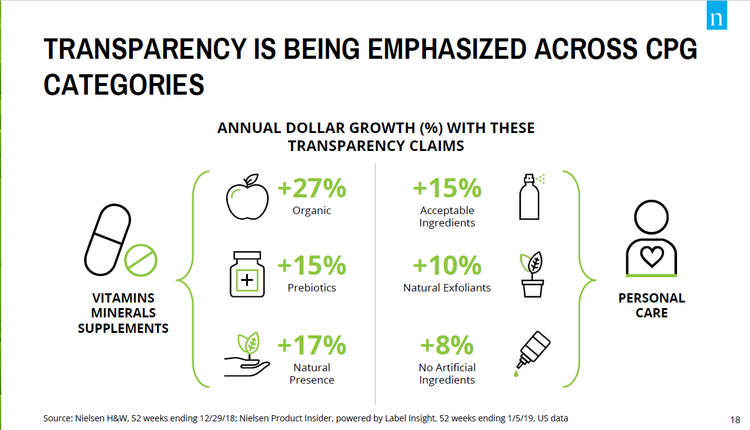
5) The Sustainable shopper is urban, affluent, well-educated and often has young children
This data has remained relatively consistent for some time, and is largely driven by the Millennial generation. While it may be that these consumers have historically had more access to products with sustainability benefits on the coasts, the trend seems to be moving inward, according to commentary in the webinar, with cities like Chicago and Cincinnati showing increasing consumption of these products.

For companies, one of the benefits about this consumer is that they are more affluent, which means that brands can be confident in being able to charge a premium for sustainability benefits if they are perceived as relevant for the category. Sustainability attributes should be a primary consideration as brands establish their innovation pipeline for the next 3-5 years.
Even though I’m a big fan of sales data, I couldn’t resist including a couple of relevant insights from the claimed data.
6) Link Sustainability claims to premium factors (i.e. attributes that consumers will pay more for)
One of the challenges with making sustainability claims, is that it actually increases the cost of goods to deliver those products. It may be that sustainably-sourced ingredients are more expensive, or the manufacturing process is more complex or runs smaller volumes, or perhaps a 3rd party certification incurs additional costs.
An essential business strategy to offset these costs is to increase prices, but if consumers are unwilling to pay for higher prices, then delivering sustainable products may not be financially viable. That’s why brands need to deliver sustainability benefits that are associated with factors that consumers will pay higher prices for.
Consistent with most product attribute data, the two biggest premium factors are Quality/Safety and Superior Function or Performance (49% and 46%, respectively, of consumers were willing to pay more for these benefits. Frankly, I’m surprised we’re not seeing even higher numbers than that.) Increasingly consumers are associating sustainability attributes like organic, or antibiotic-free with these premium factors.

7) The US lags developing countries when it comes to demand for corporate environmental practices
In a list of the top 11 countries where consumers say it’s important for companies to improve the environment, the US don’t make the list. Not by a long shot. All 11 are developing countries, with responses ranging from 92-97%. The US is at 68% (this data point is pulled from a separate Nielsen deck). One of the primary reasons cited for this variation is the visibility of negative environmental impacts due to lack of environmental regulation, such as no formal waste management processes, and higher water and air pollution.
For global companies that develop their innovation in the US and export it to other countries, they may be missing an opportunity to capitalize on the even greater relevance of sustainability in developing countries.

It’s exciting to see that products with sustainable benefits continue to outperform conventional products. The brands that understand consumers preferences by category, and innovate to understand the link between environmental, social and personal benefits, have an opportunity to be differentiated in the marketplace. With over 22% of products now considered to have some kind of “sustainability” benefit, it’s become a crowded marketplace, and that demand will continue to increase.
Consumers are becoming more informed and more savvy about the specific benefits they want by category. The time is now to innovate for the sustainable consumer, because soon, we will just call her the consumer.
(1) - https://www.nielsen.com/us/en/insights/news/2018/was-2018-the-year-of-the-influential-sustainable-consumer.html