
Real Scarcity: How to Turn Constraints Into Customer Value (Part 2)

This image was generated using AI
This is the second part of a 2-part series on scarcity. To read the prior article, visit: Part 1: Real vs. Artificial Scarcity: How to Build Urgency Without Breaking Trust
My husband is on my email list, and to his credit, he reads every one of my articles. He replied to last month’s email (part 1 of this article series) with the following: “Great article. Did you mean to offer only five spots in an article about scarcity?”
He was referring to the announcements section of my newsletter, where I mentioned that I had five spots available for a 2026 marketing plan audit. I froze for a moment, wondering if I had fallen prey to the exact thing I argued against in my article.
But a second later, I remembered my method, one I had triple checked on account of the topic. I had assessed my current capacity, the time required for each marketing plan audit, and how many I could accommodate over the next three months. I could have kept the announcement general, but I thought my audience would be better served by sharing my actual limited availability.
And that’s what today’s article is about. How do we leverage scarcity to effectively generate interest in our products and services in a way that serves our customers?
In my last article, we looked at the history of scarcity in marketing (a tactic that’s still pervasive today) and the differences between artificial and real scarcity. I define artificial scarcity as:
The use of arbitrary or manufactured limitations that are not based on any real constraint and are explicitly designed to generate urgency to incentivize purchase.
When we do this, our customers distrust us, and we erode our brand. Plus, a dependence on artificial scarcity can mask more fundamental strategy weaknesses, such as a lack of customer understanding, misaligned product-market fit, or unclear messaging.
Here’s how to utilize real scarcity ethically and effectively.
How Scarcity Can Help Your Customers
The scarcity principle is not inherently bad. Just recently, a friend trained for an entire marathon, only to find it had sold out by the time he tried to register. He would have appreciated knowing the race’s capacity and how close it was to selling out.
First, scarcity can be a valuable communication tool to help customers make mental shortcuts and simplify decision-making. When something is scarce, we assume it has higher value. We pay attention, we prioritize, and our brain makes decisions more efficiently.
Secondly, we as humans habituate to things. That is, after repeated exposure to a stimulus, we get used to it, and it has less impact or benefit. Snapping us out of this habituation has the potential to enhance our customers’ experience.
The fundamental principle is that scarcity must be real. And communicating scarcity must serve your customers’ interests as much as it serves the company’s interests.
Here are a few ways to apply the scarcity principle to create value for your customers.
1) Identify real constraints
Every business has constraints, and examples of them appear in all five approaches. Constraints may include supply, capacity, physical space, timing, or other factors. Identify which of your company’s constraints are relevant to your customers and clearly communicate them.
Here's an example from a local restaurant that sells homemade sourdough bread. You can pre-order the bread or pick up a loaf while supplies last. The weekly pick-up window is limited: Saturdays 11 a.m. to 1 p.m. These constraints, including which loaves are sold out, are clearly communicated across their website and social media channels.

2) Use transparent, accurate communication
We must tell the truth. Knowing an item or experience is limited can valuably inform a customer’s decision – if it’s real data. In part 1, I shared an example of a Shopify plugin that allowed “generated data” (i.e., fake data) for inventory levels.
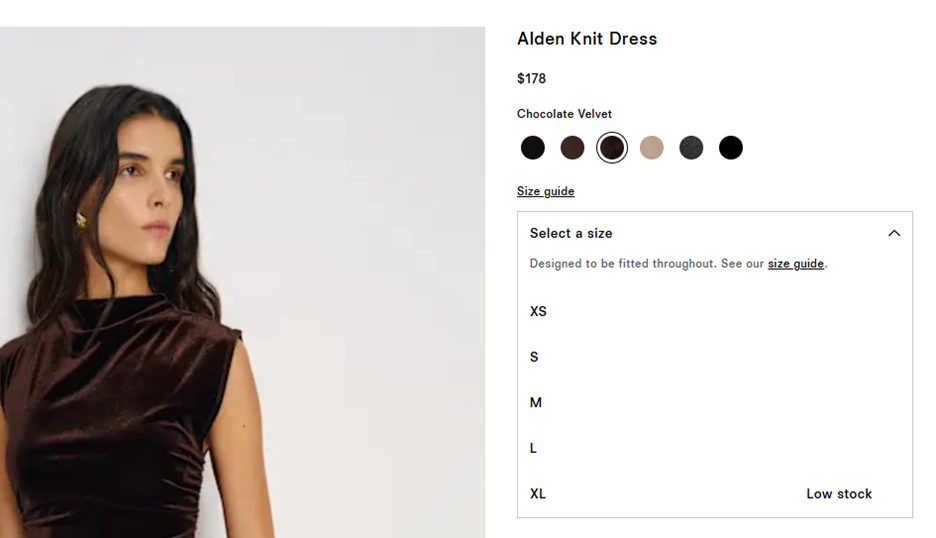
Comparatively, ethical fashion brand Reformation includes inventory data by size. Note the “Low stock” mentioned for size XL below; it is helpful but not overtly pressuring. While we can’t know for sure this is real data, the method of communication seems more focused on transparency than on generating urgency. While not lying can seem obvious, it’s easy to exaggerate or invent a seemingly harmless statement like “limited capacity” when no such limitation exists.
3) Rotate novelty
Customers appreciate new and limited offerings. Seasonality, flavor, style, and location are all legitimate reasons that a customer might want to buy a product or service. Two things to be conscious of: the environmental or other negative impacts introducing a new item may have, and the use of scarcity for scarcity’s sake. That said, there can still be opportunities to introduce newness to enhance customer enjoyment.
Here are examples of extremely popular pumpkin offerings that are only available from Starbucks each fall. Not only is pumpkin a classic fall flavor, but its limited availability creates both anticipation and greater appreciation.

4) Use natural deadlines
Our calendar creates myriad opportunities to tap into natural deadlines such as holidays, annual milestones, and seasons. For example:
• Order your costume by X to arrive for Halloween.
• Complete your taxes by April 15 to avoid late penalties.
• Get your hats, gloves, and ice scraper before the first frost.
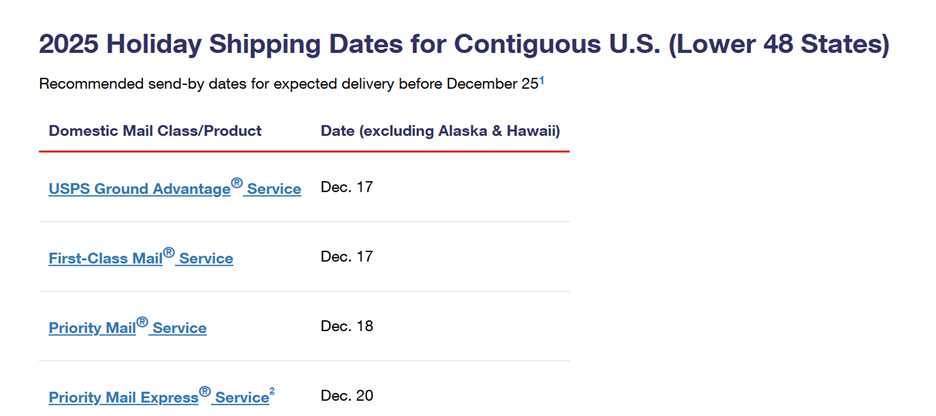
I recently received a postcard from the U.S. Postal Service with the following shipping deadlines, which immediately reminded me to complete my gift buying to avoid the year-end post office frenzy. Companies can tap into the natural deadlines associated with their industry or services to inspire prompt action.
5) Explain the rationale
When we provide context for a deadline or limit, we help our customers understand what’s driving the constraint. In turn, we may generate more goodwill than an artificial deadline with no reason. For example:
• We only have 150 Summer CSA shares available due to farmland availability.
• Early bird pricing ends October 1! Buying your ticket early helps us secure the top speakers.
• We only take five clients at a time to ensure excellent quality of service.
• Each class is limited to 20 participants to ensure maximum attention to each attendee.
I recently received a promotional email for an event capped at 100 people. The organizers explained the rationale for the attendance limitation in a way that makes the offer even more appealing. An explanation doesn’t have to be an excuse or a justification—it can reinforce value.

Reclaiming scarcity requires a mindset shift, one from selling to serving. We can do this by educating customers about our constraints so that they can make more informed decisions and by enhancing their experiences through novel and limited offerings. When we pair real constraints with transparent communication, we earn our customers’ trust and their business.

Octopus Energy entered the UK energy market in 2015 and became the UK’s leading energy supplier with 24% market share just 9 years later.