
The Hidden Foundation of Effective Marketing
Lately, several of my conversations have a common theme:
Can you advise on our email campaign?
I now have a marketing budget. How do I spend it?
We want to develop an ad campaign to promote our services.
How do we improve our social media content?
These asks are concrete. They feel actionable. Often, they reflect a business need or opportunity. But in most cases, they are beginning at the end.
When companies hit a growth inflection—when budgets grow, when referrals are exhausted, when competition increases, when the product portfolio expands—the instinct is to accelerate activity. More campaigns, more content, more channels. Understandably, marketing output feels like progress. But too often I see teams jump to execution before clarifying the strategy. Approaching marketing this way will cost the business more in the long run: decisions are unclear, individual tactics don’t ladder up to an integrated plan, messaging is inconsistent, and effectiveness is often ambiguous.
There are invisible, yet critical, elements of a marketing strategy that lay the foundation for success. Understanding and defining these helps you determine what to do, when, and why.
In this article, I will outline a simple strategic framework that ensures your marketing outputs deliver on your business goals.
Marketing strategy is like an iceberg
The tip of the iceberg is everything we can see in market—all the content and the distribution channels for that content, such as Google ads, a brand logo, social media content, in-store signage, sales presentations, website content, Amazon images—the list goes on.
It’s common to assume that the tip of the iceberg represents the entire marketing strategy. But if we jump straight to the content, we rely on one thing to determine the plan: gut instinct.
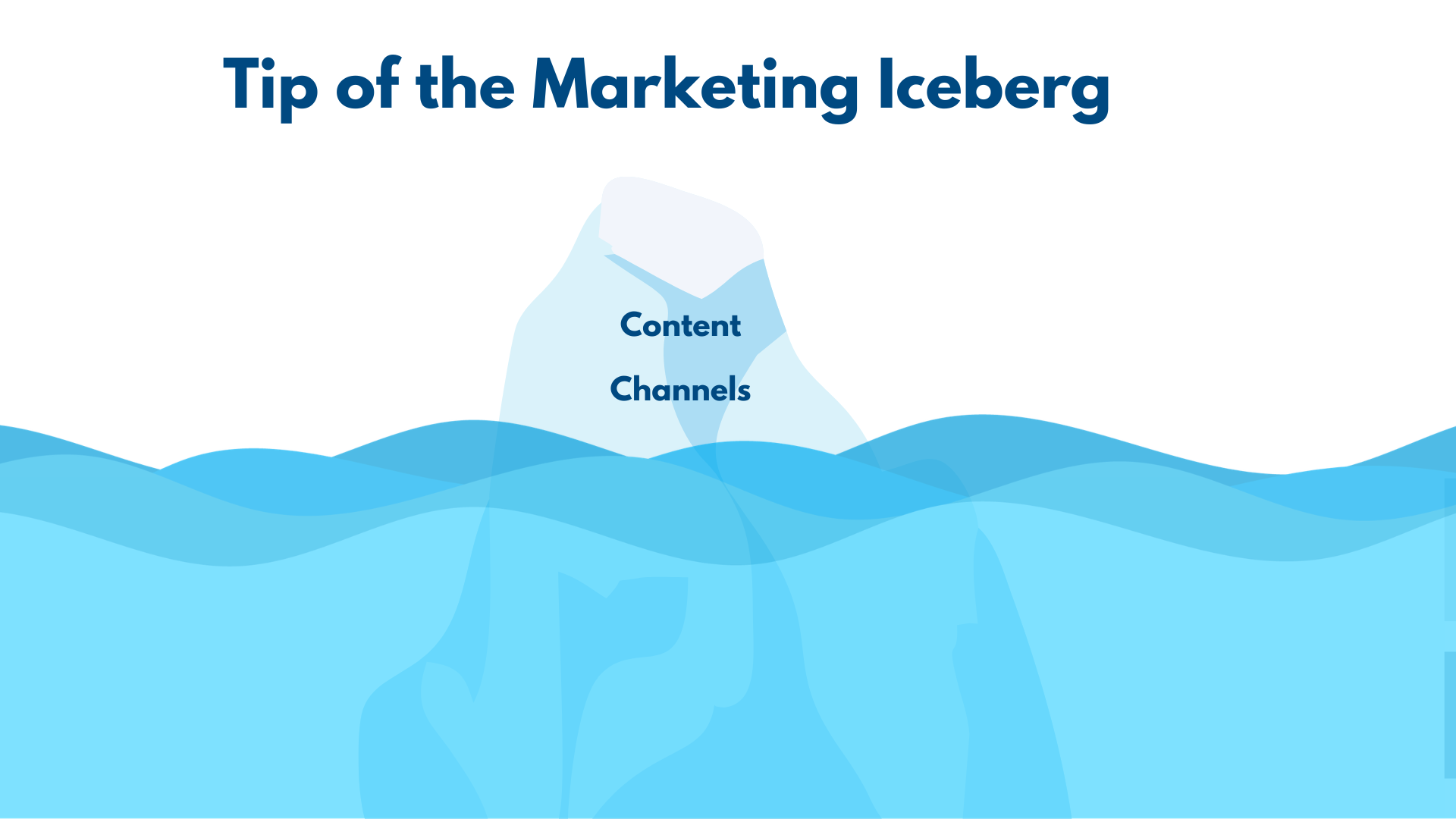
Instead of basing our plan on a hunch or by copying what everyone else is doing, there’s a more strategic approach.
Below the surface of any strong marketing execution is a clear, focused strategy tied to growth objectives. This includes:
Ideal Customer: A clearly defined target audience (or limited set of audiences)
Brand Positioning and Messaging: A defined territory (positioning) your brand occupies in your customer's mind, and ultimately in the market as a whole. This positioning is translated into a specific idea or set of messages that communicates the value your product or service delivers to the customer
Once these elements are clear, we can build a tactical plan on top of them.
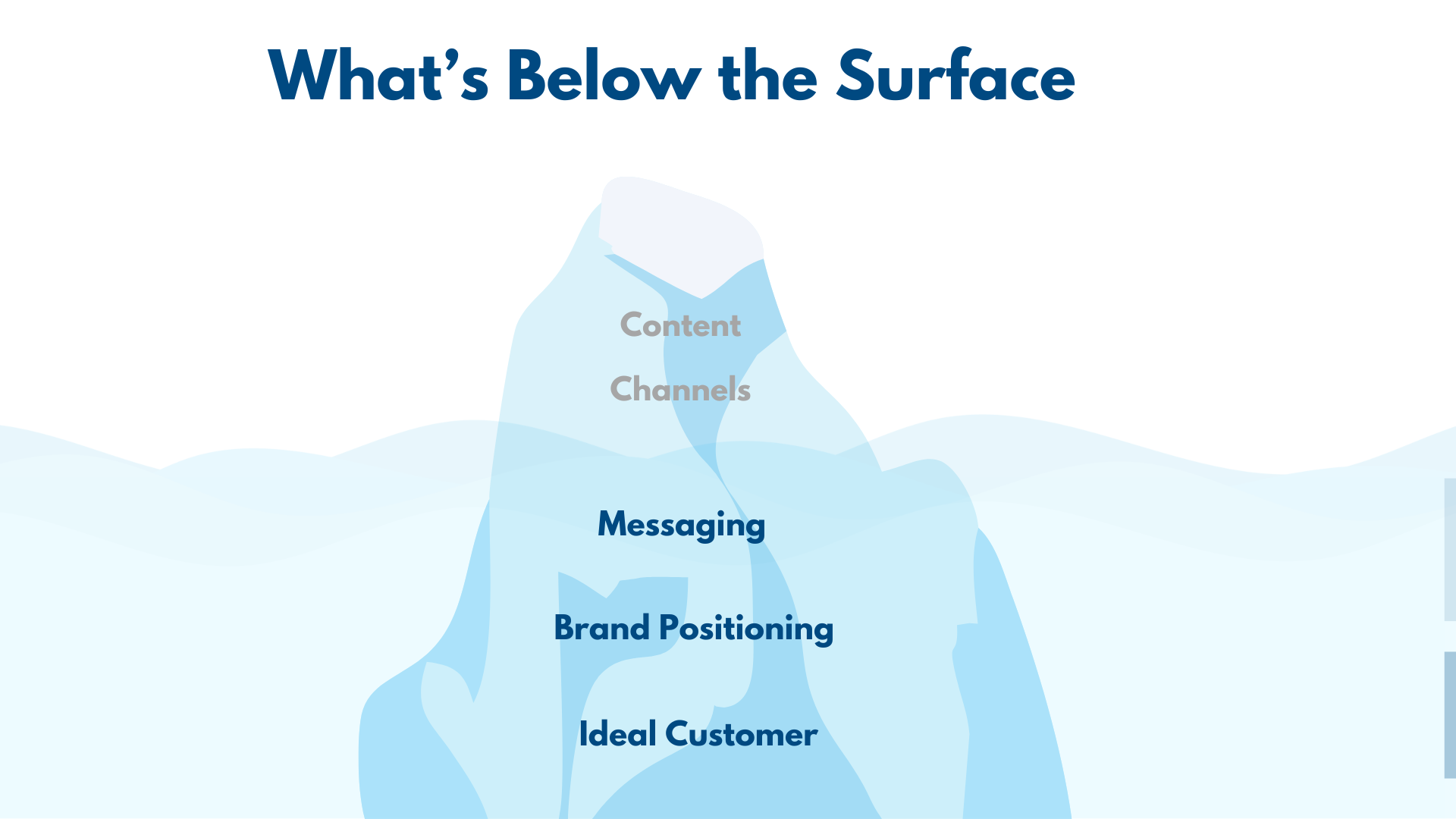
We can use these layers to create a simple three-part framework I call the Who—What—Where Marketing Strategy.
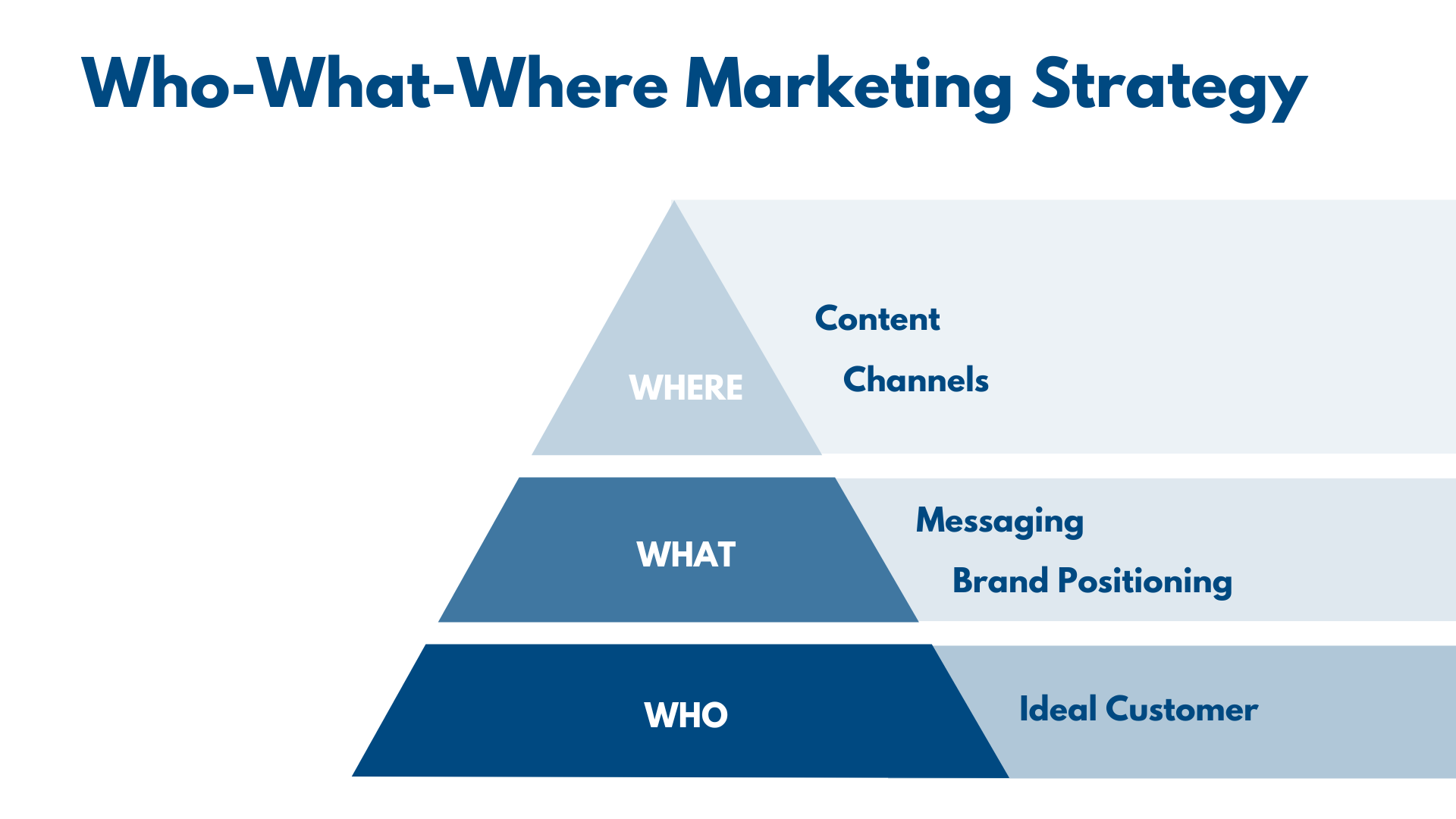
WHO: Your Ideal Customer
There’s nothing new about the idea that all marketing starts with the customer, but it’s almost too easy to slip away from this principle in practice. Even the most seasoned practitioners focus almost exclusively on telling a compelling story about what they do and why it’s better. In essence, they jump to the WHAT before grounding (or re-grounding) themselves in the WHO.
We need to begin with a clearly defined audience. This is not anyone who might use your product—it represents your ideal customer. Specifying the industry, category, and demographics is insufficient—that is, it’s not enough to know who our customer is. We need to know how and why they behave and think. We need to know their preferences, habits, perceptions of our competitors, and us. We need to know how our solution fits into their lives and how we create value for them. We need to know who influences them and where to reach them when they’re receptive to our message.
Without a clear picture of these things, we’re simply guessing which messages will resonate and what vehicles and channels we should use to build awareness. Many companies have a general sense of their audience but lack specifics. A generic WHO results in:
Messaging that is broad or irrelevant
Unnecessarily high costs to reach our customers due to crowded channels and a lack of creativity
Fewer qualified leads and lower conversion across every stage of the sales and buying process
Innovation that doesn’t solve real customer problems
Defining your WHO requires not just looking at quantitative data but regularly talking to the customer and asking foundational questions to help you understand their category behavior, how they perceive your products and services, and what influences them. And it means picking a small subset to focus on within the total group of customers you could serve.
WHAT: Brand Positioning and Messaging
The second layer of the marketing strategy outlines what you offer your customer. It’s a combination of how you strategically frame your solution within the wider market of offerings (positioning) and how you consistently communicate your value across different channels, environments, and tactics (messaging).
The most common issues I see that result from the absence of clear brand positioning and messaging are:
Lack of differentiation within the market because you sound the same as all of your competitors
Communicating too many benefits or products, which results in customers being confused about what you do and what value it creates for them
Inconsistency of messaging across different products, channels, and content
Positioning is hard. It forces really tough decisions about the core benefits you want to stand for. You can’t be or say everything, so this part of the process is about whittling away any extraneous elements that distract your customer and water down your message when you cater to everyone.
Say you have a tech software. You product might be easy to use, the only one that’s designed for individuals vs. companies, makes your customer more efficient, compatible with windows and iOS and protects your customer’s data. These are too many things to communicate everywhere. You can only pick one or two as your core differentiators.
Focus, and in particular focus over time, wins.
For more on positioning, check out my 3-part series on how to create a strong positioning.
WHERE: Content and Channels
Only after we have a deep understanding of our customers’ needs, preferences, habits, and perceptions, and we have identified a narrow, differentiated positioning that offers real value, can we then begin the process of creating a plan to reach our ideal customer. It’s here that we identify the relevant channels to reach our customers and the creative execution that brings those touchpoints to life.
After going through the WHO and WHAT exercises, many of my clients realize that what they thought was a top-priority marketing tactic is actually not the highest-leverage opportunity.
What are the benefits of a clearly defined marketing strategy?
One of the most common struggles leaders have with their marketing strategy is a lack of clarity and confidence. They don’t know if they’re doing the right things or if those things are working.
Defining all three layers of the marketing strategy will generate a level of clarity that massively reduces downstream friction.
It’s critical to link your overall business objectives to this entire strategy. Understanding how your marketing supports your business goals enables you to focus on the markets, customers, messages, and tactics that will best enable growth. The business goals are like the water that surrounds and influences the strategy.
By spending time below the surface, you can expect:
More efficient use of the budget and resources
Higher-quality execution from partners resulting from clearer expectations and fewer revisions
More consistent branding and messaging, which results in familiarity and trust
Clarity on what you’re measuring and what’s working
Hypothethical Example: An Apparel Brand
Let’s say you’re a $20 million sustainable fashion brand that sells mostly online through your website. You think you need help with Instagram ads because all of your competitors are doing them. Below is your current strategy, which may or may not be explicitly documented yet.

Like most companies, you have an idea of who your target customer is. But right now, your WHO, WHAT, and WHERE are too broad and could be interchangeable with dozens of competitors. Let’s provide more detail to identify opportunities in strategy.
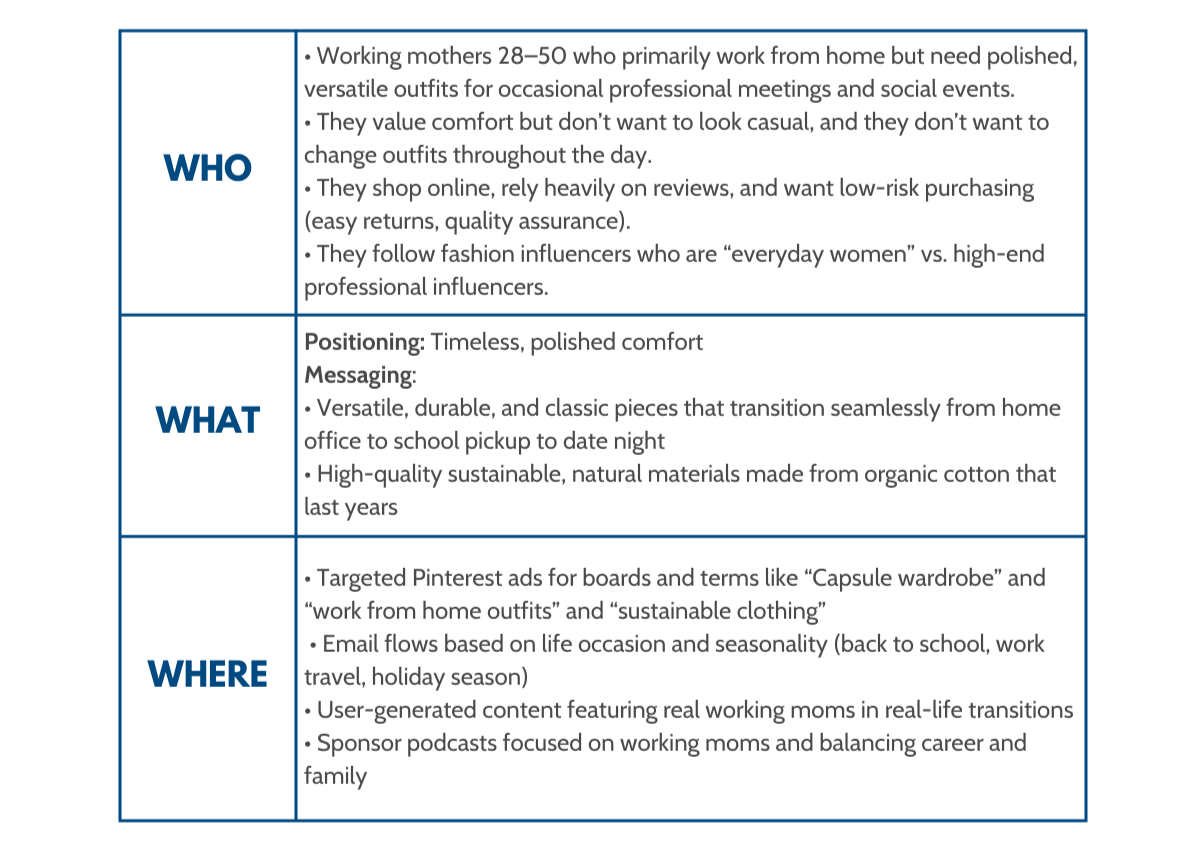
Your WHO now uncovers unique insights for a particular segment of your audience. People sometimes worry their audience is too narrow, but I find that fear is often unjustified. Many times, appealing to a narrower audience has relevant spillover to a broader audience. (The same goes for B2B companies who can often serve multiple industries. Choosing a specific industry to build depth and expertise can be an effective approach to grow market share, and other industries can be sequentially added later.)
Your WHAT now builds on your new ideal customer insights. Among all potential benefits, you hone the one or two that become the focus of all brand communications (in this example: “Polished Comfort.” It doesn’t just inspire messaging; it influences the entire product portfolio.
With your WHO and WHAT clearly defined, your WHERE almost writes itself. How to reach your customer and what will influence him or her is both more obvious and lays a solid foundation on which to be truly creative an innovative.
Each of these stages requires hard choices about what you’re going to pursue vs. what you’re not. Clearly defining your WHO and WHAT gets you more than good marketing: You get a system that focuses your effort, accelerates decision making, and ties activity to measurable outcomes. As a result, you build a growth engine that transforms scattered tactics into a foundational marketing strategy that fuels your brand goals.


Last week, I received an email from someone pitching a guest for my podcast Grow Good. The email mentioned my podcast’s name, a recent guest’s name and quote from their episode, and a thematic connection explaining why the recommended guest was a fit.