
Why Great Thinkers Write

I’ll be upfront: My goal is to help you become a better thinker, and I’m convinced writing is one of the best ways to do it. Why is this important for purpose-driven leaders? Because going outside the paradigm of normal business requires new approaches, deviations from what’s proven, and tolerating increasing levels of complexity and ambiguity. Managing and balancing these pressures requires great thinking.
Certainly, there are examples of great thinkers who didn’t write. It’s an enhancement, not a requirement. But who wouldn’t want to get a leg up on being a better thinker? What’s more, in an increasingly AI-obsessed age, when we default to LLMs to do more and more of our writing, our thinking isn’t just in maintenance mode, it’s likely declining. We need to nurture and protect this precious cognitive practice.
The Elements of Great Thinking
It’s a daunting task to try to define “great thinking,” but these three core elements, in my opinion, characterize the kind of thinking that advances ourselves, our organization, and humanity.
Great thinking is clear. Clarity is foundational. It’s concise, accurate, and decisive. When you communicate clear thinking, others easily understand it. It avoids vagueness and generalities. It has a logical or rational flow. It means one thing and not another.
Great thinking is original. It's a novel insight that connects, enhances, or furthers known information or stimuli. Not all thinking has to be completely new to the world. But to the thinker, it must be fresh and different.
Great thinking is viable. The breadth and scope of “thinking” almost defies categorization. But whether its domain be is science, philosophy, business, art, or policy, it has context. Within that context, it must be relevant, rational, testable, or intuitive. It doesn’t have to be “right.” But it does need to be something that can be evaluated, debated, and tested. It must withstand analysis and criticism.
How does writing enhance thinking?
Writing forces clarity. Research shows that reviewing and evaluating ideas uncovers knowledge gaps and helps you integrate new information with existing knowledge. It forces you to reconcile diverging, disparate ideas. It requires structure and a sequence. When you review and edit your writing, you examine your ideas from new angles and test their validity. The concept of “self-explaining” is the process of rephrasing and teaching the concepts to yourself in order to make sense of the information. When we do this, we strengthen our ideas.
Writing supports memory and retention. Writing supports memory formation and improves recall and accuracy. The “generation effect”is a studied phenomenon in which people remember information much better if they generate it themselves. In particular, handwriting versus typing has been shown to increase brain activity in areas responsible for memory formation.
Writing enhances critical thinking. Critical thinking, which is described as the ability to analyze and defend assertions, is considered essential for problem-solving and decision-making. A study of biology students who conducted an experiment tested whether thinking was improved among students who were quizzed on the outcomes vs. those who had to write a summary evaluating the results. Analysis and inference skills increased significantly in the writing group but not in the non-writing group.
Writing reduces your Cognitive load. When you put your thoughts on paper, you free up workspace inside your brain to process complexity. The Cognitive Load Theory (CLT) proposes that our working memory has limited capacity, and that writing can serve as an “external hard drive” for your brain, enabling increased capacity to generate new ideas and evaluate relationships thoughts or facts.
Great Thinkers Who Wrote: What We Can Learn From Their Practices
The following individuals faced the same circumstances that purpose-driven leaders do—operating amid ambiguity, pursuing progress, and balancing long-term vision with the realities of the present moment. From them, we can understand how writing played a formative role in sharpening their thinking to discover, clarify and take action. In researching individuals for this article, I had a thesis at the onset that writing sharpens thinking, but these examples have inspired me to even further integrate writing into my practices.
Leonardo da Vinci and Marie Curie
These individuals kept extensive notes and observations in their journals where they tested their ideas over time.
Leonardo da Vinci – Estimated to have written over 13,000 pages, he would both sketch and write his observations of the natural world, which led to many of his inventions. Based on his principle of “sapere verdere” which means “knowing how to see” in Italian, he thought that most people look without really seeing. Da Vinci is known for his drawings, but less so for his questions and analysis, which peppered all of his notebooks, covering themes and questions he returned to year after year. He carried a small notebook everywhere.

Marie Curie: Her notebooks are literally radioactive. Stored in lead-lined boxes in the Bibliothèque Nationale in Paris, they are so contaminated with radium, over a century later that they require special protection and approval before studying. These notebooks illustrate how essential writing was to her research, literally while she was mid-experiment, and were part of her rigorous process of documenting her hypotheses, noting observations, and comparing results to her expectations to uncover unexpected insights and reveal flawed logic. This approach led her to continually advance scientific progress and ultimately to two Nobel Prizes.
The Practice: Journal in notebooks
Document ideas, observations, hypotheses, and expectations of results. Return to them over time as circumstances change and outcomes materialize to evaluate, sharpen and test. Sketch, map, clarify and question.
Jeff Bezos
Famous for the six-page memo and banning PowerPoints, Bezos believes endless decks and bullet points can mask muddled thinking, he forced his organization to articulate a position through written prose. According to Bezos: "If you want to clarify your thinking, remember something important, or communicate something clearly, write it down."
The Practice: Write memos
Rather than present powerpoints, for key business decisions, require a memo or written recommendation. Ensure authors write full sentences which requires logic, rationale and sequence. Additionally, give time during the meeting itself to read the memo (another Bezos practice).
Warren Buffett
For 60 years, Buffet’s approach to writing his annual shareholder letters was to address them to his sisters, Doris and Bertie. Buffett notes they were smart, but not “active in the business.” He would “pretend that they’ve been away for a year and I’m reporting to them on their investment.” This forced him to simplify his explanations, allay fears, eliminate jargon, and defend his positions. These letters were read by the most seasoned financial experts to layperson investors and provided clear insight into one of the century's best investment minds.
The Practice: Write your organization’s most important communications yourself
While many leaders outsource speeches, annual letters, and organizational updates to communications or PR teams, writing them yourself forces clarity about what you want to say and why it matters. Only the leader can do this, and it can set the tone for the entire company strategy.
Elenor Roosevelt
Roosevelt published a column called My Day, a shocking six days a week from 1936 to 1962, totaling nearly 8,000 columns. Providing insight into what she was focused on and thinking about, the topics spanned entering WWII and foreign policy, civil rights, women’s rights, and domestic policy. With such a large audience, these columns forced her to articulate a point of view, defend policy positions, and advocate for issues that were important in real time as events unfolded on the world stage.
The Practice: Publishing your writing regularly
This could be an article, a column, an email newsletter, or even a thoughtful social media post that expresses a well-thought-out idea. The public audience forces a level of rigor and cohesiveness that unpublished writing avoids.
Maya Angelou
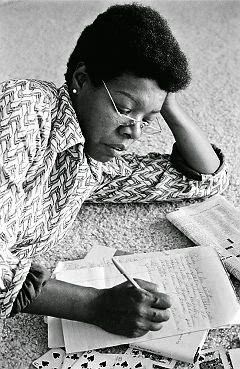
Angelou would rent a hotel room in every town she lived in and arrive by 6:30am to write. She’d ask the hotel to remove all pictures and distractions, and wrote on a legal pad, propped up by her elbow, with only a deck of cards to play solitaire when she needed a break. She cultivated isolation and the absence of distraction. Angelou credits this environment with helping her access creativity and forcing her to do the hard work of writing.
The Practice: Cultivate a disciplined writing process
It may be a specific location, a time of day, or a routine, but it requires eliminating distractions and focusing entirely on the ideas you want to express.
The Importance of Writing in the Age of AI
While writing has been a valuable thinking tool throughout history, it has never been more at risk than now. The past two years have presented an unprecedented and nearly unlimited opportunity to outsource our writing to AI. While this is easy, tempting, and can feel like an enormous productivity boost, I urge you to tread cautiously. I say this as a voracious AI user myself, but one who wants to protect my ability to think.
When we consistently use LLMs to write on our behalf, we inadvertently make our brains couch potatoes. Like a muscle atrophies with minimal use, our brain must continue working hard, processing complex ideas to remain sharp. A 2025 study by MIT Media Lab showed that the use of LLMs in essay writing, compared to brain-only writing, results in significantly less brain connectivity, cognitive activity, and lower memory recall. LLM writers cited less ownership of their work and struggled to quote their writing.
So what does this mean for practical application? First, distinguish between executional writing and strategic or critical thinking writing. Drafting an email that summarizes follow-up tasks from a meeting could be a great task to outsource. Writing a letter summarizing the successes and failures of the past year is probably not. When writing requires you to process, clarify, and define your point of view, these are the times to tackle it yourself. When we need to translate or operationalize values into strategy, only deep thinking can accomplish that task, and it’s a job that can’t be outsourced.
Here are a few principles:
Identify which writing tasks force and develop critical thinking or creativity.
Among those, write the rough draft first, rather than defaulting to LLMs.
Use AI to review and poke holes in your perspective, asking for analysis and questions rather than simply rewrite it for you.
On a personal level, I have benefited enormously from the practice of writing a monthly article. I use AI tools for research and sometimes to identify gaps in my logic, but I maintain a strict no-AI policy for the writing itself. The concepting and editing process help me tighten and clarify my perspective. As a result, I am forced to establish a coherent point of view, source evidence, and test my ideas. I have developed theses and frameworks whose genesis was exclusively from writing, which I then incorporate into client work, and I am better able to recall these ideas in advisory conversations because I wrote all of the content myself.
In essence, the process of writing is as much the point as is the output. A published article might not be your outlet, perhaps it is journaling or organizational memos, but I encourage you to establish one regular writing habit to protect, nurture, and enhance your thinking.
If this resonated with you, or you already have a writing practice that works, I’d love to hear about it. Reply to this email and tell me about it!


The most common question I get from business leaders is “How do I know if my marketing is working?”