
How to Differentiate: Why Less is More (Part 1 of 4)

If I asked you to think of a car known for safety, which manufacturer comes to mind?
Now, think of the following:
One that is reliable
One that is fast
One that is electric
Now, think of a brand that is all of these things.
My hypothesis is that you paused after that last one. It’s hard to come up with a car that is better than its competitors across each of these dimentions. Even if there were a car brand that is extremely safe, reliable, fast, and electric (and there might be), our brains can’t hold all of this information equally. Certainly, not as a gut reaction. We default to companies that have reiterated a singular message over time.
This is the first article in a series on differentiation, one of the most important factors influencing why customers choose our product or service over another.
Companies know they have to differentiate; what’s difficult is doing so effectively for a sustained period of time. Many categories feel saturated, products seem commoditized, and the market changes so quickly, with competitors constantly launching new products, services, and messaging. However, those that maintain long-term differentiation achieve more profitable, sustained growth.
In this 4-part series, I will break down various principles to guide effective differentiation. In this first article, I explain that the most critical aspect of successful differentiation is focus.
Additional articles in the series include:
Part 4: Brand as a differentiator
Types of Differentiation
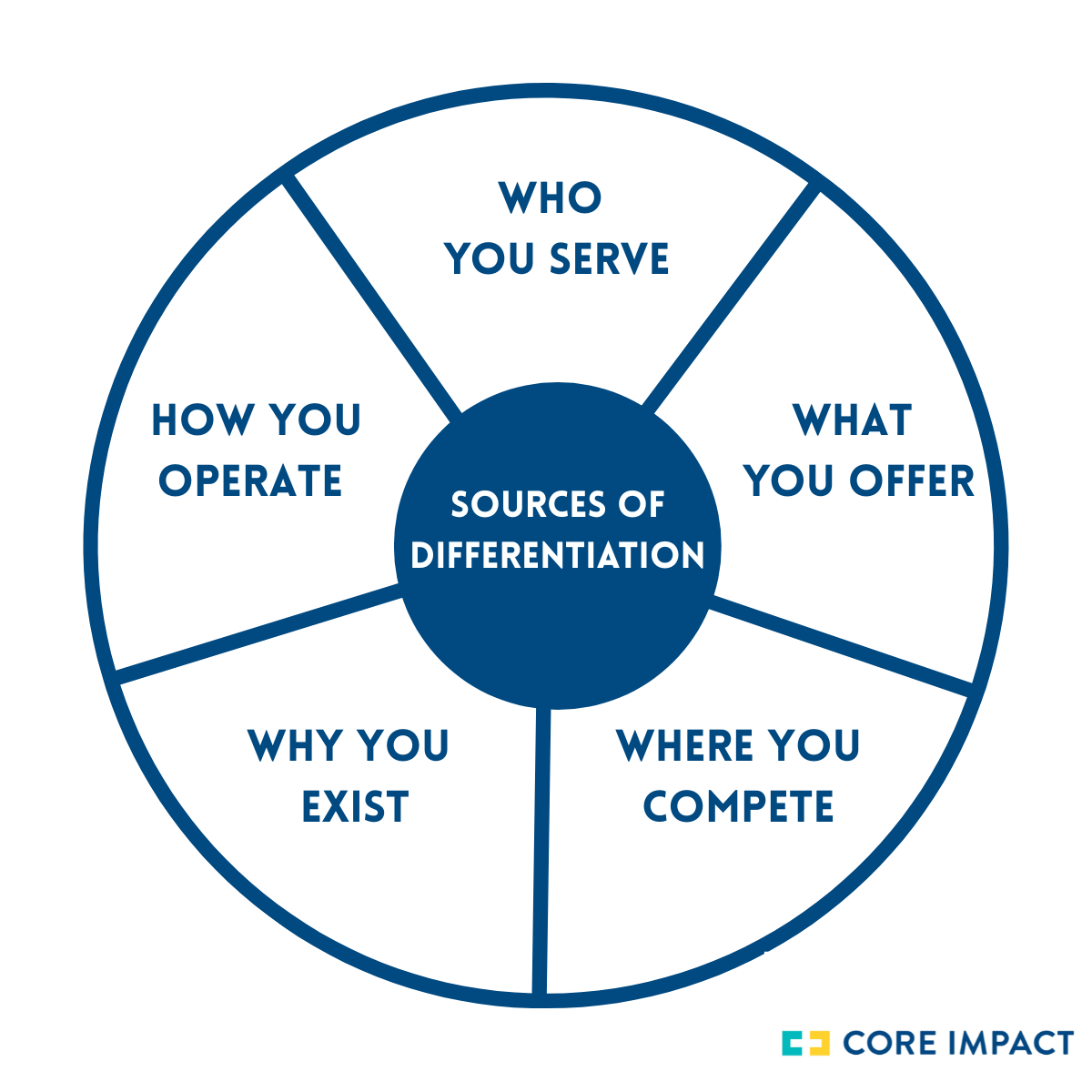
Differentiation must create value for the customer, otherwise it is simply a difference. We might have endless differences that set us apart, but ascertaining which of those meaningfully inform choice is essential. Differentiation can be categorized along five distinct axes:
WHO you serve: The product or service might serve a very specific niche audience within a larger category. For example, a CRM for solopreneurs, a yoga studio for men, or an IT consulting company for public schools.
WHAT you offer: The core value you deliver is different than alternatives. Typically, this category highlights features or benefits, but it could also be the impression your brand creates. Functional features or benefits are often first or early to market (think Uber, Airbnb, or a high-protein breakfast bar), but if they are successful, they are often quickly copied.
WHERE you compete: The geographic territory or region that you serve might set you apart from otherwise similar alternatives. If you’re an Italian restaurant, there might be nothing particularly different about your menu, ambiance, or service, but if you’re the only Italian restaurant within 15 miles, that’s a core differentiator.
WHY you exist: The mission, purpose, or values behind your company can be a compelling source of differentiation that both attracts values-aligned customers and may influence the quality and experience of your product. TOMS shoes doesn’t have a massively different style or product quality, but why they exist and how they serve the community captivates their customers.
HOW you operate: A unique approach to make or deliver your offering, such as your supply chain, technology, proprietary processes, or talent strategy, can result in increased value through performance, quality, service, or customer confidence.
Why Focus is Critical
Effective differentiation requires focus. You may have dozens of things that set you apart, many of which may be meaningful to the customer, but you can only be known for one or two.
We need our customers to both digest and retrieve the information we communicate so they prefer and select our product. When we prioritize one or two core differentiators, we enable our customers to mentally process the information we share more easily. With single-minded repetition, this information becomes familiar, which in turn increases preference. A focused message also aids the ability to recall that information with a cue.
Think of the opening exercise about cars. When I said “safe,” that word was a cue to retrieve a brand. In my case, Volvo came to mind. If a brand focuses on too many differentiators, the cue-retrieval signal is less direct, and you might not be remembered for any one thing. Too many differentiators means zero differentiators.
Let’s use on of my clients, 80 Acres Farms, as an example for how to decide which differentiators to focus on.
80 Acres grows lettuce, herbs, and other vegetables in a pesticide-free, climate-controlled environment that is powered by 100% renewable energy. Because of the growing process and the fact that farms are close to stores, the product is locally grown, fresher, and more nutritious than other lettuce.
When I first started working with 80 Acres eight years ago, we had a multitude of potential differentiators to choose from: vertically farmed, fresh, locally grown, sustainably grown, nutritious, flavorful, and pesticide-free. But trying to communicate all of them, or even several of them would be confusing. Nothing would stick, and customers wouldn’t know what was really different about the brand. So, how do we choose?
Differentiation Requires Context
To narrow our core differentiators, we must first consider three important factors for context: the category, the customer, and competing alternatives. These factors, along with your core differentiator, comprise your market positioning. [Read more here about how to create a strong positioning strategy.]
Category
The category and subcategory we play in creates certain expectations and norms for our customers. If you’re an airline, you have to be on time (or should be!). If you’re banking software, you have to be secure. Sometimes these expectations become an opportunity for differentiation. Other times, you just need to meet the minimum expectation to remain under consideration.
Discovering unmet needs in your category reveals potential areas of differentiation. In what ways do today’s solutions fall short? Where might there be an opportunity for differentiation?
Customer
We must have a clear, specific customer to help us pinpoint what matters to them. If you target a broad audience, it will be more difficult to identify which differentiators create the most value. In fact, narrowing your ideal customer according to which segments most value a particular differentiator can be an effective approach to select your target audience.
We also need to understand how we add value from our customers’ perspective. Ask yourself:
What features or attributes create real value for your customer?
Does your customer see your product or service as truly differentiated in the areas where you think it is? ( In other words, are the things you consider to be differentiated actually noticeable to your customer?
Among all of the meaningful benefits you offer, which ones most influence the sale of your product or service?
Competing Alternatives
Oftentimes, we think of competition as companies in the same category we operate. However, the customer doesn’t always consider options with this lens. To uncover real substitutes, we need to know what our customer would do without our product or service. It could be nothing. It could be a homemade, makeshift solution. It could be the cheap option from 20 years ago. For example, alternatives to taking Uber to the airport may not be taxis, or even Lyft, but paying for long-term parking or getting a ride from someone else. Understanding the actual alternatives your customer uses will inform your frame of reference for differentiation and help you evaluate which differences create real value. A “low-cost” ride-share program might not be a differentiator when the main alternative is free.
Conduct Research to Uncover Answers
Assessing our category, the customer, and competing alternatives may be all that’s needed to narrow our core differentiators. However, I find that most companies don’t have enough customer insight to make an informed strategic choice. In these cases, I recommend doing qualitative research. (You may need to do some quantitative research as well.)
Interview current and prospective customers (or look at data from prior customer interactions). Ask them critical questions about what they value, unmet category needs, and benefit prioritization. After conducting research, you will be well-positioned to select the one or two core differentiators.
Case Study: How 80 Acres Farms Prioritized its Differentiators
Before working together, the team had leaned into “Local” as the core point of difference on packaging because they kept hearing from customers and retailers that local resonated.
We conducted a series of interviews with customers to observe their shopping behavior in a real store, asking them to narrate what they were choosing and why. What we discovered was that the most important thing to customers was freshness. Local was important, but not for its own sake. Local mattered because it signified freshness, and freshness also implied flavor.
Most lettuce had a highly variable shelf life, and even though freshness was most important, no competitor used it as a point of differentiation because they couldn’t. Ninety percent of lettuce in the US comes from the same region in California, which means that brands use the same product from the same farms. As a result, brands couldn’t differentiate their products because they were the same.
Other insights helped us rule out potential differentiators. Among the boxed lettuces, nearly all of them were organic, which customers saw as essentially interchangeable with 80 Acres’ pesticide-free claims. Customers also said they weren’t purchasing lettuce based on flavor and used dressing or salad inclusions for that. Sustainability was meaningful, but didn’t drive sales.
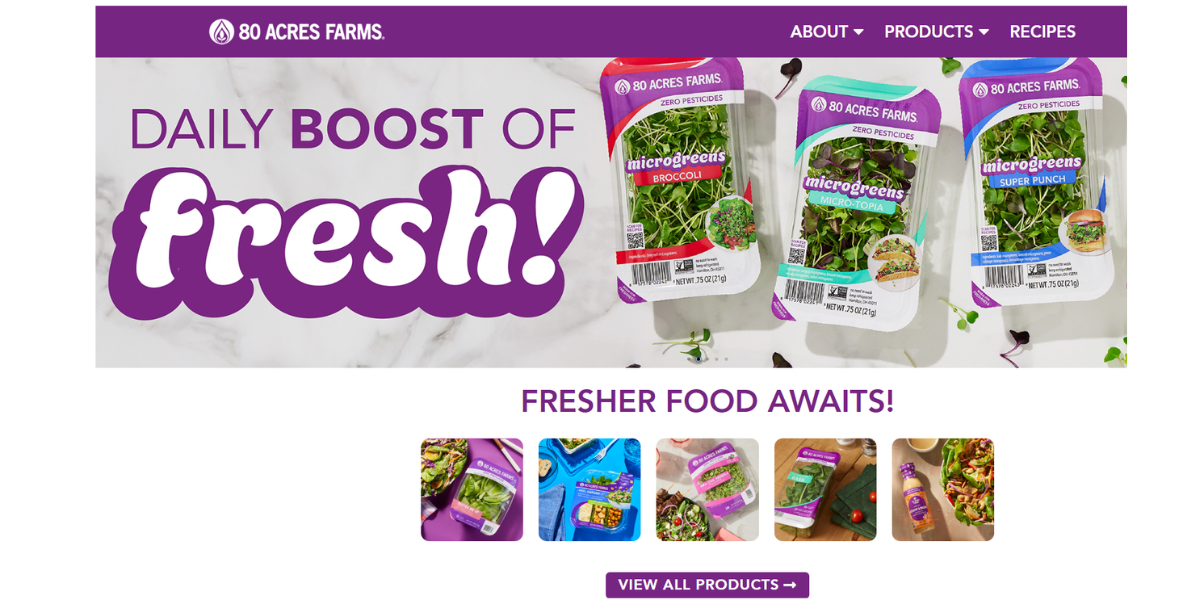
This research laid the foundation for 80 Acres’ differentiation strategy. Rather than focusing on local or flavorful, we leaned into freshness. It was a core category purchase driver, it represented an unmet need, and 80 Acres had consumer-noticeable benefits around longer shelf life. We knew we had to communicate pesticide-free, even though it wasn’t differentiated, because otherwise customers wouldn’t consider the brand. Therefore, the two central messages were freshness (differentiator) and pesticide-free (parity). We built all messaging, claims, packaging design, and innovation strategy around these two attributes.
Differentiators Are a Strategic Choice
Identifying long-term points of differentiation isn’t simply a matter of asking consumers what they need and which of your benefits they prefer. Ultimately, differentiators represent a long-term brand strategy that informs communication and marketing, as well as innovation and overall company growth.
To ensure we are planning for long-term sustainable differentiation, we must consider:
How long is this likely to remain a differentiator?
How much can we innovate based on this differentiator? (For example, will new products or services enhance this differentiator, or are they separate or peripheral?)
How noticeable is this differentiator to the customer?
How transferable is this differentiator across categories? (That is, will the differentiator remain relevant as you expand into adjacent products or services?)
Going back to 80 Acres, because the differentiator of freshness was built on a fundamentally different business model—indoor farms built close to retail stores—it was difficult to copy. It was relevant for other produce beyond lettuce, so it was transferable across categories.
Selecting a core differentiator doesn’t mean that you can’t ever mention other benefits. On 80 Acres packaging, the brand highlights smaller claims, such as sustainability and locally grown. If someone is searching for these benefits or reading the packaging carefully, they can find them. However, these product features aren’t what we want a customer to think of when they think of the brand.
Having the courage to focus on a few core points may feel limiting at first. But in the long term, your brand will be known for something specific that adds value, and it will orient your innovation and growth strategy. Sustained differentiation drives growth, and it starts with focus.
In the next 3 parts of this series, we will dive into the following topics:
Part 2: Why quality is not a differentiation strategy
Part 3: How to differentiate when your competitors are saying the same thing
Part 4: Brand as a differentiator

Last week, I received an email from someone pitching a guest for my podcast Grow Good. The email mentioned my podcast’s name, a recent guest’s name and quote from their episode, and a thematic connection explaining why the recommended guest was a fit.