

[This image is an AI Recreation.]
A few months ago, I drove past a billboard with this exact headline, illustrating one of the most common mistakes I see companies make when communicating differentiators.
Messaging always requires category context and understanding audience perception. When it comes to bananas, consumers see them as commodities. That is, most people can’t tell the difference between brands and don’t pay attention to which brand they are buying. Brand does not inform choice. With that in mind, let’s dissect the two benefits being made here: taste and quality.
Taste: What would you say most impacts the taste of a banana? For most of us, it’s ripeness. Too green and it’s not sweet, too brown and it’s mushy. Therefore, a taste differentiator is not a believable promise because it has nothing to do with the brand and everything to do with ripeness.
Quality: What is a quality banana? Not damaged? Lasts longer? More nutritious? Without a clear understanding of what “quality” means in the banana category, it’s either meaningless or can be interpreted in several ways. The result is that it’s vague and unmemorable, and therefore fails to communicate value.
This article is the 2nd in a 4-part series on differentiation, one of the most important yet challenging aspects of telling your story. Today, we focus on why quality (and other similar benefits) are not differentiators.
Additional articles in this series include:
Part 1: Why Less Is More
Part 3: Standing Out When Everyone Sounds the Same
Part 4: Brand as a Differentiator
What Our Customers Tell Us Shouldn’t Be Our Strategy
I hear consistent themes whenever I ask a company what makes them different.
“Our product is just really high quality.”
“Ours tastes better than our competitors.”
“We have excellent service.”
“We have the best people.”
“Our customers trust us.”
Quality, service, people, taste, and trust are categories of customer perceptions, not differentiators. They are what your customers say (or you want them to say) about you. They help you understand within which domain you are differentiated—because they are how your customer expresses that differentiation—but they cannot be your strategy. I call them umbrella benefits.
Umbrella benefits are destinations, not directions. They can’t be claimed. Instead, they must be earned through specific, observable, and, ideally, measurable attributes that set you apart. You must offer your customer a map that helps them arrive at the destination you seek.
How to Identify Specific Differentiators
To create the map for our desired destination, we must uncover what is driving superior taste, quality, service, trust, or values. What specific attributes contribute to the perception of these umbrella benefits?
Taste: Is it smooth, crunchy, rich, or sweet?
Quality: Is it leakproof, durable, error-free, or easy to use?
Service: Is it friendly, a luxury concierge, quick response time, or always human?
People: Are they service-oriented, deep-subject experts, Harvard MBAs, or collaborative?
Trust: Do you offer transparent pricing, an impressive client roster, a money-back guarantee, or a 3rd-party certification?
Mission-Driven: Are you sustainably sourced, hire second-chance labor, carbon neutral, or pay a living wage?
We can self-examine what sets us apart, but the most helpful insights come from our customers. However, we often need to ask “why?” multiple times to reveal the specifics of what truly differentiates us.
We can assess effectiveness retroactively by asking our customers why they trust us or what makes our service different. In particular, inviting comparison (for example, why our product tastes better than others or why they trust us more than alternatives, even those outside our industry) forces customers to better articulate the differences.
We can also assess effectiveness proactively by using various differentiators to test what resonates. Brainstorm a set of messages, each featuring combinations of differentiators, and run an experiment using them in sales calls or digital messaging. This approach often identifies which differentiators resonate versus those that fall flat.
Likely, this process will surface a series of attributes within each umbrella category that contribute to the perception of what makes you different. Then, you must choose one or two attributes that most consistently and strongly connect to your umbrella benefit. (See last week’s article on why we need to limit our differentiators.)
Specificity is Essential for Purpose-Driven Brands
When it comes to purpose, brands are often extremely vague. Whether it’s “more sustainable,” “better for the planet,” or “mission-driven,” these benefits are assumed to be differentiators, but in reality, they too are generic umbrella benefits. The same rules of specificity apply for mission and values. Unless a customer understands how or why you are better for the environment, human health, or how well you treat your employees, your advertised benefits won’t resonate with your customer.
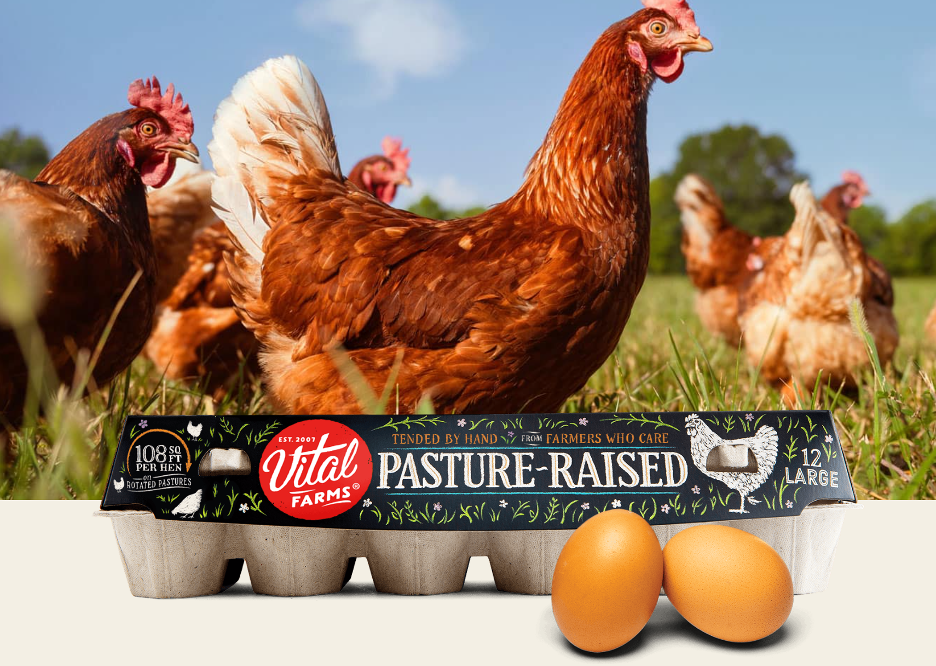
Vital Farms is a great example of a brand that provides specifics of how they live their mission of “bringing ethically produced food to the table.” With their eggs, they highlight the benefit of “pasture-raised” and consistently feature the claim of “108 sq feet per hen on rotated pastures,” (left of Vital Farms red logo below). Whether on pack, on their website, or across social media, they consistently highlight the proof point of 108 feet per hen as credible evidence of “pasture-raised.”
Our Strategic Differentiators Aren’t Our Message
Once you decide on one or two specific attributes, you have a strategy. These are your core differentiators, but they don’t have to be the words you use to bring your message to life.
Picture an ice cream brand with “decadent” as its differentiator. One approach is to communicate this literally, with a headline that such as, “The Most Decadent Ice Cream You’ve Ever Tasted.” Alternatively, you could allude to decadence by showing a cone drizzled with chocolate fudge, surrounded by dark chocolate chunks. In one, we tell; in the other, we show. Neither strategy is the right one—though in this case, you probably find showing more effective. Effectiveness depends on the category, the brand, and what will resonate with the customer. Our objective is to communicate our core differentiator in a way that makes our customer viscerally believe, and ideally, experience it.
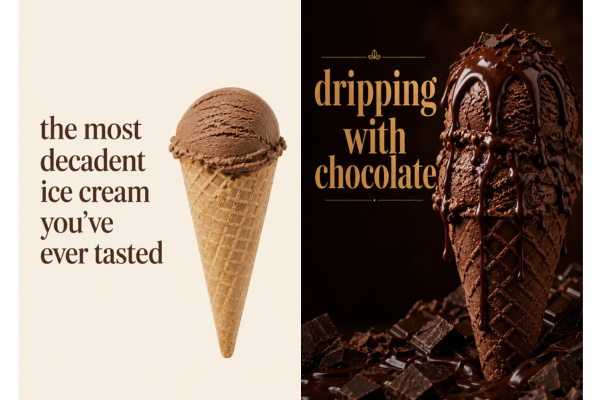
Differentiators lay the foundation of our strategy, but need not be a copy-paste exercise. We may use myriad ways to bring it to life through language, imagery, experience, sound, story, and emotion.
Going back to the ice cream example, different words may describe a new chocolate cookie dough ice cream versus a red velvet ice cream, but the foundational strategy of “decadent” must underpin either execution.
When We Can Claim Umbrella Benefits
There is one exception to the principle of never stating umbrella benefits.
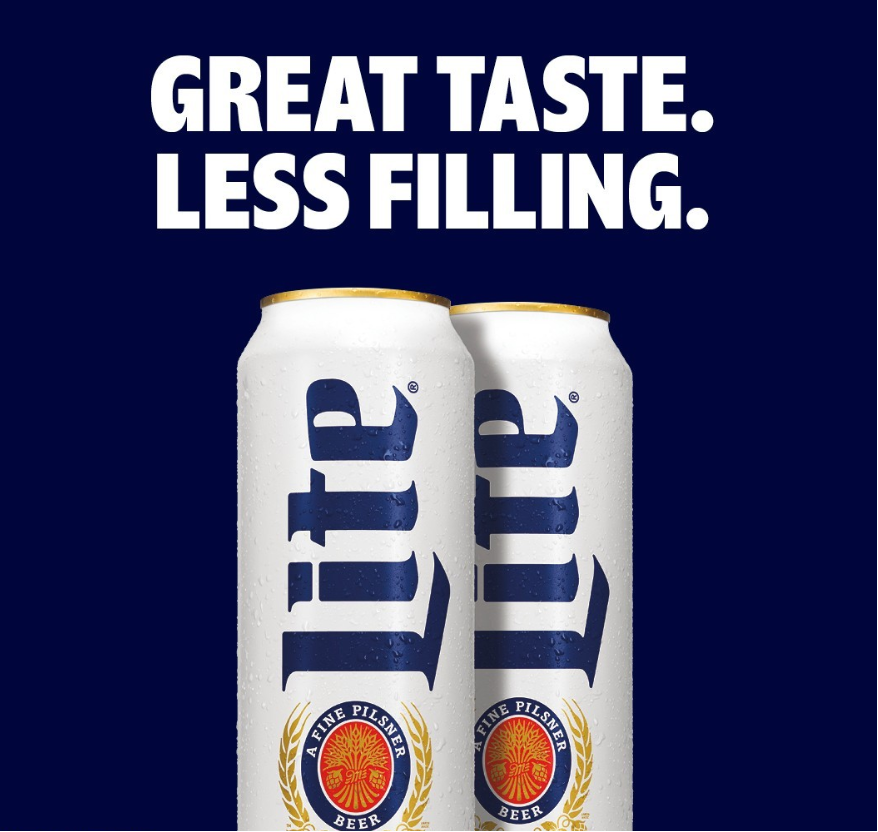
As an example, let’s use Miller Lite’s tagline, “Great Taste. Less Filling.”
On first glance, this tagline violates the principles I’ve argued for in this article. However, “Great Taste” is not the differentiator. “Less Filling” is. In this case, taste is the reassurance that you’re not sacrificing flavor for a less-filling feeling. We can use these broad categories as reassurance when the customer might perceive a tradeoff, because they are not the differentiator. Rather, they serve as a parity claim. When we are making parity claims, we default to the customer’s perception of the general category, which is exactly our intention—we want to be seen as parity when reassuring our customer.
Taste, quality, service, and mission are not differentiators. They are the aspiration, the final destination we hope all customers arrive at, but they are not the route. When customers tell us that these attributes set us apart, they are revealing an opportunity, not a strategy. We must do the hard work to give new travelers, your future customers, directions. Unless the map tells them specifically what is different and more valuable about your solution vs. another, they might not decide to take the trip.
The most common question I get from business leaders is “How do I know if my marketing is working?”