
How to Know if Your Marketing is Working
The most common question I get from business leaders is “How do I know if my marketing is working?”
This is a broad and complex question because it covers both strategy and execution. A strong marketing strategy includes a clear target customer and differentiated market positioning; however, when most leaders ask this question, they are usually wondering whether their investments to reach customers are the best and most efficient ones to grow the business. This article will focus on the conceptual framework for evaluating marketing activities; however, if you want to read more about creating a strong total marketing strategy, I encourage you to read “The Hidden Foundation of Effective Marketing.”)
When evaluating whether particular investments are supporting your growth goals, it’s tempting to jump to measurement tools and attribution data. But without defining success and identifying the relevant metrics for each objective, you'll misjudge the value of your investments. No matter how big or small your measurement budget, understanding how to think about the role of each marketing activity and how different activities work together to deliver your goals will give you a strong foundation for assessing what’s working.
“Half the money I spend on advertising is wasted; the trouble is I don’t know which half.”
What Does “Working” Mean?
Determining whether you’re making the right investments begins with defining what you’re trying to achieve. We often assume effective marketing has a clear definition, but success can take many forms.
Here are a few examples of marketing objectives:
Increasing awareness of the total brand or specific product
Generating purchases from new customers
Repositioning how your customer sees you compared to competitors
Increasing repeat purchase
Expanding the number of products or services that a customer buys from you
Generating a qualified pipeline
A Good ROI Isn’t Enough
Most business leaders want to know if they’re generating a good return on their marketing spend. ROI is too vague if it doesn’t specify what counts as return (revenue or profit), what costs are included, and over what time period.
Relevant financial metrics vary based on how you sell and what data you can access. Examples include customer acquisition cost (CAC), customer lifetime value (CLV), contribution margin, return on ad spend (ROAS), sales velocity, or cost per qualified lead.
Once you know these metrics, you can more clearly articulate what success looks like for your marketing investment.
For example, a 5x ROAS might sound great, especially if you know it’s above industry average. However, if your product has a 20% contribution margin, you are spending all your margin on ad spend and making no profit on that initial marketing investment, even before accounting for creative costs. Even if the sales are incremental, the marketing only pays out if repeat sales generate enough contribution to cover all customer acquisition costs.
Additionally, we need to understand incrementality. That is, how much of the sales would have happened anyway without the marketing spend? Just because a sale was attributed to an ad, for example, doesn’t mean that the individual wouldn’t have bought the product anyway without seeing the ad. Incrementality is expensive, complex, and sometimes impossible to measure. While there are tools such as Market Mix Modeling (MMM) or controlled tests, these can be expensive, require extensive data, and require someone who knows how to run them. Therefore, applying a conceptual lens to measurement lets you make strategic decisions, even with imperfect data.
Each Investment Needs an Objective
Most financial metrics give you a holistic picture of how all marketing activities support sales growth, but they don’t necessarily help you evaluate each investment. Even individual ROAS or CAC metrics can misattribute sales and don’t help us understand incrementality. To assess whether individual marketing activities are effective, you need to determine which objective(s) it delivers on. The following five objectives—exposure, awareness, consideration, purchase, and repeat purchase—form a basic measurement framework that mirrors the customer journey.
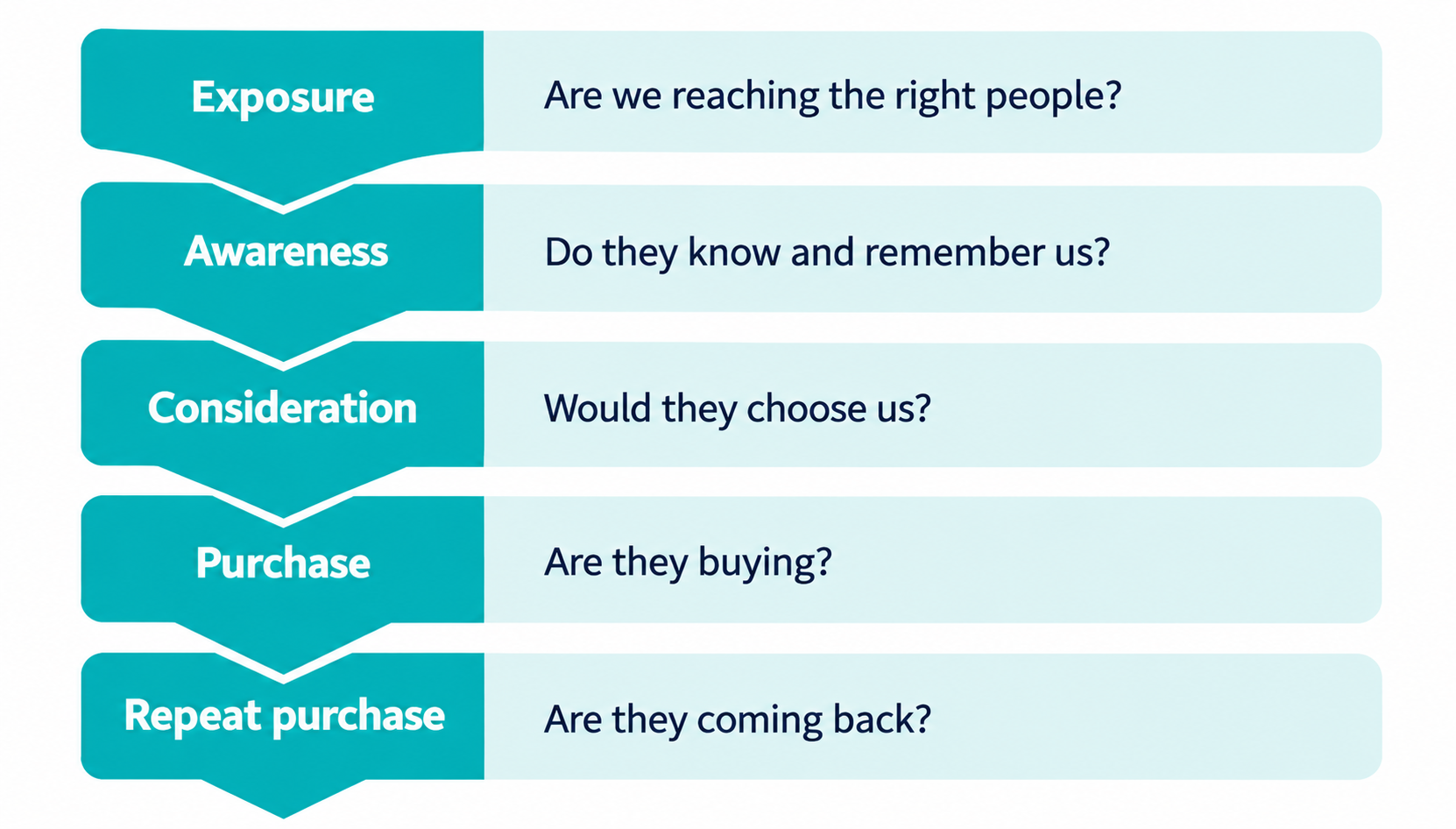
While many investments can technically achieve all objectives at once, they’re not inherently suited to doing so. Expecting each tactic to achieve all objectives can undermine your strategy and set you up for failure.
You can pair individual tactics and channels to move the customer from discovering your brand to buying and repurchasing. For example, brand sponsorship on a pro soccer team jersey might increase exposure but do little to incentivize purchase. Therefore, measuring short-term sales returns based on that sponsorship would mean evaluating it against objectives it’s unlikely to meet, which is why logo placement is often paired with advertisements that focus on generating consideration and in-store promotions that incentivize purchase.
Measuring Your Objectives
When the objective for each marketing investment is clear, you can then decide what metric you will use to evaluate it, and what improvement you want to see over what time period. Use a mix of quantitative and qualitative evidence to generate hypotheses around what’s working. Gathering the data to prove a specific investment is achieving your objective can be extremely expensive, but aggregating multiple sources of evidence increases your confidence that your analysis is accurate. This chart outlines common metrics and methods for gathering qualitative and quantitative measures.
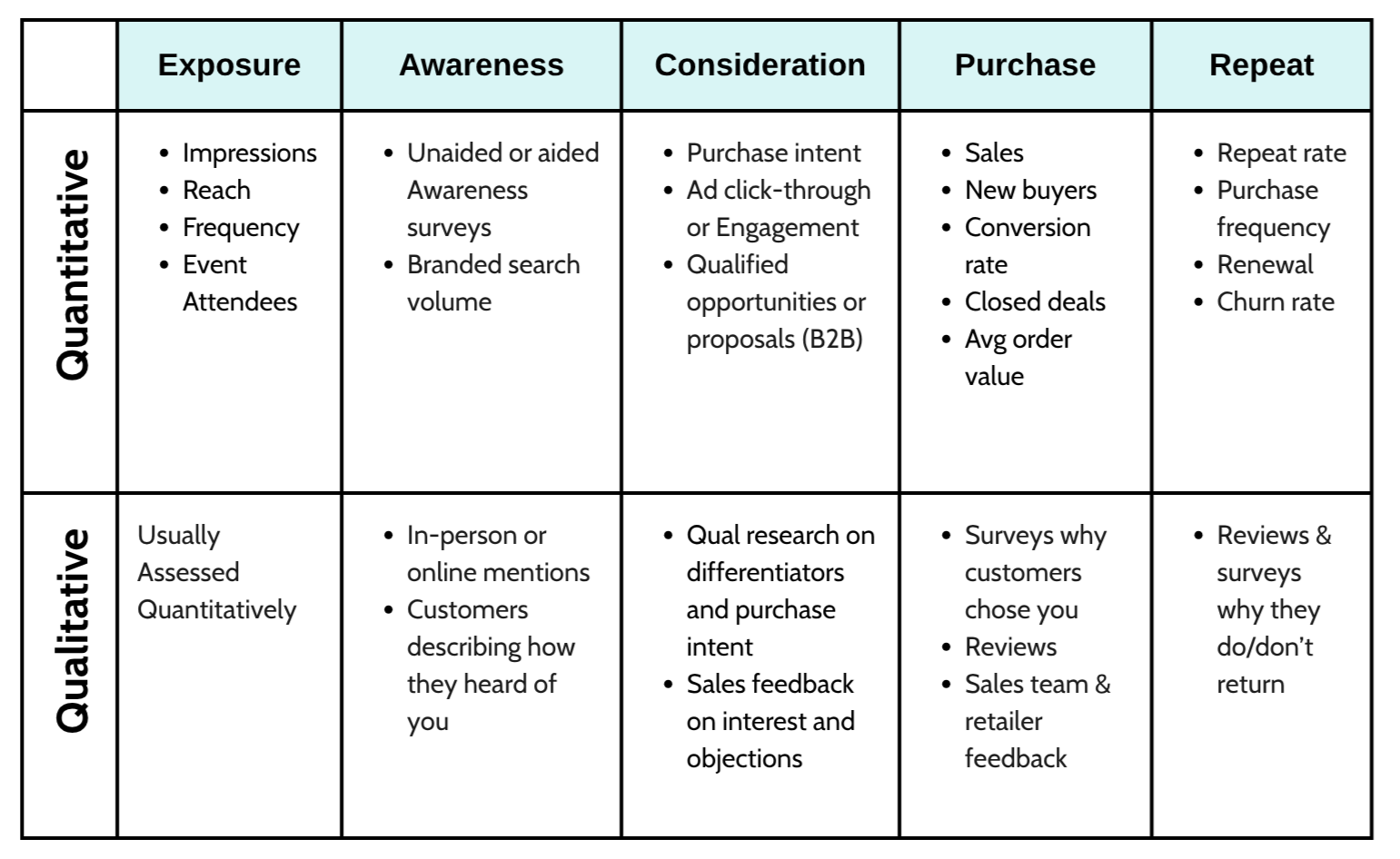
As a personal example, I post regularly on LinkedIn. Each year, my impressions and engagement increase, which means I am gaining exposure (note: I’m excluding the impact of changing algorithms). What’s hard to assess is whether those impressions are actually building awareness. That is, are people seeing and noticing my content in a way that makes them become aware of me and/or remember me? I’ve had dozens of people who I haven’t spoken to in 5+ years proactively mention that they see my content on LinkedIn. This combination of quantitative and qualitative signals gives me confidence (in a very inexpensive way) that LinkedIn is not only increasing exposure, but actually building top-of-mind awareness among my network.
If I were to evaluate LinkedIn based on direct customer acquisition, I would consider it ineffective. However, if I define it as an awareness-driving tactic, I can pair it with other channels better suited to those objectives. Alternatively, I could adjust my LinkedIn strategy to generate qualified leads and sales conversations more directly. Defining the objective and role for each marketing activity is critical to evaluate whether the channel is working.
How to Diagnose the Problem When It’s Not Working
A common challenge brands have is investing in something that doesn’t seem to be working, but they can’t pinpoint why, and therefore don’t know how to fix the issue. Here’s a simple process to diagnose the problem:
First, validate your value proposition and message. If nothing is working, start by assessing whether your offer or messages resonate. Talking to customers and prospects directly (qualitatively) gives you richer insight into how they respond and why, so I always recommend this step before using a survey. Then, if needed, you can validate the insights quantitatively.
Second, check to ensure the message you validated is what you’re putting into the market across all of your channels. Often the tested message gets changed as it reaches the market, especially when it’s distributed by influencers or others who control the final message.
If you know your message and offer work, expand your diagnosis to evaluate awareness, purchase, and repeat to investigate whether ether there’s a gap in awareness, purchase, or repeat.
Awareness
i. Is your creative or message breaking through to be noticed?
ii. Are you reaching the right audience with your investment?
iii. Are the channels you are using allowing you to actually be seen? (think digital channels that no one sees or a trade show booth on a floor no one visits)
Purchase:
i. Is there friction in the shopping/buying process?
ii. Can customers find you online or in-store?
Repeat Purchase:
If you have quality data to evaluate the percentage of buyers who repurchase, you may be able to quickly identify this as your problem. Here are a few questions to understand why buyers may not be repeating:
i. Does the product or service experience deliver on their expectations? And does it solve a meaningful problem?
ii. Does the value or benefit they receive match the price they pay?
iii. Do they remember or are they incentivized to purchase again?
Evaluating each marketing investment independently helps you clarify your objective and shows what is and isn’t working. However, marketing channels build and amplify one another and shouldn’t be measured in complete isolation. Attribution is notoriously difficult to measure because often no single channel is accountable for a sale. Having a holistic view of the entire customer journey and how different marketing investments support your objectives is a nuanced art to avoid making isolated cuts that undermine your strategy.
Marketing impact also builds over time. Last week, I cut into an English muffin and recalled the “nooks and crannies” advertisements from my youth. Short-term attribution doesn’t capture the total benefit of marketing investments. Sustained investment with consistent and validated messaging is the foundation for brand building. No measurement system is perfect, but if you evaluate multiple signals and connect them to your financial metrics, you will have greater confidence that your investments are working.

The most common question I get from business leaders is “How do I know if my marketing is working?”