
Standing Out When Everyone Sounds the Same (Part 3 of 4)
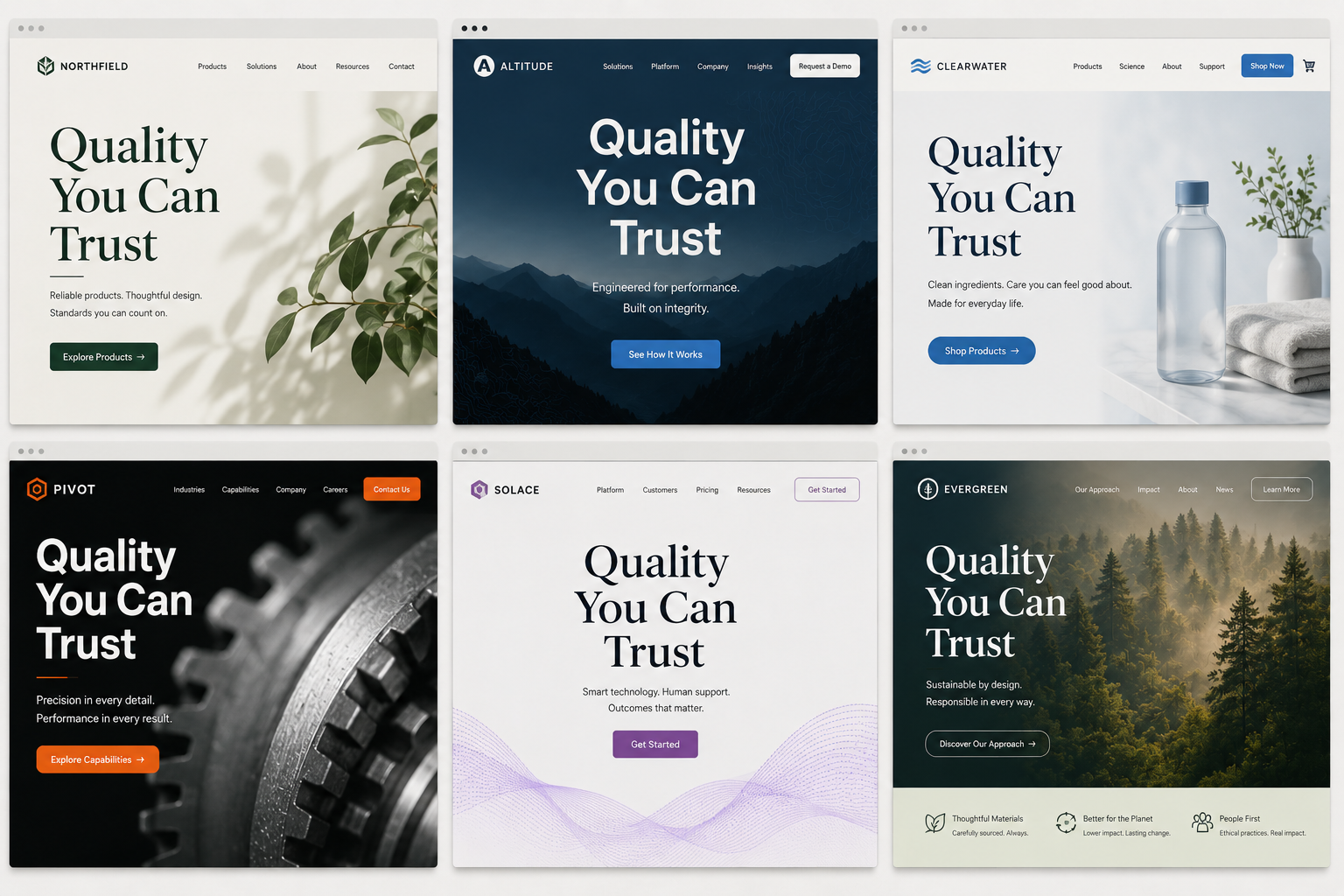
The challenge so many companies face is: how do you differentiate your message when everyone is saying the same thing?
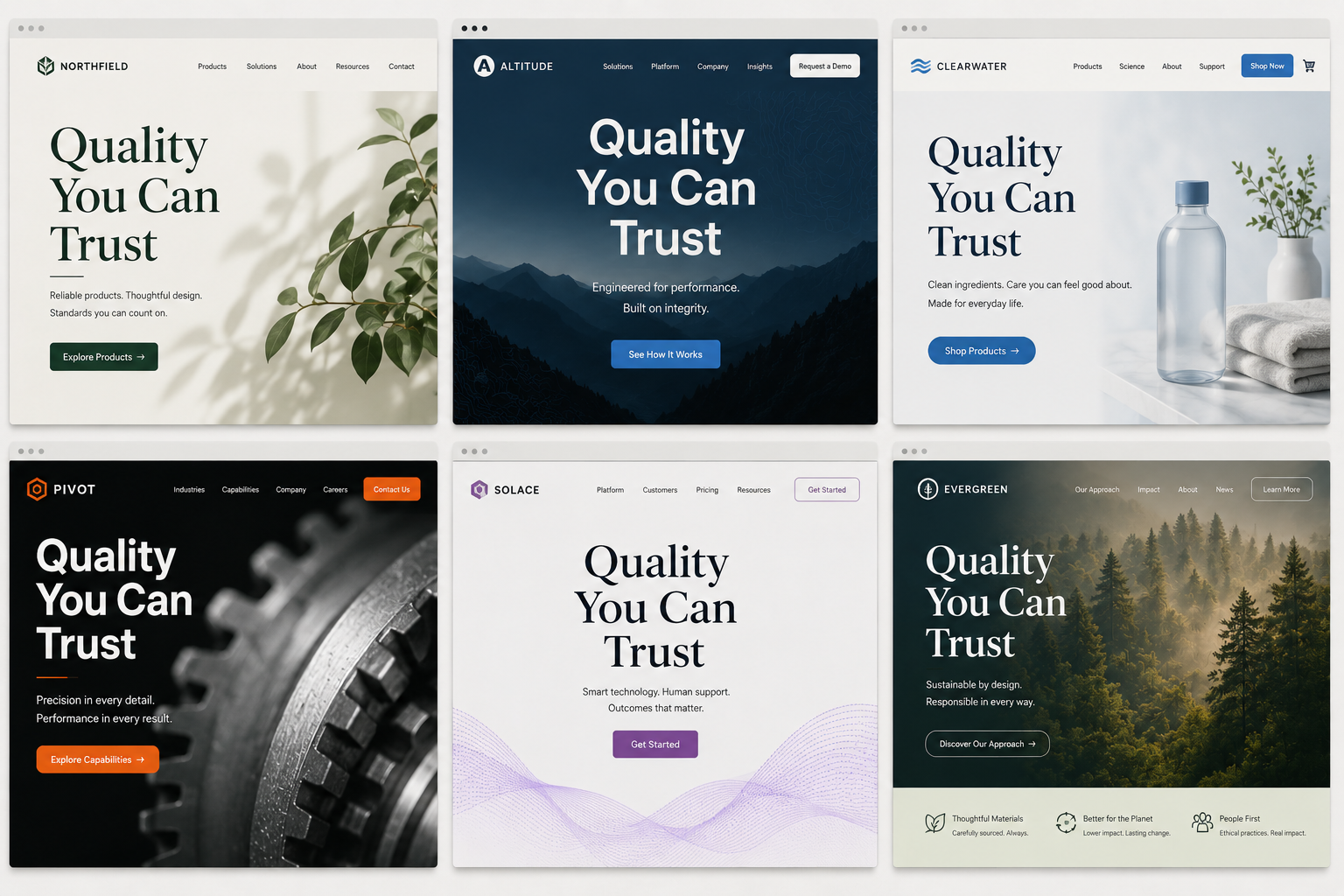
(This image was generated with ChatGPT)
I work with a company that perpetually needs to redefine its story. Two years ago, they launched a differentiated message into the market. Fast-forward to today: nearly all of their competitors are using the same message. The challenge this company faces, alongside so many others, is: how do they differentiate their message when everyone is saying the same thing?
This article is the 3rd in a 4-part series on differentiation, one of the most important yet challenging aspects of telling your story.
Additional articles in this series include:
Part 2: Quality Is Not a Differentiator
Part 4: How to Use Branding as a Differentiator
Marketing expert Seth Godin describes brand value as “the sum total of how much extra people will pay, or how often they choose” one brand over an alternative. Think of the products you buy that are commodities—those in which the brand makes no difference to you. For me, a few examples include airlines, resealable sandwich bags, tissues, and yellow mustard. When a customer perceives products to be interchangeable within a category, they are undifferentiated.
One of the most common differentiation traps is when companies converge on the same messaging. Whether your category has always sounded this way or whether your competitors have recently applied your language, it can feel almost impossible to distinguish yourself. Even when your product or service is superior, if you struggle to communicate those differences, you don’t get recognized for the value you create. There are multiple reasons you could be in this scenario:
Certain benefits or messages are a baseline requirement in a category—everyone talks about those benefits, but no one is differentiated.
A company successfully identifies a differentiated message that resonates in market, and competitors start copying that approach.
Brands repeatedly make exaggerated or unrealized claims, so customers no longer believe those specific promises.
Category norms dictate how certain messaging will look and sound, and everyone is used to doing it that way.
Regulatory requirements limit what companies can say or require them to use standard terminology.
4 Strategies to Set Yourself Apart
Here are four strategies to create differentiation amid uniform industry messaging. These strategies assume you have a functional or emotional difference that is meaningful to the customer. It’s unethical and unsustainable to promise differentiation in an area where you lack it. If there is truly no difference, you could differentiate your brand personality (which we will discuss in more depth in part 4 of this series), or you could invest innovation resources to develop a product or service that gives you a meaningful advantage.
1: Us vs. Them
One of the most effective approaches is to call out what distinguishes you from your competitors. When companies tout the same benefits, it’s hard for customers to distinguish between similar options. However, when you illuminate differences that are not obvious or even visible to your customer, you expose a comparison that reinforces why your option should be the preferred choice.
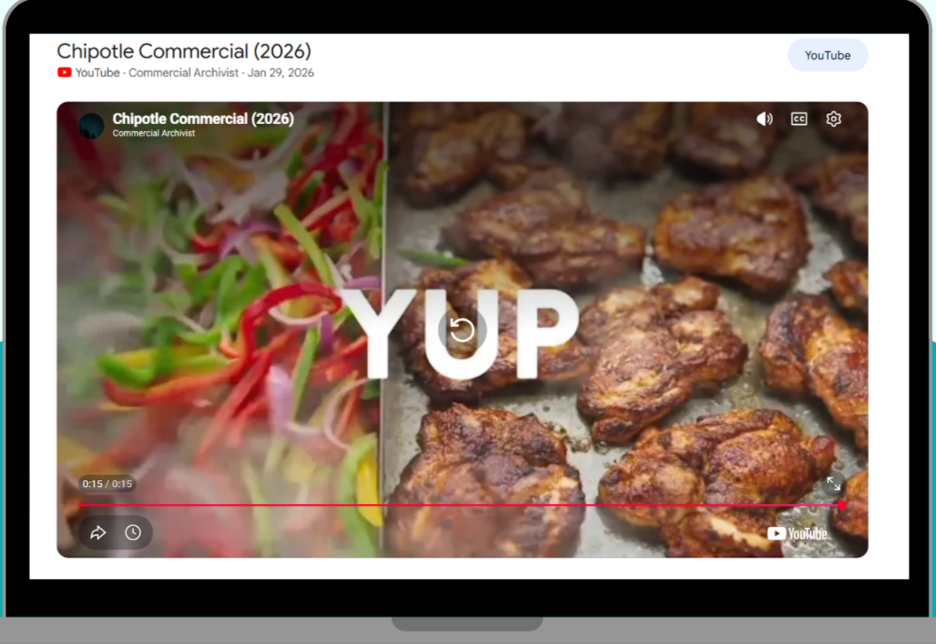
The Us vs. Them approach is used by Chipotle in this ad, which features video of typical fast-food preparation compared to Chipotle’s. Most quick service restaurants use frozen ingredients that are fried, whereas Chipotle prepares fresh vegetables and meats daily. Visualizing what happens behind the scenes exposes or simply reminds customers why they would prefer buying Chipotle because reframes what “fresh” means to customers.
Note: Avoid using competitors’ names or logos, as this gives their brands visibility. Using category norms as a comparison reduces the risk of unintentionally building awareness for competitors.
2: Show vs. Tell
Exclusively using words to describe why your offering is different has limitations. Some differences can only be understood through experience.
Tech companies regularly use “demos” to give potential users insight into how their products work. Product sampling has been a longstanding practice in the food and consumer packaged goods industries. Firsthand experience communicates far more than any words can.
This approach is less about your message and more about designing an environment where the solution or product speaks for itself. It requires building your go-to-market strategy around tactics that showcase the value you create.
What does “showing” look like for your brand?
Video explaining how something works
Taking your customers’ data or situation and doing your own analysis
Free demo or workshop
Product sampling
3: Proven vs. Promised
Messages have no impact if customers don’t believe them. Your competitors might make the same promise, but what information gives your customer higher confidence that you will actually deliver? Your message need not be differentiated in the benefit you provide if you can differentiate your credibility.
What makes your promise more believable than your competitors’?
Amount of experience or years of service
Credentials, affiliations, or endorsements
Third-party testing or certifications
Results or case studies
4: Third Party vs. You
A third party delivering your message is often more compelling than talking about yourself. For this approach to be effective, the third party must be credible, believable, and have influence with your customer. Mega influencers might build awareness but often don’t increase trust because your audience knows they are paid. The most effective advocates have personal experience using your brand and empathize with the same struggles your customers have. Empathy and specificity build credibility.
While this approach makes any list of marketing strategies, it best supports differentiated messaging when paired with the three prior approaches. Encourage the third party to communicate how your brand compares to other options they have tried (“us vs. them”), their personal experience using the product in descriptive, experiential language(“show vs. tell”), and reinforce why your sources of credibility matter or the results they experienced (“proven vs. promised”).
Who are the trusted sources that can deliver your message for you?
Customer testimonials
Industry experts (doctors, scientists, academics)
A podcaster who has used your product or service
Ambassadors sharing their personal experience with your brand
The client that struggled with competitors copying their messaging has leaned into all four of these strategies:
Evolving their messaging to include how their service is different than what competitors offer (Us vs Them)
Adding more data and credentials (e.g., years of experience, volume of business they manage) to convey their level of experience and inspire confidence that they can deliver (Proven vs Promised)
Incorporating more demonstrations of their expertise into the sales process (Show vs. Tell)
Expanding the number of case studies to share with clients, including customer testimonials on video (Third Party vs. You)
To stay differentiated, you must stay close enough to your customer to see their unmet needs evolving as the category evolves. This is how you anticipate market needs before your competitors do. Evolving your story to preserve differentiation while staying consistent with what you stand for over time is a balancing act. Those who can find equilibrium—often enabled by innovation—build a valuable brand that generates demand and premium pricing in the market.
If functional differentiation remains out of reach for your brand, the final article in this series explores a different tactic: how to differentiate based on your brand personality. Stay tuned!

Quality Is Not a Differentiator (Part 2 of 4)
A few months ago, I drove past a billboard just like this that illustrated one of the most common mistakes I see companies make when communicating differentiators.

[This image is an AI Recreation.]
A few months ago, I drove past a billboard with this exact headline, illustrating one of the most common mistakes I see companies make when communicating differentiators.
Messaging always requires category context and understanding audience perception. When it comes to bananas, consumers see them as commodities. That is, most people can’t tell the difference between brands and don’t pay attention to which brand they are buying. Brand does not inform choice. With that in mind, let’s dissect the two benefits being made here: taste and quality.
Taste: What would you say most impacts the taste of a banana? For most of us, it’s ripeness. Too green and it’s not sweet, too brown and it’s mushy. Therefore, a taste differentiator is not a believable promise because it has nothing to do with the brand and everything to do with ripeness.
Quality: What is a quality banana? Not damaged? Lasts longer? More nutritious? Without a clear understanding of what “quality” means in the banana category, it’s either meaningless or can be interpreted in several ways. The result is that it’s vague and unmemorable, and therefore fails to communicate value.
This article is the 2nd in a 4-part series on differentiation, one of the most important yet challenging aspects of telling your story. Today, we focus on why quality (and other similar benefits) are not differentiators.
Additional articles in this series include:
Part 1: Why Less Is More
Part 3: Standing Out When Everyone Sounds the Same
Part 4: Brand as a Differentiator
What Our Customers Tell Us Shouldn’t Be Our Strategy
I hear consistent themes whenever I ask a company what makes them different.
“Our product is just really high quality.”
“Ours tastes better than our competitors.”
“We have excellent service.”
“We have the best people.”
“Our customers trust us.”
Quality, service, people, taste, and trust are categories of customer perceptions, not differentiators. They are what your customers say (or you want them to say) about you. They help you understand within which domain you are differentiated—because they are how your customer expresses that differentiation—but they cannot be your strategy. I call them umbrella benefits.
Umbrella benefits are destinations, not directions. They can’t be claimed. Instead, they must be earned through specific, observable, and, ideally, measurable attributes that set you apart. You must offer your customer a map that helps them arrive at the destination you seek.
How to Identify Specific Differentiators
To create the map for our desired destination, we must uncover what is driving superior taste, quality, service, trust, or values. What specific attributes contribute to the perception of these umbrella benefits?
Taste: Is it smooth, crunchy, rich, or sweet?
Quality: Is it leakproof, durable, error-free, or easy to use?
Service: Is it friendly, a luxury concierge, quick response time, or always human?
People: Are they service-oriented, deep-subject experts, Harvard MBAs, or collaborative?
Trust: Do you offer transparent pricing, an impressive client roster, a money-back guarantee, or a 3rd-party certification?
Mission-Driven: Are you sustainably sourced, hire second-chance labor, carbon neutral, or pay a living wage?
We can self-examine what sets us apart, but the most helpful insights come from our customers. However, we often need to ask “why?” multiple times to reveal the specifics of what truly differentiates us.
We can assess effectiveness retroactively by asking our customers why they trust us or what makes our service different. In particular, inviting comparison (for example, why our product tastes better than others or why they trust us more than alternatives, even those outside our industry) forces customers to better articulate the differences.
We can also assess effectiveness proactively by using various differentiators to test what resonates. Brainstorm a set of messages, each featuring combinations of differentiators, and run an experiment using them in sales calls or digital messaging. This approach often identifies which differentiators resonate versus those that fall flat.
Likely, this process will surface a series of attributes within each umbrella category that contribute to the perception of what makes you different. Then, you must choose one or two attributes that most consistently and strongly connect to your umbrella benefit. (See last week’s article on why we need to limit our differentiators.)
Specificity is Essential for Purpose-Driven Brands
When it comes to purpose, brands are often extremely vague. Whether it’s “more sustainable,” “better for the planet,” or “mission-driven,” these benefits are assumed to be differentiators, but in reality, they too are generic umbrella benefits. The same rules of specificity apply for mission and values. Unless a customer understands how or why you are better for the environment, human health, or how well you treat your employees, your advertised benefits won’t resonate with your customer.
Vital Farms is a great example of a brand that provides specifics of how they live their mission of “bringing ethically produced food to the table.” With their eggs, they highlight the benefit of “pasture-raised” and consistently feature the claim of “108 sq feet per hen on rotated pastures,” (left of Vital Farms red logo below). Whether on pack, on their website, or across social media, they consistently highlight the proof point of 108 feet per hen as credible evidence of “pasture-raised.”

Our Strategic Differentiators Aren’t Our Message
Once you decide on one or two specific attributes, you have a strategy. These are your core differentiators, but they don’t have to be the words you use to bring your message to life.
Picture an ice cream brand with “decadent” as its differentiator. One approach is to communicate this literally, with a headline that such as, “The Most Decadent Ice Cream You’ve Ever Tasted.” Alternatively, you could allude to decadence by showing a cone drizzled with chocolate fudge, surrounded by dark chocolate chunks. In one, we tell; in the other, we show. Neither strategy is the right one—though in this case, you probably find showing more effective. Effectiveness depends on the category, the brand, and what will resonate with the customer. Our objective is to communicate our core differentiator in a way that makes our customer viscerally believe, and ideally, experience it.

Differentiators lay the foundation of our strategy, but need not be a copy-paste exercise. We may use myriad ways to bring it to life through language, imagery, experience, sound, story, and emotion.
Going back to the ice cream example, different words may describe a new chocolate cookie dough ice cream versus a red velvet ice cream, but the foundational strategy of “decadent” must underpin either execution.
When We Can Claim Umbrella Benefits
There is one exception to the principle of never stating umbrella benefits.
As an example, let’s use Miller Lite’s tagline, “Great Taste. Less Filling.”
On first glance, this tagline violates the principles I’ve argued for in this article. However, “Great Taste” is not the differentiator. “Less Filling” is. In this case, taste is the reassurance that you’re not sacrificing flavor for a less-filling feeling. We can use these broad categories as reassurance when the customer might perceive a tradeoff, because they are not the differentiator. Rather, they serve as a parity claim. When we are making parity claims, we default to the customer’s perception of the general category, which is exactly our intention—we want to be seen as parity when reassuring our customer.

Taste, quality, service, and mission are not differentiators. They are the aspiration, the final destination we hope all customers arrive at, but they are not the route. When customers tell us that these attributes set us apart, they are revealing an opportunity, not a strategy. We must do the hard work to give new travelers, your future customers, directions. Unless the map tells them specifically what is different and more valuable about your solution vs. another, they might not decide to take the trip.

How to Differentiate: Why Less is More (Part 1 of 4)
This is the first article in a series on differentiation, one of the most important factors influencing why customers choose our product or service over another.

If I asked you to think of a car known for safety, which manufacturer comes to mind?
Now, think of the following:
One that is reliable
One that is fast
One that is electric
Now, think of a brand that is all of these things.
My hypothesis is that you paused after that last one. It’s hard to come up with a car that is better than its competitors across each of these dimentions. Even if there were a car brand that is extremely safe, reliable, fast, and electric (and there might be), our brains can’t hold all of this information equally. Certainly, not as a gut reaction. We default to companies that have reiterated a singular message over time.
This is the first article in a series on differentiation, one of the most important factors influencing why customers choose our product or service over another.
Companies know they have to differentiate; what’s difficult is doing so effectively for a sustained period of time. Many categories feel saturated, products seem commoditized, and the market changes so quickly, with competitors constantly launching new products, services, and messaging. However, those that maintain long-term differentiation achieve more profitable, sustained growth.
In this 4-part series, I will break down various principles to guide effective differentiation. In this first article, I explain that the most critical aspect of successful differentiation is focus.
Additional articles in the series include:
Part 4: Brand as a differentiator
Types of Differentiation
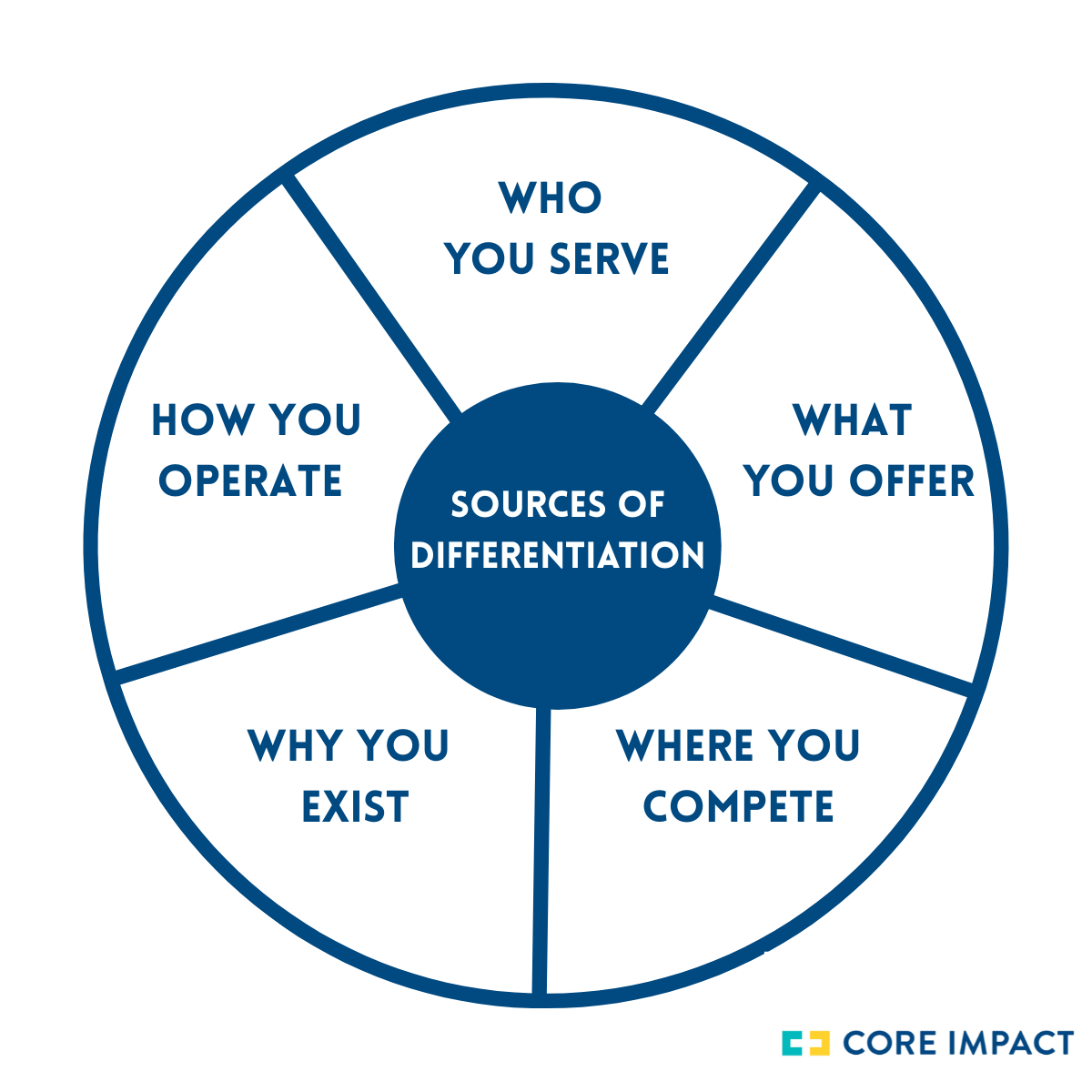
Differentiation must create value for the customer, otherwise it is simply a difference. We might have endless differences that set us apart, but ascertaining which of those meaningfully inform choice is essential. Differentiation can be categorized along five distinct axes:
WHO you serve: The product or service might serve a very specific niche audience within a larger category. For example, a CRM for solopreneurs, a yoga studio for men, or an IT consulting company for public schools.
WHAT you offer: The core value you deliver is different than alternatives. Typically, this category highlights features or benefits, but it could also be the impression your brand creates. Functional features or benefits are often first or early to market (think Uber, Airbnb, or a high-protein breakfast bar), but if they are successful, they are often quickly copied.
WHERE you compete: The geographic territory or region that you serve might set you apart from otherwise similar alternatives. If you’re an Italian restaurant, there might be nothing particularly different about your menu, ambiance, or service, but if you’re the only Italian restaurant within 15 miles, that’s a core differentiator.
WHY you exist: The mission, purpose, or values behind your company can be a compelling source of differentiation that both attracts values-aligned customers and may influence the quality and experience of your product. TOMS shoes doesn’t have a massively different style or product quality, but why they exist and how they serve the community captivates their customers.
HOW you operate: A unique approach to make or deliver your offering, such as your supply chain, technology, proprietary processes, or talent strategy, can result in increased value through performance, quality, service, or customer confidence.
Why Focus is Critical
Effective differentiation requires focus. You may have dozens of things that set you apart, many of which may be meaningful to the customer, but you can only be known for one or two.
We need our customers to both digest and retrieve the information we communicate so they prefer and select our product. When we prioritize one or two core differentiators, we enable our customers to mentally process the information we share more easily. With single-minded repetition, this information becomes familiar, which in turn increases preference. A focused message also aids the ability to recall that information with a cue.
Think of the opening exercise about cars. When I said “safe,” that word was a cue to retrieve a brand. In my case, Volvo came to mind. If a brand focuses on too many differentiators, the cue-retrieval signal is less direct, and you might not be remembered for any one thing. Too many differentiators means zero differentiators.
Let’s use on of my clients, 80 Acres Farms, as an example for how to decide which differentiators to focus on.
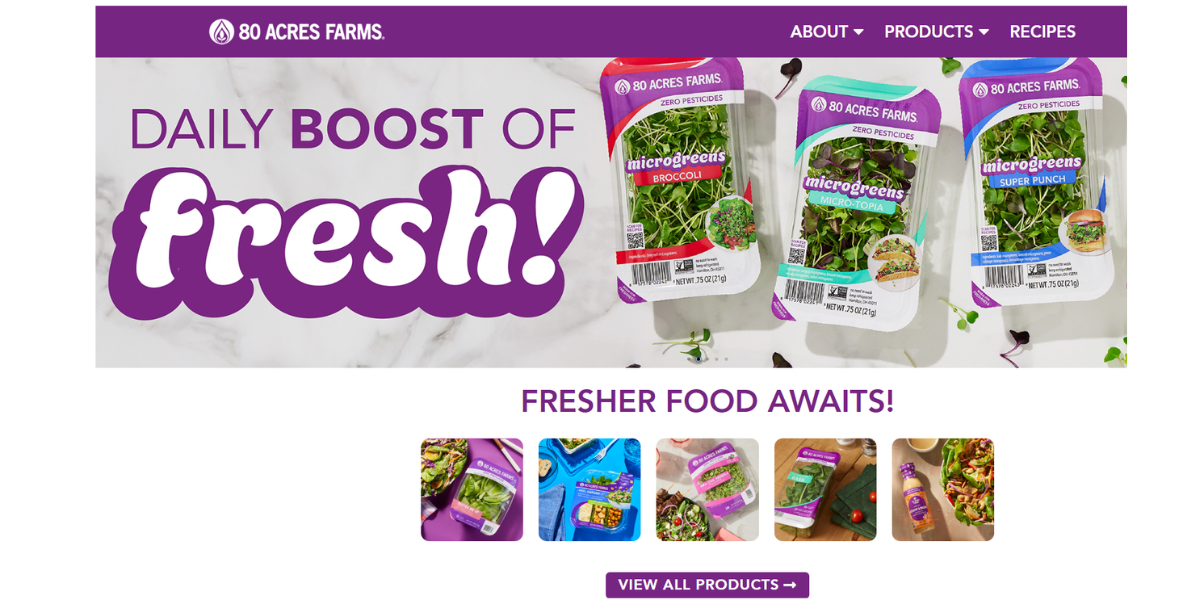
80 Acres grows lettuce, herbs, and other vegetables in a pesticide-free, climate-controlled environment that is powered by 100% renewable energy. Because of the growing process and the fact that farms are close to stores, the product is locally grown, fresher, and more nutritious than other lettuce.
When I first started working with 80 Acres eight years ago, we had a multitude of potential differentiators to choose from: vertically farmed, fresh, locally grown, sustainably grown, nutritious, flavorful, and pesticide-free. But trying to communicate all of them, or even several of them would be confusing. Nothing would stick, and customers wouldn’t know what was really different about the brand. So, how do we choose?
Differentiation Requires Context
To narrow our core differentiators, we must first consider three important factors for context: the category, the customer, and competing alternatives. These factors, along with your core differentiator, comprise your market positioning. [Read more here about how to create a strong positioning strategy.]
Category
The category and subcategory we play in creates certain expectations and norms for our customers. If you’re an airline, you have to be on time (or should be!). If you’re banking software, you have to be secure. Sometimes these expectations become an opportunity for differentiation. Other times, you just need to meet the minimum expectation to remain under consideration.
Discovering unmet needs in your category reveals potential areas of differentiation. In what ways do today’s solutions fall short? Where might there be an opportunity for differentiation?
Customer
We must have a clear, specific customer to help us pinpoint what matters to them. If you target a broad audience, it will be more difficult to identify which differentiators create the most value. In fact, narrowing your ideal customer according to which segments most value a particular differentiator can be an effective approach to select your target audience.
We also need to understand how we add value from our customers’ perspective. Ask yourself:
What features or attributes create real value for your customer?
Does your customer see your product or service as truly differentiated in the areas where you think it is? ( In other words, are the things you consider to be differentiated actually noticeable to your customer?
Among all of the meaningful benefits you offer, which ones most influence the sale of your product or service?
Competing Alternatives
Oftentimes, we think of competition as companies in the same category we operate. However, the customer doesn’t always consider options with this lens. To uncover real substitutes, we need to know what our customer would do without our product or service. It could be nothing. It could be a homemade, makeshift solution. It could be the cheap option from 20 years ago. For example, alternatives to taking Uber to the airport may not be taxis, or even Lyft, but paying for long-term parking or getting a ride from someone else. Understanding the actual alternatives your customer uses will inform your frame of reference for differentiation and help you evaluate which differences create real value. A “low-cost” ride-share program might not be a differentiator when the main alternative is free.
Conduct Research to Uncover Answers
Assessing our category, the customer, and competing alternatives may be all that’s needed to narrow our core differentiators. However, I find that most companies don’t have enough customer insight to make an informed strategic choice. In these cases, I recommend doing qualitative research. (You may need to do some quantitative research as well.)
Interview current and prospective customers (or look at data from prior customer interactions). Ask them critical questions about what they value, unmet category needs, and benefit prioritization. After conducting research, you will be well-positioned to select the one or two core differentiators.
Case Study: How 80 Acres Farms Prioritized its Differentiators
Before working together, the team had leaned into “Local” as the core point of difference on packaging because they kept hearing from customers and retailers that local resonated.
We conducted a series of interviews with customers to observe their shopping behavior in a real store, asking them to narrate what they were choosing and why. What we discovered was that the most important thing to customers was freshness. Local was important, but not for its own sake. Local mattered because it signified freshness, and freshness also implied flavor.
Most lettuce had a highly variable shelf life, and even though freshness was most important, no competitor used it as a point of differentiation because they couldn’t. Ninety percent of lettuce in the US comes from the same region in California, which means that brands use the same product from the same farms. As a result, brands couldn’t differentiate their products because they were the same.
Other insights helped us rule out potential differentiators. Among the boxed lettuces, nearly all of them were organic, which customers saw as essentially interchangeable with 80 Acres’ pesticide-free claims. Customers also said they weren’t purchasing lettuce based on flavor and used dressing or salad inclusions for that. Sustainability was meaningful, but didn’t drive sales.
This research laid the foundation for 80 Acres’ differentiation strategy. Rather than focusing on local or flavorful, we leaned into freshness. It was a core category purchase driver, it represented an unmet need, and 80 Acres had consumer-noticeable benefits around longer shelf life. We knew we had to communicate pesticide-free, even though it wasn’t differentiated, because otherwise customers wouldn’t consider the brand. Therefore, the two central messages were freshness (differentiator) and pesticide-free (parity). We built all messaging, claims, packaging design, and innovation strategy around these two attributes.
Differentiators Are a Strategic Choice
Identifying long-term points of differentiation isn’t simply a matter of asking consumers what they need and which of your benefits they prefer. Ultimately, differentiators represent a long-term brand strategy that informs communication and marketing, as well as innovation and overall company growth.
To ensure we are planning for long-term sustainable differentiation, we must consider:
How long is this likely to remain a differentiator?
How much can we innovate based on this differentiator? (For example, will new products or services enhance this differentiator, or are they separate or peripheral?)
How noticeable is this differentiator to the customer?
How transferable is this differentiator across categories? (That is, will the differentiator remain relevant as you expand into adjacent products or services?)
Going back to 80 Acres, because the differentiator of freshness was built on a fundamentally different business model—indoor farms built close to retail stores—it was difficult to copy. It was relevant for other produce beyond lettuce, so it was transferable across categories.
Selecting a core differentiator doesn’t mean that you can’t ever mention other benefits. On 80 Acres packaging, the brand highlights smaller claims, such as sustainability and locally grown. If someone is searching for these benefits or reading the packaging carefully, they can find them. However, these product features aren’t what we want a customer to think of when they think of the brand.
Having the courage to focus on a few core points may feel limiting at first. But in the long term, your brand will be known for something specific that adds value, and it will orient your innovation and growth strategy. Sustained differentiation drives growth, and it starts with focus.
In the next 3 parts of this series, we will dive into the following topics:
Part 2: Why quality is not a differentiation strategy
Part 3: How to differentiate when your competitors are saying the same thing
Part 4: Brand as a differentiator

Why Great Thinkers Write
My goal is to help you become a better thinker, and I’m convinced writing is one of the best ways to do it.

I’ll be upfront: My goal is to help you become a better thinker, and I’m convinced writing is one of the best ways to do it. Why is this important for purpose-driven leaders? Because going outside the paradigm of normal business requires new approaches, deviations from what’s proven, and tolerating increasing levels of complexity and ambiguity. Managing and balancing these pressures requires great thinking.
Certainly, there are examples of great thinkers who didn’t write. It’s an enhancement, not a requirement. But who wouldn’t want to get a leg up on being a better thinker? What’s more, in an increasingly AI-obsessed age, when we default to LLMs to do more and more of our writing, our thinking isn’t just in maintenance mode, it’s likely declining. We need to nurture and protect this precious cognitive practice.
The Elements of Great Thinking
It’s a daunting task to try to define “great thinking,” but these three core elements, in my opinion, characterize the kind of thinking that advances ourselves, our organization, and humanity.
Great thinking is clear. Clarity is foundational. It’s concise, accurate, and decisive. When you communicate clear thinking, others easily understand it. It avoids vagueness and generalities. It has a logical or rational flow. It means one thing and not another.
Great thinking is original. It's a novel insight that connects, enhances, or furthers known information or stimuli. Not all thinking has to be completely new to the world. But to the thinker, it must be fresh and different.
Great thinking is viable. The breadth and scope of “thinking” almost defies categorization. But whether its domain be is science, philosophy, business, art, or policy, it has context. Within that context, it must be relevant, rational, testable, or intuitive. It doesn’t have to be “right.” But it does need to be something that can be evaluated, debated, and tested. It must withstand analysis and criticism.
How does writing enhance thinking?
Writing forces clarity. Research shows that reviewing and evaluating ideas uncovers knowledge gaps and helps you integrate new information with existing knowledge. It forces you to reconcile diverging, disparate ideas. It requires structure and a sequence. When you review and edit your writing, you examine your ideas from new angles and test their validity. The concept of “self-explaining” is the process of rephrasing and teaching the concepts to yourself in order to make sense of the information. When we do this, we strengthen our ideas.
Writing supports memory and retention. Writing supports memory formation and improves recall and accuracy. The “generation effect”is a studied phenomenon in which people remember information much better if they generate it themselves. In particular, handwriting versus typing has been shown to increase brain activity in areas responsible for memory formation.
Writing enhances critical thinking. Critical thinking, which is described as the ability to analyze and defend assertions, is considered essential for problem-solving and decision-making. A study of biology students who conducted an experiment tested whether thinking was improved among students who were quizzed on the outcomes vs. those who had to write a summary evaluating the results. Analysis and inference skills increased significantly in the writing group but not in the non-writing group.
Writing reduces your Cognitive load. When you put your thoughts on paper, you free up workspace inside your brain to process complexity. The Cognitive Load Theory (CLT) proposes that our working memory has limited capacity, and that writing can serve as an “external hard drive” for your brain, enabling increased capacity to generate new ideas and evaluate relationships thoughts or facts.
Great Thinkers Who Wrote: What We Can Learn From Their Practices
The following individuals faced the same circumstances that purpose-driven leaders do—operating amid ambiguity, pursuing progress, and balancing long-term vision with the realities of the present moment. From them, we can understand how writing played a formative role in sharpening their thinking to discover, clarify and take action. In researching individuals for this article, I had a thesis at the onset that writing sharpens thinking, but these examples have inspired me to even further integrate writing into my practices.
Leonardo da Vinci and Marie Curie
These individuals kept extensive notes and observations in their journals where they tested their ideas over time.
Leonardo da Vinci – Estimated to have written over 13,000 pages, he would both sketch and write his observations of the natural world, which led to many of his inventions. Based on his principle of “sapere verdere” which means “knowing how to see” in Italian, he thought that most people look without really seeing. Da Vinci is known for his drawings, but less so for his questions and analysis, which peppered all of his notebooks, covering themes and questions he returned to year after year. He carried a small notebook everywhere.

Marie Curie: Her notebooks are literally radioactive. Stored in lead-lined boxes in the Bibliothèque Nationale in Paris, they are so contaminated with radium, over a century later that they require special protection and approval before studying. These notebooks illustrate how essential writing was to her research, literally while she was mid-experiment, and were part of her rigorous process of documenting her hypotheses, noting observations, and comparing results to her expectations to uncover unexpected insights and reveal flawed logic. This approach led her to continually advance scientific progress and ultimately to two Nobel Prizes.
The Practice: Journal in notebooks
Document ideas, observations, hypotheses, and expectations of results. Return to them over time as circumstances change and outcomes materialize to evaluate, sharpen and test. Sketch, map, clarify and question.
Jeff Bezos
Famous for the six-page memo and banning PowerPoints, Bezos believes endless decks and bullet points can mask muddled thinking, he forced his organization to articulate a position through written prose. According to Bezos: "If you want to clarify your thinking, remember something important, or communicate something clearly, write it down."
The Practice: Write memos
Rather than present powerpoints, for key business decisions, require a memo or written recommendation. Ensure authors write full sentences which requires logic, rationale and sequence. Additionally, give time during the meeting itself to read the memo (another Bezos practice).
Warren Buffett
For 60 years, Buffet’s approach to writing his annual shareholder letters was to address them to his sisters, Doris and Bertie. Buffett notes they were smart, but not “active in the business.” He would “pretend that they’ve been away for a year and I’m reporting to them on their investment.” This forced him to simplify his explanations, allay fears, eliminate jargon, and defend his positions. These letters were read by the most seasoned financial experts to layperson investors and provided clear insight into one of the century's best investment minds.
The Practice: Write your organization’s most important communications yourself
While many leaders outsource speeches, annual letters, and organizational updates to communications or PR teams, writing them yourself forces clarity about what you want to say and why it matters. Only the leader can do this, and it can set the tone for the entire company strategy.
Elenor Roosevelt
Roosevelt published a column called My Day, a shocking six days a week from 1936 to 1962, totaling nearly 8,000 columns. Providing insight into what she was focused on and thinking about, the topics spanned entering WWII and foreign policy, civil rights, women’s rights, and domestic policy. With such a large audience, these columns forced her to articulate a point of view, defend policy positions, and advocate for issues that were important in real time as events unfolded on the world stage.
The Practice: Publishing your writing regularly
This could be an article, a column, an email newsletter, or even a thoughtful social media post that expresses a well-thought-out idea. The public audience forces a level of rigor and cohesiveness that unpublished writing avoids.
Maya Angelou
Angelou would rent a hotel room in every town she lived in and arrive by 6:30am to write. She’d ask the hotel to remove all pictures and distractions, and wrote on a legal pad, propped up by her elbow, with only a deck of cards to play solitaire when she needed a break. She cultivated isolation and the absence of distraction. Angelou credits this environment with helping her access creativity and forcing her to do the hard work of writing.
The Practice: Cultivate a disciplined writing process
It may be a specific location, a time of day, or a routine, but it requires eliminating distractions and focusing entirely on the ideas you want to express.

The Importance of Writing in the Age of AI
While writing has been a valuable thinking tool throughout history, it has never been more at risk than now. The past two years have presented an unprecedented and nearly unlimited opportunity to outsource our writing to AI. While this is easy, tempting, and can feel like an enormous productivity boost, I urge you to tread cautiously. I say this as a voracious AI user myself, but one who wants to protect my ability to think.
When we consistently use LLMs to write on our behalf, we inadvertently make our brains couch potatoes. Like a muscle atrophies with minimal use, our brain must continue working hard, processing complex ideas to remain sharp. A 2025 study by MIT Media Lab showed that the use of LLMs in essay writing, compared to brain-only writing, results in significantly less brain connectivity, cognitive activity, and lower memory recall. LLM writers cited less ownership of their work and struggled to quote their writing.
So what does this mean for practical application? First, distinguish between executional writing and strategic or critical thinking writing. Drafting an email that summarizes follow-up tasks from a meeting could be a great task to outsource. Writing a letter summarizing the successes and failures of the past year is probably not. When writing requires you to process, clarify, and define your point of view, these are the times to tackle it yourself. When we need to translate or operationalize values into strategy, only deep thinking can accomplish that task, and it’s a job that can’t be outsourced.
Here are a few principles:
Identify which writing tasks force and develop critical thinking or creativity.
Among those, write the rough draft first, rather than defaulting to LLMs.
Use AI to review and poke holes in your perspective, asking for analysis and questions rather than simply rewrite it for you.
On a personal level, I have benefited enormously from the practice of writing a monthly article. I use AI tools for research and sometimes to identify gaps in my logic, but I maintain a strict no-AI policy for the writing itself. The concepting and editing process help me tighten and clarify my perspective. As a result, I am forced to establish a coherent point of view, source evidence, and test my ideas. I have developed theses and frameworks whose genesis was exclusively from writing, which I then incorporate into client work, and I am better able to recall these ideas in advisory conversations because I wrote all of the content myself.
In essence, the process of writing is as much the point as is the output. A published article might not be your outlet, perhaps it is journaling or organizational memos, but I encourage you to establish one regular writing habit to protect, nurture, and enhance your thinking.
If this resonated with you, or you already have a writing practice that works, I’d love to hear about it. Reply to this email and tell me about it!

The Hidden Foundation of Effective Marketing
When companies hit a growth inflection—when budgets grow, when referrals are exhausted, when competition increases, when the product portfolio expands—the instinct is to accelerate activity.
Lately, several of my conversations have a common theme:
Can you advise on our email campaign?
I now have a marketing budget. How do I spend it?
We want to develop an ad campaign to promote our services.
How do we improve our social media content?
These asks are concrete. They feel actionable. Often, they reflect a business need or opportunity. But in most cases, they are beginning at the end.
When companies hit a growth inflection—when budgets grow, when referrals are exhausted, when competition increases, when the product portfolio expands—the instinct is to accelerate activity. More campaigns, more content, more channels. Understandably, marketing output feels like progress. But too often I see teams jump to execution before clarifying the strategy. Approaching marketing this way will cost the business more in the long run: decisions are unclear, individual tactics don’t ladder up to an integrated plan, messaging is inconsistent, and effectiveness is often ambiguous.
There are invisible, yet critical, elements of a marketing strategy that lay the foundation for success. Understanding and defining these helps you determine what to do, when, and why.
In this article, I will outline a simple strategic framework that ensures your marketing outputs deliver on your business goals.
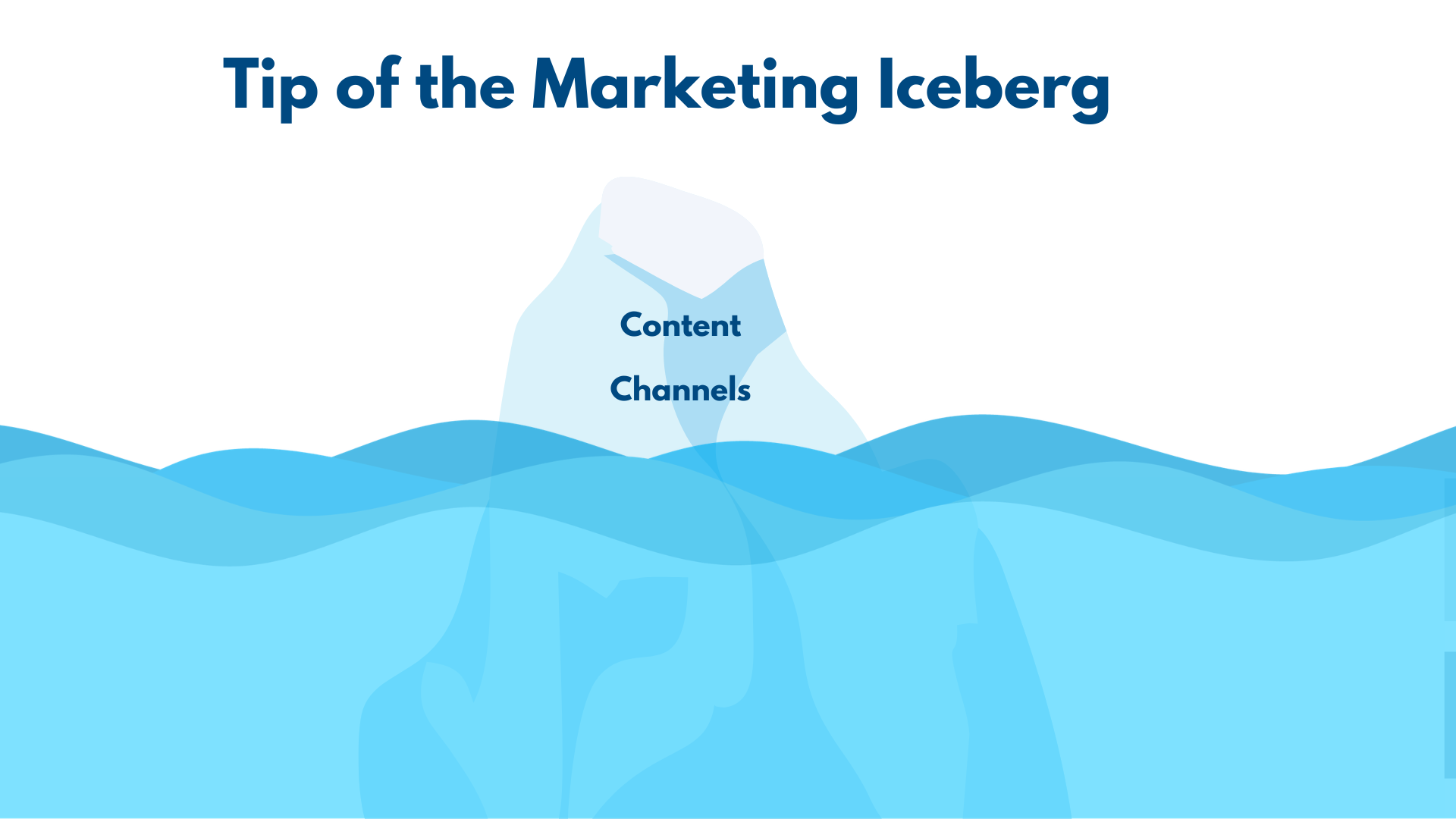
Marketing strategy is like an iceberg
The tip of the iceberg is everything we can see in market—all the content and the distribution channels for that content, such as Google ads, a brand logo, social media content, in-store signage, sales presentations, website content, Amazon images—the list goes on.
It’s common to assume that the tip of the iceberg represents the entire marketing strategy. But if we jump straight to the content, we rely on one thing to determine the plan: gut instinct.
Instead of basing our plan on a hunch or by copying what everyone else is doing, there’s a more strategic approach.
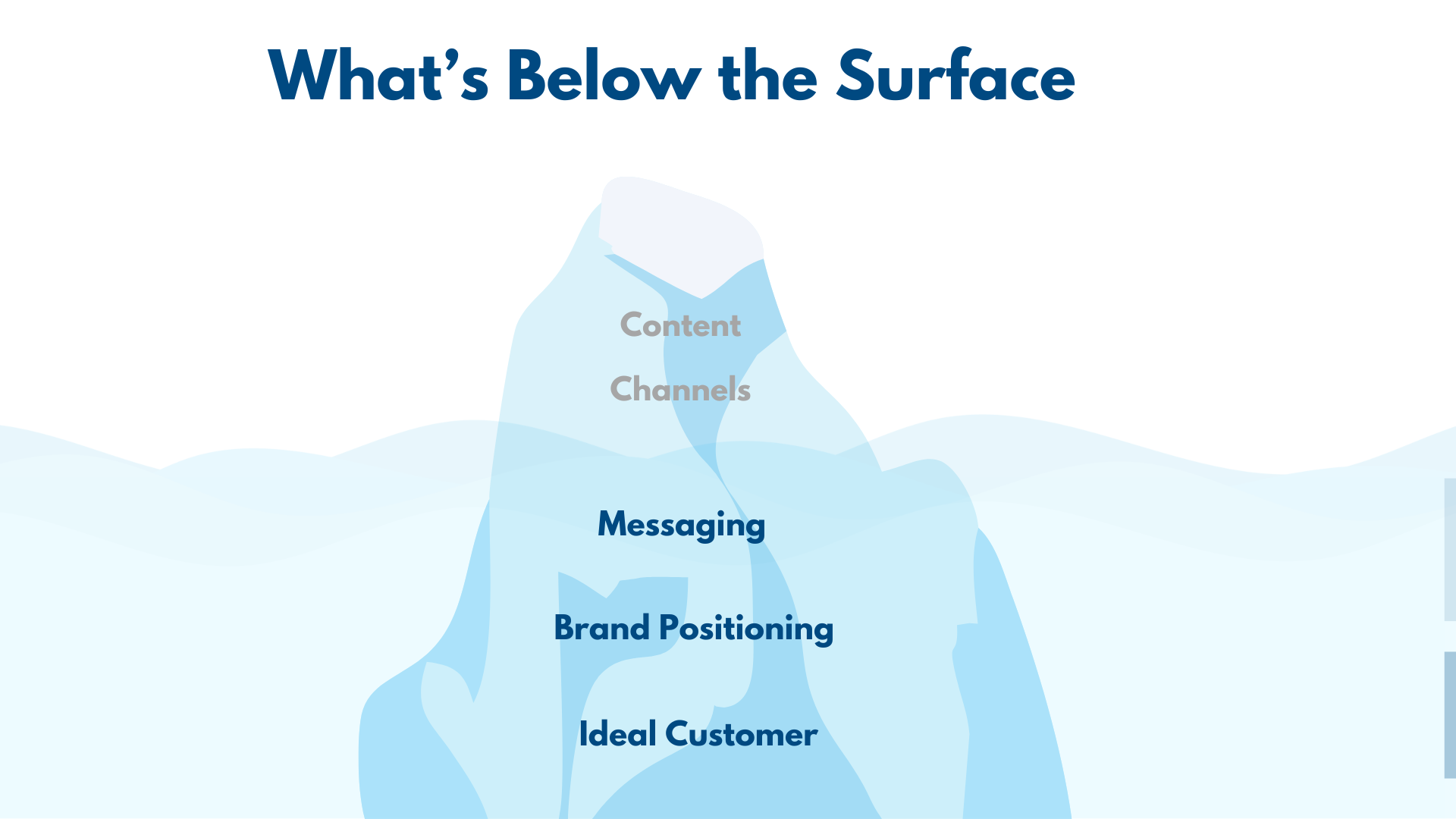
Below the surface of any strong marketing execution is a clear, focused strategy tied to growth objectives. This includes:
Ideal Customer: A clearly defined target audience (or limited set of audiences)
Brand Positioning and Messaging: A defined territory (positioning) your brand occupies in your customer's mind, and ultimately in the market as a whole. This positioning is translated into a specific idea or set of messages that communicates the value your product or service delivers to the customer
Once these elements are clear, we can build a tactical plan on top of them.
We can use these layers to create a simple three-part framework I call the Who—What—Where Marketing Strategy.
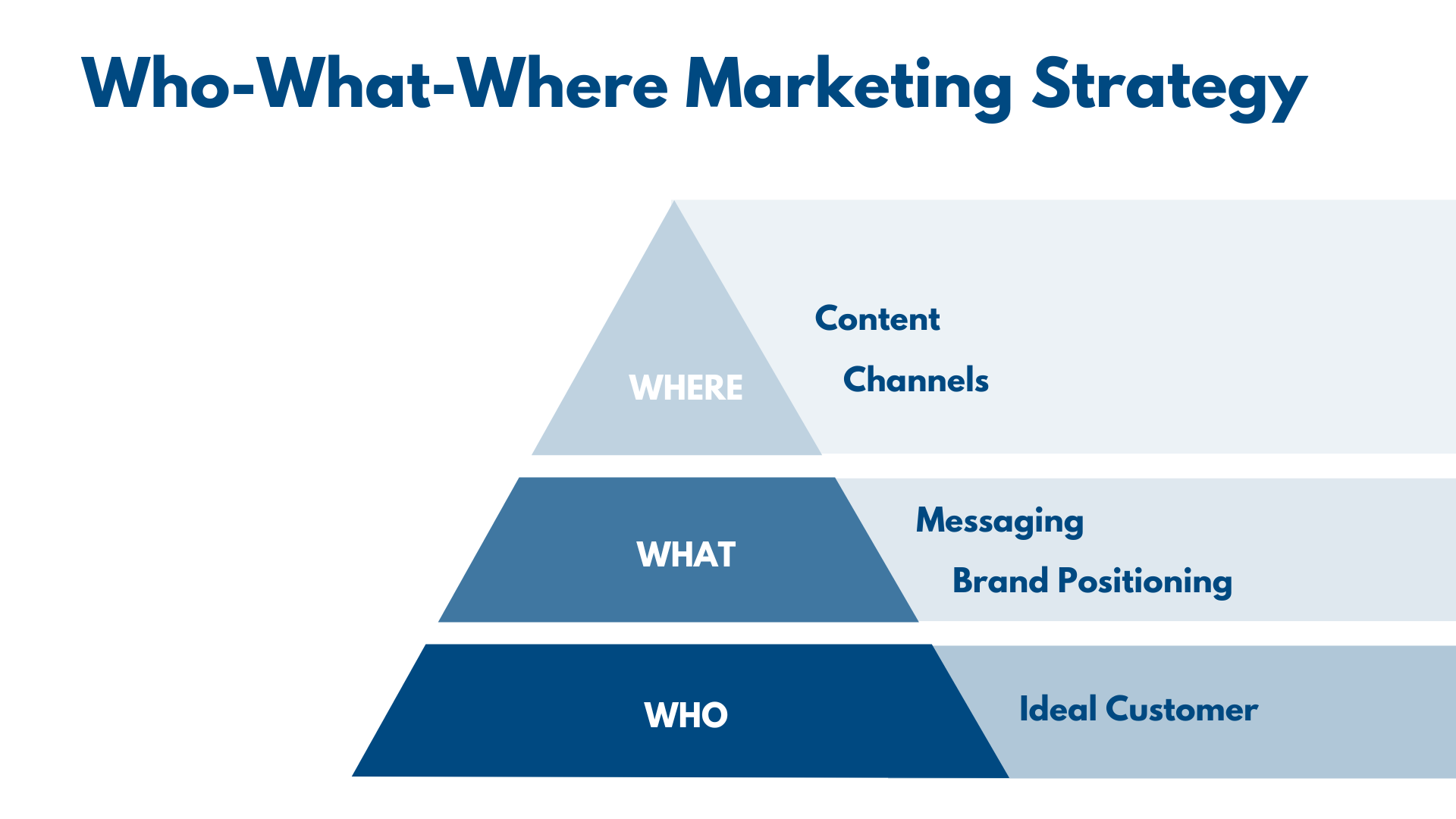
WHO: Your Ideal Customer
There’s nothing new about the idea that all marketing starts with the customer, but it’s almost too easy to slip away from this principle in practice. Even the most seasoned practitioners focus almost exclusively on telling a compelling story about what they do and why it’s better. In essence, they jump to the WHAT before grounding (or re-grounding) themselves in the WHO.
We need to begin with a clearly defined audience. This is not anyone who might use your product—it represents your ideal customer. Specifying the industry, category, and demographics is insufficient—that is, it’s not enough to know who our customer is. We need to know how and why they behave and think. We need to know their preferences, habits, perceptions of our competitors, and us. We need to know how our solution fits into their lives and how we create value for them. We need to know who influences them and where to reach them when they’re receptive to our message.
Without a clear picture of these things, we’re simply guessing which messages will resonate and what vehicles and channels we should use to build awareness. Many companies have a general sense of their audience but lack specifics. A generic WHO results in:
Messaging that is broad or irrelevant
Unnecessarily high costs to reach our customers due to crowded channels and a lack of creativity
Fewer qualified leads and lower conversion across every stage of the sales and buying process
Innovation that doesn’t solve real customer problems
Defining your WHO requires not just looking at quantitative data but regularly talking to the customer and asking foundational questions to help you understand their category behavior, how they perceive your products and services, and what influences them. And it means picking a small subset to focus on within the total group of customers you could serve.
WHAT: Brand Positioning and Messaging
The second layer of the marketing strategy outlines what you offer your customer. It’s a combination of how you strategically frame your solution within the wider market of offerings (positioning) and how you consistently communicate your value across different channels, environments, and tactics (messaging).
The most common issues I see that result from the absence of clear brand positioning and messaging are:
Lack of differentiation within the market because you sound the same as all of your competitors
Communicating too many benefits or products, which results in customers being confused about what you do and what value it creates for them
Inconsistency of messaging across different products, channels, and content
Positioning is hard. It forces really tough decisions about the core benefits you want to stand for. You can’t be or say everything, so this part of the process is about whittling away any extraneous elements that distract your customer and water down your message when you cater to everyone.
Say you have a tech software. You product might be easy to use, the only one that’s designed for individuals vs. companies, makes your customer more efficient, compatible with windows and iOS and protects your customer’s data. These are too many things to communicate everywhere. You can only pick one or two as your core differentiators.
Focus, and in particular focus over time, wins.
For more on positioning, check out my 3-part series on how to create a strong positioning.
WHERE: Content and Channels
Only after we have a deep understanding of our customers’ needs, preferences, habits, and perceptions, and we have identified a narrow, differentiated positioning that offers real value, can we then begin the process of creating a plan to reach our ideal customer. It’s here that we identify the relevant channels to reach our customers and the creative execution that brings those touchpoints to life.
After going through the WHO and WHAT exercises, many of my clients realize that what they thought was a top-priority marketing tactic is actually not the highest-leverage opportunity.
What are the benefits of a clearly defined marketing strategy?
One of the most common struggles leaders have with their marketing strategy is a lack of clarity and confidence. They don’t know if they’re doing the right things or if those things are working.
Defining all three layers of the marketing strategy will generate a level of clarity that massively reduces downstream friction.
It’s critical to link your overall business objectives to this entire strategy. Understanding how your marketing supports your business goals enables you to focus on the markets, customers, messages, and tactics that will best enable growth. The business goals are like the water that surrounds and influences the strategy.
By spending time below the surface, you can expect:
More efficient use of the budget and resources
Higher-quality execution from partners resulting from clearer expectations and fewer revisions
More consistent branding and messaging, which results in familiarity and trust
Clarity on what you’re measuring and what’s working
Hypothethical Example: An Apparel Brand
Let’s say you’re a $20 million sustainable fashion brand that sells mostly online through your website. You think you need help with Instagram ads because all of your competitors are doing them. Below is your current strategy, which may or may not be explicitly documented yet.

Like most companies, you have an idea of who your target customer is. But right now, your WHO, WHAT, and WHERE are too broad and could be interchangeable with dozens of competitors. Let’s provide more detail to identify opportunities in strategy.
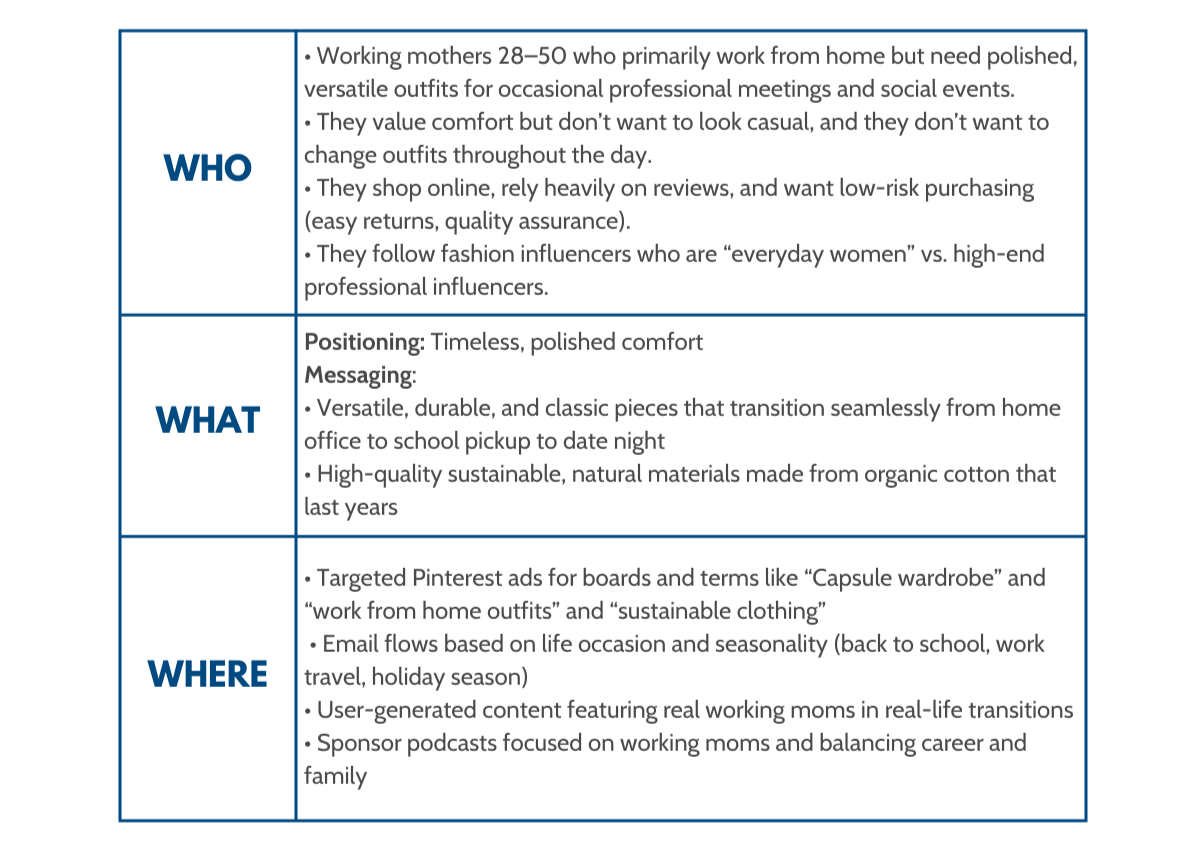
Your WHO now uncovers unique insights for a particular segment of your audience. People sometimes worry their audience is too narrow, but I find that fear is often unjustified. Many times, appealing to a narrower audience has relevant spillover to a broader audience. (The same goes for B2B companies who can often serve multiple industries. Choosing a specific industry to build depth and expertise can be an effective approach to grow market share, and other industries can be sequentially added later.)
Your WHAT now builds on your new ideal customer insights. Among all potential benefits, you hone the one or two that become the focus of all brand communications (in this example: “Polished Comfort.” It doesn’t just inspire messaging; it influences the entire product portfolio.
With your WHO and WHAT clearly defined, your WHERE almost writes itself. How to reach your customer and what will influence him or her is both more obvious and lays a solid foundation on which to be truly creative an innovative.
Each of these stages requires hard choices about what you’re going to pursue vs. what you’re not. Clearly defining your WHO and WHAT gets you more than good marketing: You get a system that focuses your effort, accelerates decision making, and ties activity to measurable outcomes. As a result, you build a growth engine that transforms scattered tactics into a foundational marketing strategy that fuels your brand goals.

How to Earn Attention: Invitation vs. Interruption
A few years ago, Red Bull came to Cincinnati for its Flugtag event. Teams designed and constructed contraptions that launched off a 30-foot platform over water, aspiring to remain airborne as long as possible.

A few years ago, Red Bull came to Cincinnati for its Flugtag event. Teams designed and constructed contraptions that launched off a 30-foot platform over water, aspiring to remain airborne as long as possible. The creativity of themes, costumes, and aerodynamic construction made for a highly entertaining event, which debuted in 1992 and has been held in over 50 countries.
My family was mesmerized by the spectacle, anticipating which teams would plummet into the water and which would sail 30-plus meters into the air before landing. When we returned home, each of my kids set to work designing their own winged concept. The photo above is my son’s idea for a sponsored craft by “Mosquito Joe,” a local mosquito service. Inspired by all things Red Bull, we proceeded to watch a series of captivating extreme-sports videos on YouTube sponsored by the brand. I knew we were being marketed to, but I didn’t care. In fact, I loved it.
The name Flugtag means “Flying Day” in German, and the event is fabulously on brand. Red Bull’s tagline, “Red Bull Gives You Wings,” was coined just a few years after the company’s founding in 1978 and embodies the brand’s high-energy, high-octane ethos.
This event is a perfect example of what I call invitation marketing—a concept that focuses on inviting your customer into a relationship based on curiosity, value, permission, and respect.
What works about invitation marketing is that it perpetuates the Growth Flywheel, a framework that treats customer acquisition as part of a continuous cycle. When we turn the flywheel by creating content, experiences, and communication that delight our audience, we create positive momentum.
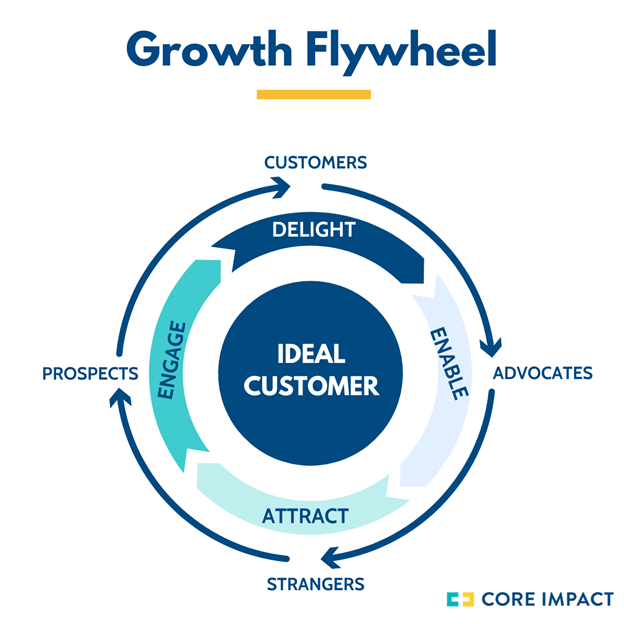
The alternative framework to the growth flywheel is the marketing funnel, which visualizes the customer journey as an inverted triangle. At the top is awareness, the widest part of the triangle, followed by consideration, and the tip of the triangle represents the few that purchase. By treating awareness as the first step in a vacuum, the funnel leads us down this common path:
How do we make people aware of us?
↓
We get their attention.
How do we get their attention?
↓
We interrupt them.
The Cost of Interruption Marketing
When we constantly interrupt people to deliver our message, attention comes before value. Interruption marketing is based on the philosophy that attention can be taken, rather than earned; it’s right, not a privilege. The best way to tell our customers what we offer, according to this approach, is by diverting their attention from something else. The goal is to break routines. We place ads in the middle of magazine articles. We run commercials in the middle of TV shows. We construct billboards to disrupt drives to work.
These tactics aren’t inherently bad, but it’s the branding equivalent of screaming “PAY ATTENTION TO ME!!!” when trying to build a friendship. It’s no surprise that interruption marketing annoys people. That’s why we use ad-blockers, pay for subscriptions that avoid ads, and click “skip ad” as soon as possible.
But we don’t need to depend on interrupting to gain attention. There are countless approaches to attract interest. When I help companies create a marketing plan, they often jump to traditional channels and tactics that push the company’s message to potential buyers – namely, ads. When this happens, I shift the conversation to focus on how to create value through the marketing itself, something that delights, evokes curiosity, and is inherently shareable. Ads can serve as a secondary, supplemental approach built around an invitation strategy.
How to Execute Invitation Marketing
Invitation marketing invites customers into a relationship by putting value ahead of attention. Here are some of my favorite approaches to do just that:
Be Fun: For my first “business” job, I worked in a beer company’s marketing department. Our primary marketing strategy was holding seasonal events where the beer taps flowed nonstop: Oktoberfest, running and biking events, and BBQ competitions. The customers so enjoyed the craft beer and the experiences that they loudly professed their appreciation (perhaps due to intoxication). Competitions, events, and mysterious storylines (e.g. Duolingo’s owl dying) that inject fun into our customers’ lives create memorable, shareable associations for your brand.
Educate: Our customers are constantly seeking information, and content that solves their problem or satisfies their curiosity attracts attention. Content marketing is not a new strategy, but we must constantly remind ourselves that we are serving our customers. It can’t be a one-time transactional exchange of an email address for a webinar or a download. The goal isn’t to obtain permission to contact an individual; it’s to consistently deliver real value that builds a long-term relationship.
Give It Away: This applies to products, services, and expertise. When someone tries your product for free, whether it’s a store sample, a trial of your software, or free expertise, you’re giving them a solution. Yes, we ultimately need to convert unpaid customers into paying customers, but often the desire for short-term profit overshadows opportunities to let potential customers experience our value firsthand, which can be the most effective tool for generating sales. Value first, sale second.
Use Humor: When certain ads come on during football games, my kids jump off the couch and recite them word-for-word because they’re funny. While these are clearly ads, they feel less like interruptions and more like stimulants. We know we’re watching an ad, and my kids are too young to buy whatever it’s selling, but the humor engages us, turning an annoying disruption into an enjoyable experience. Of course, strategy is key. The humor must also communicate the brand’s message, but entertainment can overshadow irritation.
Show Respect: It’s important to ask our customers for permission to subscribe, join an event, or offer value rather than assuming we have the right to email them or sign them up. Honor your customers’ time. Be mindful of tone. Show humility. In particular, if we are interrupting someone through an ad or have no existing relationship (cold email), acknowledging that our tactic interrupts our customer shows we care about them.
Borrow Trust: While I try to avoid most ads, I do listen to the ads from my favorite podcasters. Why? I know these individuals have used the products they promote and are personally vouching for their quality. Because I trust their opinion and am genuinely curious which brands they prefer, I have purchased a number of the products they promote. We can earn attention by earning the trust of someone our customers trust.
Sometimes we need to interrupt to invite. Sometimes we will be irrelevant to people who hear our message. But if we begin to prioritize invitation over interruption, we’ll more effectively get customers to engage in our message and to experience the benefit of our products and services. If we earn their attention, rather than seize it, we’ve taken the more sustainable path to building a business.
How to Win in 2026: Intentional Experimentation
As we enter 2026, we face two somewhat opposing dynamics. On the one hand, there is massive uncertainty – tariffs, political polarization, economic volatility. On the other hand, we have massive opportunity.
As we enter 2026, we face two somewhat opposing dynamics. On the one hand, there is massive uncertainty – tariffs, political polarization, economic volatility. On the other hand, we have massive opportunity. Generative AI can enable us to learn faster and produce more than ever before. But what worked in the past may not work in the future.
With these underlying forces in mind, I recommend making 2026 a year of intentional experimentation.
Let me offer the metaphor of GPS. Many companies have long-term growth goals. Let’s call this the destination. We know the address. What we don’t know is the best route. There are endless routes to that destination: scenic back roads, the highway, state roads.
In times of less uncertainty, we might have done a multi-year strategic planning exercise to determine a route at the outset of our journey and stayed the course. Today, the pace of change makes that course unwise. Instead, we need to check our GPS regularly to reevaluate. The GPS is our experimentation plan. It’s our regular check-in to ensure that there isn’t any new traffic, speed checks, construction, or detours. We need to keep checking our GPS, not because we’re lost, but because the road conditions keep changing.
Why Most Growth Plans Fail
The path to growth is never certain, but we can increase our chances of success. While working with companies to build growth strategies, I’ve noticed that the identified sources of growth are often not grounded in data: they are hypotheses based on gut or anecdotal evidence. I see two common approaches that result in suboptimal growth.
Buckshot approach: Chasing everything because it seems like a good idea results in:
Fragmented resources
Overwhelm and burnout among teams
Lack of quality or depth
The buckshot approach is never really picking a route. It’s constantly switching lanes, getting on and off the highway at the first sign of traffic, and winding through backroads from memory—never sticking with a route long enough to see whether it will get you there fastest.
Early overcommitment: Determining the route before the signals are clear:
Creating a multi-year plan without room for change and modification
Overinvesting in people, technology, and equipment before there’s a clear indication of success
Overreliance on gut vs. data
Lack of team buy-in and confidence, leading to constant questioning
The early overcommitment approach is like picking one route on a paper map and never checking your GPS to see when you’ll arrive, whether the roads are still there, or if there’s a faster way.
Whether you’re a new business or an established business trying new things, you don’t know what’s going to work, and yet you can’t do everything. Intentional experimentation resolves this tension and maximizes your chances of success.
5 Steps of the Experimentation Process
Experiments help us ensure we’re on the fastest route.
This approach builds on the scientific method, which has been frequently used by business teams, especially in tech start-ups. I have modified these steps from frameworks such as The Lean Startup Method by Eric Ries.
This method can be applied to any growth opportunity at any stage of development and any size of impact. The key is to identify metrics that give us confidence we will have in-market success, and to design an experiment to gather those indicators.
In each of these steps, I have included several examples relevant to growth and marketing, but this experimentation framework can be applied to any new approach.
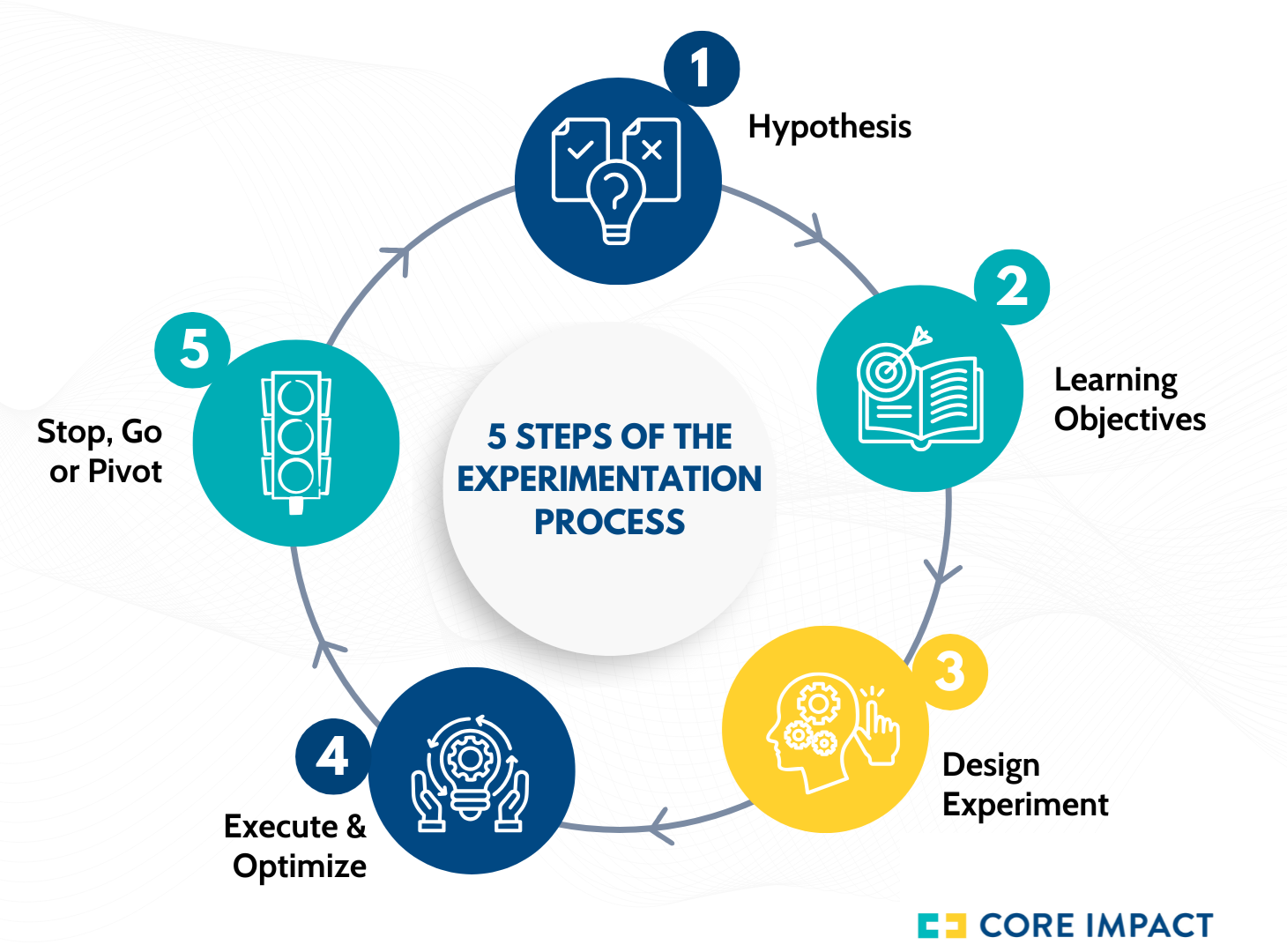
1) State your hypotheses
Do this by answering these questions: What do you think is going to happen? What bet are you making with this approach? We act because we think it will deliver results, but we don’t always specify our expectations. For example:
We think launching this product will help us acquire lapsed category buyers.
We think this marketing channel will make us more top-of-mind among our ideal customers.
We believe using AI to generate creative will increase the quantity of our creative by 25% and maintain the current quality.
We think targeting this market segment will increase sales by 10%
2) Define learning objectives and leading indicators
Your hypothesis states the ultimate outcome you want to achieve. Translating your hypothesis into a set of learning objectives and corresponding leading indicators can help you determine where to invest more resources. Leading indicators aren’t vanity metrics. Rather, they give you early confidence that your approach is effective. For example:
Do we have market interest?
Indicators: Qualitative feedback showing interest in buying a product or service in a new market
Does our message resonate?
Indicators: Repeat visits to your website; increased customers using your language in reviews and comments
Does this product delight our customers?
Indicators: Frequency of use, interest in repeat purchase, organic word of mouth
Does this approach increase conversion?
Indicators: Increased website conversions; increased rate of prospects converting to a second meeting
3) Design an experiment
Designing an experiment helps you decide whether or not to pursue a growth opportunity. Design the experiment to give you the leading indicator data. The scope must also be clear because, as you optimize, it’s helpful to know what modifications are in vs. out of scope. You don’t always need to have robust metrics and tracking systems. Here are a few examples with varying levels of rigor:
Interviews: Seek in-depth responses from 10 people to test a specific assumption
Test Market: Launch in one constrained environment—one geography, customer segment, or retailer—to understand market interest, messaging or pricing
Pilot Project: Run a project with a few customers to evaluate feasibility, systems, cost, and delivery capability
Message Assessment: Create a single message (e.g., one landing page, an email, or a sales deck) to test message resonance
Channel Sprint: Execute a specific and repeated set of activities in a limited timeframe to evaluate channel fit
4) Execute and optimize
I prefer to run experiments with frequent analytics and optimizations. Learn as you go, adapt quickly. If you get poor results, do something different that helps you answer your primary learning objective. For example:
Change the message
Talk to a different prospect
Try a different channel
5) Stop, go, or pivot
When an idea is a homerun, the decision to move forward is obvious. What’s more difficult is when the picture is less clear. Pursuing a path with mixed results is a recipe for mediocracy. Sunk cost fallacy is a major barrier to progress. Having the courage to stop doing one thing in search of another can unlock focus and growth within the team. Ask questions to determine whether or not it’s time to move forward. For example:
Did I gather all the data I need?
Did we achieve our success criteria?
Does the team still think there’s potential even though the results are bad?
When to use this framework
This plan only works if it’s integrated into your business’s operating rhythm. Even when using GPS, if we don’t have the volume on, we often miss a critical turn. Similarly, we need to build reliable systems that force us to experiment.
Integrate this framework into your annual planning. Identify your hypotheses—the strategies or investments that are more of a guess than a market-informed approach. Then, experiment. Document. Prioritize. Test your ideas sequentially, not simultaneously. If you have quarterly or monthly strategic planning reviews, consider adding experiments as a regular topic.
The leaders who will thrive this year won’t be the ones who lock into a rigid plan, nor the ones who chase everything at once. They will be the ones who do less but learn more.

Real Scarcity: How to Turn Constraints Into Customer Value (Part 2)
My husband is on my email list, and to his credit, he reads every one of my articles. He replied to last month’s email with the following: “Great article. Did you mean to offer only five spots in an article about scarcity?”

This image was generated using AI
This is the second part of a 2-part series on scarcity. To read the prior article, visit: Part 1: Real vs. Artificial Scarcity: How to Build Urgency Without Breaking Trust
My husband is on my email list, and to his credit, he reads every one of my articles. He replied to last month’s email (part 1 of this article series) with the following: “Great article. Did you mean to offer only five spots in an article about scarcity?”
He was referring to the announcements section of my newsletter, where I mentioned that I had five spots available for a 2026 marketing plan audit. I froze for a moment, wondering if I had fallen prey to the exact thing I argued against in my article.
But a second later, I remembered my method, one I had triple checked on account of the topic. I had assessed my current capacity, the time required for each marketing plan audit, and how many I could accommodate over the next three months. I could have kept the announcement general, but I thought my audience would be better served by sharing my actual limited availability.
And that’s what today’s article is about. How do we leverage scarcity to effectively generate interest in our products and services in a way that serves our customers?
In my last article, we looked at the history of scarcity in marketing (a tactic that’s still pervasive today) and the differences between artificial and real scarcity. I define artificial scarcity as:
The use of arbitrary or manufactured limitations that are not based on any real constraint and are explicitly designed to generate urgency to incentivize purchase.
When we do this, our customers distrust us, and we erode our brand. Plus, a dependence on artificial scarcity can mask more fundamental strategy weaknesses, such as a lack of customer understanding, misaligned product-market fit, or unclear messaging.
Here’s how to utilize real scarcity ethically and effectively.
How Scarcity Can Help Your Customers
The scarcity principle is not inherently bad. Just recently, a friend trained for an entire marathon, only to find it had sold out by the time he tried to register. He would have appreciated knowing the race’s capacity and how close it was to selling out.
First, scarcity can be a valuable communication tool to help customers make mental shortcuts and simplify decision-making. When something is scarce, we assume it has higher value. We pay attention, we prioritize, and our brain makes decisions more efficiently.
Secondly, we as humans habituate to things. That is, after repeated exposure to a stimulus, we get used to it, and it has less impact or benefit. Snapping us out of this habituation has the potential to enhance our customers’ experience.
The fundamental principle is that scarcity must be real. And communicating scarcity must serve your customers’ interests as much as it serves the company’s interests.
Here are a few ways to apply the scarcity principle to create value for your customers.
1) Identify real constraints
Every business has constraints, and examples of them appear in all five approaches. Constraints may include supply, capacity, physical space, timing, or other factors. Identify which of your company’s constraints are relevant to your customers and clearly communicate them.
Here's an example from a local restaurant that sells homemade sourdough bread. You can pre-order the bread or pick up a loaf while supplies last. The weekly pick-up window is limited: Saturdays 11 a.m. to 1 p.m. These constraints, including which loaves are sold out, are clearly communicated across their website and social media channels.

2) Use transparent, accurate communication
We must tell the truth. Knowing an item or experience is limited can valuably inform a customer’s decision – if it’s real data. In part 1, I shared an example of a Shopify plugin that allowed “generated data” (i.e., fake data) for inventory levels.
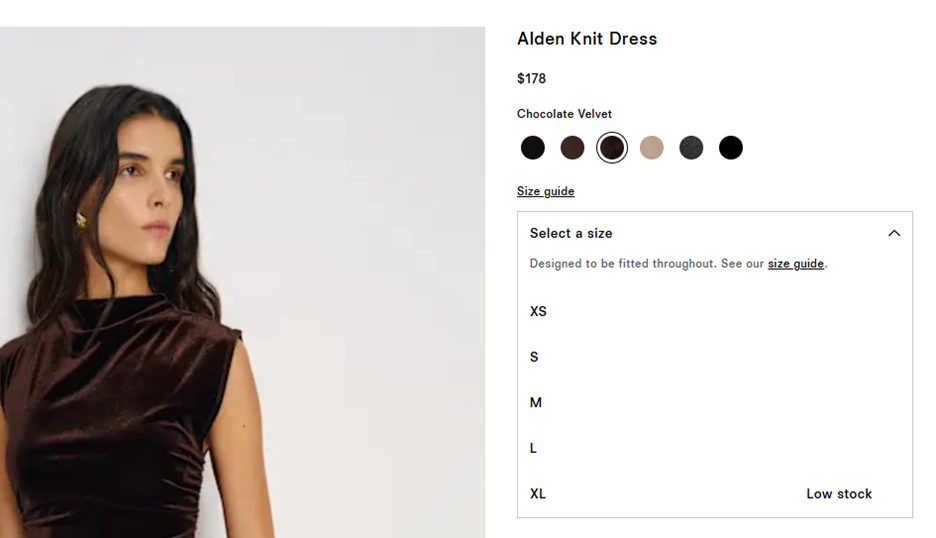
Comparatively, ethical fashion brand Reformation includes inventory data by size. Note the “Low stock” mentioned for size XL below; it is helpful but not overtly pressuring. While we can’t know for sure this is real data, the method of communication seems more focused on transparency than on generating urgency. While not lying can seem obvious, it’s easy to exaggerate or invent a seemingly harmless statement like “limited capacity” when no such limitation exists.
3) Rotate novelty
Customers appreciate new and limited offerings. Seasonality, flavor, style, and location are all legitimate reasons that a customer might want to buy a product or service. Two things to be conscious of: the environmental or other negative impacts introducing a new item may have, and the use of scarcity for scarcity’s sake. That said, there can still be opportunities to introduce newness to enhance customer enjoyment.
Here are examples of extremely popular pumpkin offerings that are only available from Starbucks each fall. Not only is pumpkin a classic fall flavor, but its limited availability creates both anticipation and greater appreciation.

4) Use natural deadlines
Our calendar creates myriad opportunities to tap into natural deadlines such as holidays, annual milestones, and seasons. For example:
• Order your costume by X to arrive for Halloween.
• Complete your taxes by April 15 to avoid late penalties.
• Get your hats, gloves, and ice scraper before the first frost.
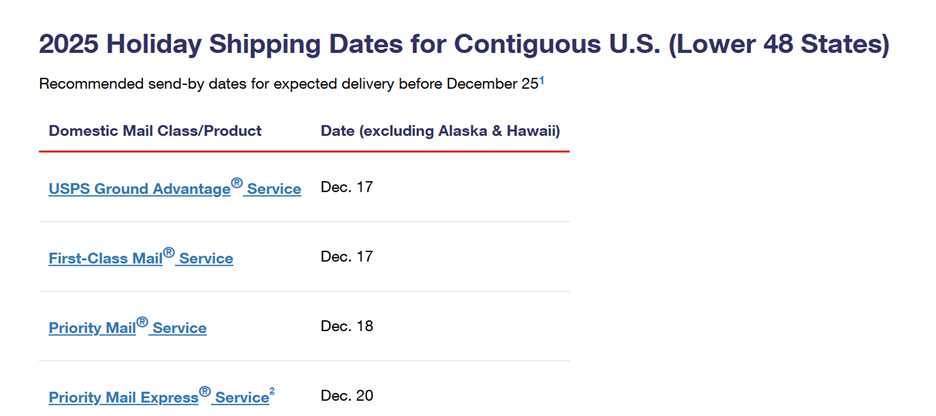
I recently received a postcard from the U.S. Postal Service with the following shipping deadlines, which immediately reminded me to complete my gift buying to avoid the year-end post office frenzy. Companies can tap into the natural deadlines associated with their industry or services to inspire prompt action.
5) Explain the rationale
When we provide context for a deadline or limit, we help our customers understand what’s driving the constraint. In turn, we may generate more goodwill than an artificial deadline with no reason. For example:
• We only have 150 Summer CSA shares available due to farmland availability.
• Early bird pricing ends October 1! Buying your ticket early helps us secure the top speakers.
• We only take five clients at a time to ensure excellent quality of service.
• Each class is limited to 20 participants to ensure maximum attention to each attendee.
I recently received a promotional email for an event capped at 100 people. The organizers explained the rationale for the attendance limitation in a way that makes the offer even more appealing. An explanation doesn’t have to be an excuse or a justification—it can reinforce value.

Reclaiming scarcity requires a mindset shift, one from selling to serving. We can do this by educating customers about our constraints so that they can make more informed decisions and by enhancing their experiences through novel and limited offerings. When we pair real constraints with transparent communication, we earn our customers’ trust and their business.

Real vs. Artificial Scarcity: How to Build Urgency Without Breaking Trust
When vacationing a few years ago, I walked past a gallery, and a huge sign in the window declared it was going out of business and all art was “80% off.” I was delighted to discover this great value and bought a few paintings at a huge discount.

This image was generated using AI
When vacationing a few years ago, I walked past a gallery, and a massive sign in the window declared it was going out of business and all art was “80% off.” I was delighted to discover this great value and bought a few paintings at a considerable discount.
The following year, I passed the same gallery with the same sign. What? I thought. They already went out of business. I took a closer look at the sign. It said: “Going out FOR Business.” I had been duped. All the art was permanently on sale when I thought it was a limited-time offer. These were lower-quality paintings worth the low price I paid.
This gallery employed the common approach of manufacturing scarcity to create a sense of urgency, in this instance, through the illusion of a massive one-time sale.
Intent matters. If our only goal is to make a sale, it’s easy to default to scarcity. If, however, our goal is to satisfy our customers and help them make an informed choice that adds value to their lives and builds a trusting, long-term relationship, we will re-examine whether and how we create scarcity in our business and focus on real constraints when they truly exist.
In part one of this series, we’ll look at the history of scarcity in marketing and the difference between artificial and real scarcity. I’ll also help you evaluate if scarcity tactics are masking structural or strategic business gaps.
In part two of this series, we’ll look at how to utilize real scarcity ethically and successfully, with specific case studies to inspire you.
The History of Scarcity
Scarcity is a psychological trigger rooted in the economic principle of supply and demand. When supply is scarce, demand goes up, which drives prices up. When we feel an item is limited, especially when others want it too, our desire for that item increases.
A study published in the Journal of Personality and Social Psychology in 1975 tested the concept of scarcity by having participants rate the attractiveness and value of two jars of cookies, one containing 10 cookies (an abundant supply) and the other containing two (a scarce supply). The results indicated that cookies in short supply were rated as more desirable than those in abundant supply.
The concept of scarcity as a tool for influencing behavior was popularized by Robert Cialdini in his groundbreaking book, Influence: The Psychology of Persuasion, first published in 1984. Cialdini identified scarcity as one of six mental shortcuts that drive behavior. In his book, he writes, “Opportunities seem more valuable to us when their availability is limited.” When we perceive scarcity, we are motivated to act, and in the context of marketing, to make a purchase.
Over time, marketers embraced and leveraged this behavioral phenomenon to their advantage. In the 1990s, the internet took off, more products and services were sold online, and this tactic became ubiquitous. Creating a perception of scarcity to induce a sense of urgency became an objective, regardless of whether real constraints actually existed.

Today, scarcity tools are commonplace. Website builders and plugins offer pre-built templates that include countdown timers and inventory displays, which aren’t necessarily linked to real data.
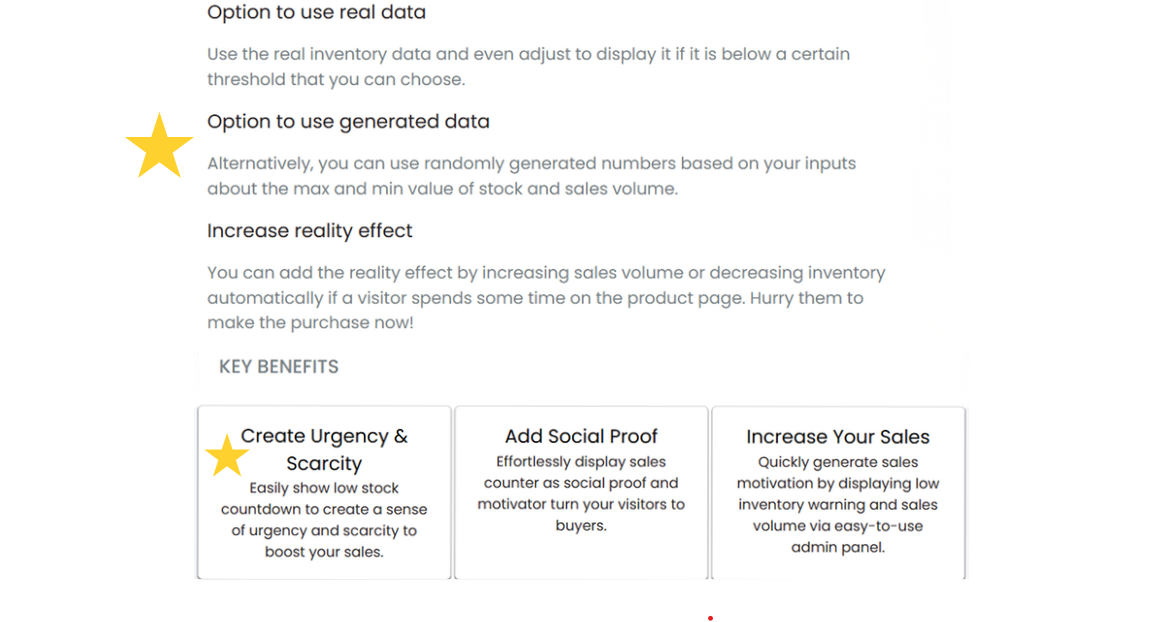
Consider the Shopify plugin “Hey!” that lets companies use either real data or “generated data” based on “randomly generated numbers” to populate inventory numbers. This means a customer may see only two left in stock, even if that’s not true.

Real vs. Artificial Scarcity
When companies sense a lull in sales or hesitation from their buyers, they are often told the solution is to create urgency. Indeed, helping a customer overcome indecision inertia can serve their best interest. However, when companies manufacture urgency through the use of inaccurate information, manipulation, arbitrary deadlines, or artificial limitations, they create an artificial scarcity that deceives customers.
Here are a few examples that illustrate the difference between real and artificial scarcity:
Real Scarcity:
Production or supply constraints – When there is an actual limit on the volume that can be sourced or produced. For example: Wine from a specific year’s harvest, or an artist’s paintings who only paints a limited amount each year.
Seasonal or time-bound Availability – These are tied to natural changes in seasons, holidays, or annual rhythms and have cyclical availability. For example, Oktoberfest beer, annual tax preparation services, or poinsettias, which are only available or relevant during a particular time of the year.
Physical space or capacity limitations – These limit the number of people who can access the offering, such as concert tickets, hotel rooms, or restaurant reservations.
Lifecycle transitions or discontinuation – One-time events that are not available again (e.g., retiring an American Girl Doll collection, end of season clearance for items that were overproduced)
Artificial Scarcity:
Countdown timers that automatically rest, inventory claims or customer shopping behavior such as “someone else is interested in this item!” that are not tied to real data
Perpetual sales cycles with similar deals that reset at a regular frequency or a permanent sale such as “80% Off - Going out for Business” as in my gallery example
Arbitrary deadlines with no real reason, e.g., “Loyalty points expire in 1 month”
Manufactured exclusivity, such as “Limited Time offer” or “Only 50 spots available,” when there isn’t any real limit
The Business Case Against Artificial Scarcity
While egregious examples of using fake data may seem an obvious no-no, for more innocuous examples, using artificial scarcity tactics can be tempting. It can lead to short-term sales. Multiple brands have claimed that using countdown timers has doubled or even tripled their sales. But there can be long-term consequences. Using artificial scarcity can:
Erode trust: If you automatically reset timers or your inventory data isn’t real, you break trust and may lose customers.
Delay buying: Customers can become accustomed to perpetual sales and may distrust your pricing or wait for a better sale in the future.
Attract bargain hunters: You want lifetime customers who value your core offering, not one-time buyers seeking a deal.
Buying regret and higher return rates: When customers feel pressured, they may experience buyer’s remorse, leading to more returns and sometimes, negative reviews.
It's also important to note that customers are more savvy than you think. Studies have shown that customers who are familiar with scarcity tactics are less susceptible to their influence.
How To Know If Urgency is the Real Problem
If you find yourself manufacturing urgency and depending on artificial scarcity as a core business tactic, you might have a bigger problem. Take some time to reevaluate whether your core value proposition or messaging are strong enough. Specific questions to reflect on include:
Does my core product/service fulfill a real need for my customer?
Is my messaging compelling? Does it generate interest and action?
Am I targeting the right customers who have the budget, authority, and desire to make this buying decision?
Fundamentally, an excessive reliance on scarcity tactics may indicate that you’re brand foundation isn’t strong. Either you may not be delivering enough value, or you may not be communicating it properly to build trust and encourage sales among the right customers.
As consumers, be wary of the myriad artificial scarcity tactics that are luring you into a sale, especially as the holiday season approaches. The more informed the buyer, the less power these tactics hold.
Stay tuned for part two of this series, where we’ll look at ways to incorporate real scarcity into your business strategy effectively.

What I Didn’t Expect About Getting B Corp Certified
Last month, Core Impact became a B Corp-certified company. Joining the ranks of Patagonia, Athleta, Allbirds, and Ben & Jerry’s, it was an honor to be recognized as a business with “high social and environmental standards.”

This image was created using AI.
Last month, Core Impact became a B Corp-certified company. Joining the ranks of Patagonia, Athleta, Allbirds, and Ben & Jerry’s, it was an honor to be recognized as a business with “high social and environmental standards.” What surprised me is that the process revealed something I’m now convinced every purpose-driven leader needs.
I thought the main value would be the external validation – proving to clients and prospects that I practice what I preach. The certification turned out to be the accountability and the challenge I didn’t know was missing. B Corp is not a one-time achievement. Rather, it’s pushing me to live my values continuously.
What is B Corp Certification?
Orchestrated by the global nonprofit B Lab, B Corp is a certification standard that evaluates a company’s environmental and social performance. Over 10,000 businesses in 100+ countries are B Corp certified (out of over 300 million businesses worldwide). Certification requires taking the B Impact Assessment (BIA) and providing proof of your responses. The review process can take up to a year, and potentially longer for larger, more complex organizations.
Core Impact’s assessment included five impact topics: Environment, Customers, Workers, Community, and Governance. New B Lab standards were released in 2025, which now require companies to hit mandatory minimums in specific topics, with additional emphasis on climate action.

Why I Became B Corp Certified
I’ve always wanted Core Impact to become a B Corp, but I knew it would require a significant amount of time and financial investment. Ultimately, I took the plunge to:
Live My Values: Many of my current or former clients are or were B Corps. As a company that serves purpose-driven businesses, I wanted to demonstrate my commitment to the mission.
Grow My Business: I wanted to meet and work with more purpose-driven businesses. Doing so diversifies my portfolio and invites new experiences with mission-focused companies that ultimately benefit all clients.
Learn the Process: I wanted to gain a deeper understanding of the assessment and point scoring system, so I could provide advice on whether the certification is right for businesses based on their strategy and priorities.
Evaluate Core Impact against the gold standard: As a competitive person, I wanted to see how my business stacked up. I wondered whether I had enough points to qualify and where there was room for additional opportunity.
What I Didn’t Expect
While navigating the certification process and after participating in the B Corp community, I discovered an uncomfortable truth: I had been operating in an eco-chamber of my own good intentions. I went in thinking I was doing as much as possible to incorporate impact into my business, but we are subjective judges of our own performance. Feeling good can be a warning sign. We often need someone else to move the goalpost a little bit further away. Here are some of the specific ways that B Corp exposed my blind spots:
Accountability:
As the saying goes, you get what you measure. Any official certification, especially one that requires renewal, demands a level of accountability that you’re unlikely to hold yourself to. The B Corp assessment forced me to track:
Clients’ and suppliers’ social and environmental impact
Core Impact’s water, energy, and waste impact (including business travel)
The ways I use my business to educate or advance social or environmental improvements
Volunteer hours
I know these things are important, but my efforts were ad hoc at best. I made most impact decisions in a vacuum or on the fly without a set of metrics to evaluate the business. As part of an effort to transparently communicate these metrics, I published my first impact report. Now, as I create strategies and develop plans, I factor impact into my decision-making process.
Unexpected Sustainability Progress:
I didn’t intend to enhance my sustainability profile, but as a result of going through the certification process, Core Impact is now carbon neutral (I partnered with We Are Neutral, which I highly recommend!) The assessment educated me on the climate impact of green banking, which I’m currently evaluating. It led me to formalize an Environmental Purchasing Policy, a Civic Engagement Policy, an Ethical Advertising Policy, and a Code of Ethics. Documenting my approach to these topics ensures a set standard that I will adhere to, even during stressful times or when these principles are challenged.
External Pressure:
I recently returned from my first B Corp community event, BLD Southeast. Being surrounded by this group challenged me to use my voice, skills, and relationships to do even more to advocate for doing business differently. I was inspired and provoked to be discontent with the status quo, to interpret comfort as a sign of complacency.
This has emboldened me to be more vocal about my belief that marketing can contribute to excessive consumption and materialism, and to rethink business models to create more value while minimizing environmental impact. Incorporating these topics into my writing, speaking, and strategic consultation will be a bigger priority in the years ahead.
B Corp might not be the right choice or even a possibility for your business. But as purpose-driven leaders, we need to surround ourselves with communities of like-minded individuals that challenge us and push us to go further than we would on our own. We need accountability—a system or set of individuals that forces us to follow through and measure our progress. If not B Corp, it could be Conscious Capitalism, Net Impact, 1% for the Planet, or any other mission-driven group that holds its members to a higher standard and pushes for accountability.

What I Learned On My Sabbatical
For three months, I didn’t check my work email. I never logged on to LinkedIn. I didn’t earn an income. I didn’t read the news. I took a sabbatical.

For three months, I didn’t check my work email. I never logged on to LinkedIn. I didn’t earn an income. I didn’t read the news.
I took a sabbatical.
My family packed up and travelled to Europe for 10 weeks to rest, explore, spend quality time together, and reset some of the norms and rhythms of daily life.
Sabbaticals are an extended time away from work, intended for personal and/or professional development. While most common in academia, more companies are offering sabbaticals to reward loyalty and rejuvenate their employees. Having this opportunity was a tremendous privilege, one that our family spent years saving and planning for.
When we’re given space and time to reflect, we bring fresh ideas and a sense of gratitude and purpose to our work. My hope is that these reflections spark insight, but even more so, I hope that you’re inspired to take time to step back from work, experience life in a new way, and enable this experience for your employees.
1) Accept Your Limitations
One of the most dramatic and unexpected changes was having enough time each day. My to-do list didn’t exceed my available time.
It’s almost automatic to dismiss this feeling as simply the result of having no responsibilities. No emails to respond to, no yard to upkeep, no carpools to arrange. Certainly, that was part of it. And yet, we constantly faced decisions about what we were not going to do. The towns and museums we were not visiting. The trails we were not hiking. The souvenirs we were not buying. We were highly conscious of the endless options to fill our time and spend our money, and, perhaps as a result, we accepted our limitations. In our case, limitations of physical energy, hunger, time, suitcase space, and mental engagement—limitations that made choices clearer.
After only a few weeks of reentering the real world, I find myself slipping back into my too-long to-do list. Too many tasks to complete. Too many initiatives to kickstart. Too many people to connect with.
What differs from our sabbatical is that the number of options is not obviously endless, so I find myself under the illusion of possibility. That with just a little more time, people, or focus, it can all be accomplished. Subconsciously, I’m rejecting the limits I so desperately need to embrace. These limits improve the quality of work, physical and emotional health, and how we interact with others.
The only solution I can offer is to intentionally choose to do less. We must embrace our organizational and personal limitations and be conscious of the trade-offs we make when we overextend. Limitations force better decisions.
(For a related article on this topic, see: Grow More with Less: 5 Principles to Power Your Strategy.)
Questions to consider:
Does your to-do list or strategic plan consistently exceed the resources available?
What limits need to be embraced to preserve quality and personal and/or team engagement?
2) Repurpose the Obsolete
What happens when something doesn’t work anymore? When it has outlasted its purpose? We get rid of it. Our culture prefers new over old, replacing over repairing.
In Europe, countless cities and towns sport architecture dating back to the 1100s, if not Roman times. History imbues these towns with a sense of longevity and endurance unrivaled in the United States.
Throughout our travels, I encountered numerous examples of obsolete structures that were not destroyed but repurposed, creating arguably even greater value.
The Piazza dell’Anfiteatro in Lucca, Italy, was once the site of gladiator games and has been preserved as a ring of restaurants and shops, built on the original foundation. Maintaining the classic oval shape, it has become an iconic symbol of the city.

Also in Lucca (clearly masters at reinvention!), the military walls surrounding the city, which provided protection during the Middle Ages and Renaissance, were turned into a public park by Elisa Bonaparte Baciocchi (Napoleon’s sister) in the 19th century. Many formerly walled cities have demolished these structures, but in Lucca, locals and visitors alike enjoy a complete 2.5-mile tree-lined bike and running path encircling the city.

The Musée d’ Orsay, a now famous Impressionist museum in Paris, was formerly a train station. After becoming functionally obsolete, it was scheduled for demolition, but a movement mounted in the 1970s to preserve the structure, and it was transformed into a museum.

In each of these examples, the full and sustained value of a new purpose couldn’t have been anticipated. The novelty of creative reinvention is the very thing that enhances its appeal.
Reflection Questions:
What outdated product, system, or structure are you considering disposing of?
How can it be repurposed to create new, unique forms of value?
3) Be Humble with Your Fluency
We travelled to multiple countries where I didn’t speak the language. I wanted to ask for help, but felt helpless, incompetent, and rude because I couldn’t communicate properly.
I found my personality subtly changing. I preferred to stay in the background, lost confidence, became frustrated. Other than language, my capacities were the same. It was my inability to articulate myself that led to withdrawal.
Being fluent in a language gives us unconscious confidence. We know what to say and how to express ourselves. We have the tools to better understand those around us. Whether that language is spoken, conceptual, or a skill set—be it German, engineering, plumbing, or strategy— we often take our fluency for granted because it comes so naturally to us.
Reflection Questions:
What “languages,” such as a particular skill set, are you fluent in that you take for granted?
Do you make assumptions or judge others if they don’t possess the same competency?
How might you support others in becoming fluent? Or can you redirect their efforts into languages where they already have greater competency?
4) Pursue Your Passion (Even if it Delays Success)
On multiple museum visits, I learned that many artists we recognize as geniuses today faced enormous criticism and weren’t successful until later in life or after death.
Vincent van Gogh was virtually unknown when he died at the age of 37, selling only one painting in his lifetime. His numerous, and now iconic, self portraits were mostly a product of his inability to afford models.
Spanish architect Antonio Gaudí faced consistent opposition and criticism for his distinct style, with most of his projects funded by a single patron. The full recognition of his genius didn’t occur until nearly a century later.
Claude Monet began painting in his novel Impressionist style in his 20s but lived in poverty for two more decades. Not until his mid-50s did Monet experience widespread appreciation for his work and financial success.

Our culture prioritizes the quick win, the hack, the instant success story. When real measures of success are hard to come by, we settle for a deceiving proxy: attention. Impressions, views, likes, and comments can sneak into our goals, sometimes replacing the very thing we set out to achieve. We follow the crowd rather than pursuing a unique path.
Reflection Questions:
Has your business stopped pursuing a unique direction to follow a more conventional path?
Where are you seeking quick wins, based on vanity metrics, that might be distracting you from what’s truly original and breakthrough?
5) Explore Apprenticeship
We encountered the concept of apprenticeship throughout our trip: Renaissance art produced by Florentine artistic guilds, modern-day winemaking where knowledge of the terrain, methods, and taste is passed down generation to generation, and Venetian glassblowing.
At a glassblowing demonstration, we witnessed an apprentice (who looked in his mid-30s) being coached. It was the first time I’ve viewed a public, paid demonstration of an adult being corrected.

What’s distinct about apprenticeship is that it involves dedicated instruction alongside an expert teacher for a long time, years if not decades. Historically supported by a formal agreement, the practice demands much from both parties. By the student: humility—a submission to authority and acceptance that there is much to be learned. By the teacher: a sustained commitment to invest in and share knowledge with another, knowing he or she will likely move on, perhaps to even surpass the talent of the instructor.
Today’s mentorship model is more akin to speed dating, where mentors and mentees dabble with commitment and advice, picking and choosing the things they like and dismissing the rest.
Companies resist investing too much in training because junior talent may prematurely leave. Young people entering the workforce resist humbling themselves too much to one individual because they want to keep their options open and avoid making an exclusive commitment.
As AI adoption scales, the long-term human-to-human knowledge exchange will continue to decrease. On one hand, AI is replacing talent; on the other, skill acquisition becomes ever more self-service.
Reflection Questions:
What might an informal apprenticeship look like in your life or business? How might it differ from a traditional training or mentorship model?
Does your company hold back training and development for fear of overinvesting?
Most meaningful observations occur not through the retelling of someone else’s experience, but through personal experience. I hope these reflections have sparked an interest in taking time away from work. If you’re the leader, consider implementing a sabbatical policy. If you’re an employee, discuss your options with your employer. A few great resources can be found at the Sabbatical Project and HBR.
An extended break allows you to reflect and return to work renewed, full of ideas, and ready for new possibilities.

The Untapped Power of the Brand Placebo Effect
It’s early in my career. I’ve joined a hair care brand which has just launched two new products: one pink grapefruit and the other orange, each with the corresponding bottle color, fruit imagery, and scent.

It’s early in my career. I’ve joined a hair care brand which has just launched two new products: one pink grapefruit, the other orange. Each variant has the color, imagery, and scent of either fruit.
While sitting at my desk one day, an R&D director informs me that they are the same scent. I’m shocked. “That’s not possible,” I say. “They smell different.” She assures me they are the same.
Perplexed, I lift each of the bottles to smell them again. Even armed with 100% certainty that these fragrances are identical, the pink bottle still smells like grapefruit to me, and the orange one like orange. My brain simply can’t separate the two. It feels like my mind is playing tricks on me, but I can’t deny the difference in scent.
As my neuroscientist friend often says about the brain, “perception is reality.”
We’re taught that most products and services deliver objective, quantifiable results. R&D, engineering, and professional service teams build or implement products and measure definitive outcomes. Branding and marketing are often seen as the fluff on top. But is product performance absolute?
In this article, I argue that branding creates a placebo effect – a powerful expectation-setting tool that can measurably impact our customers’ experience.
What is the Placebo Effect?
The placebo effect describes the health improvements observed after receiving a treatment that has no therapeutic effect. It used to be perceived as mysterious, unexplainable, sometimes gullible healing, but is now understood to be the result of how the brain processes expected health outcomes.
Let me share just a few medical examples to illustrate its power.
Motor function: In one study, Parkinson’s patients received an injection of an active drug or a placebo. The placebo injection triggered a 200% increase in dopamine in the brain and translated into improved motor function among half of the patients.
Pain management: Placebos are often considered as effective as pain drugs. One study showed that a placebo resulted in strong pain relief, verified by fMRI brain scans.
Depression and anxiety: In one study, patients were given active or placebo antidepressants. Remarkably, 75–82% of the patients felt better, regardless of which drug they received. In a meta review of studies, about 35–40% of patients responded to placebos, and some studies suggested that 17% of individuals may show greater improvement with placebos than antidepressants.
How the Brand Placebo Effect Works
So, what does the placebo effect have to do with branding? In short, everything.
To put it simply, brands have the power to create the placebo effect.
In this case, the brand represents a set of expectations on top of the functional benefits the product or service delivers. Even with no additional performance or quality enhancement, brands can biochemically and behaviorally modify a customer’s experience.
Cues such as price, authority, logos, and claims create expectations about an impending result, and in doing so, have the power to influence the brain to make the expectation a reality.
Let’s look at an example of a brand’s impact on the functional performance of Ibuprofen. This drug is legally required to be the exact same ingredient across generic and branded versions, and in clinical trials, it has the same pharmacological impact.
One study looked at the impact of branded ibuprofen to treat headaches. In one leg of the study, participants were given ibuprofen tablets with a brand name (Nurofen). In reality, half the tablets were active ibuprofen and half were a placebo (no actual drug). Amazingly, the pain reduction reported was similar between the active ibuprofen and the placebo.
The study also examined the impact of tablets labeled as “generic ibuprofen.” Again, half the participants received active ibuprofen and half a placebo. This time, participants reported the placebo as significantly less effective compared to the generic active ibuprofen. This result is not surprising. We expect the actual drug to be more effective. What’s fascinating is how the branded placebo ibuprofen was able to so effectively reduce pain, delivering the SAME level of improvement as the actual drug.

Similar effects have been observed and measured across a number of other domains such as athletic performance, pleasure enhancement, and persistence. Brand and price cues consistently prove the power of branding to influence product results.
Here are a few more branded examples:
· Physical Performance: Two groups of people were given a putter and told to putt into a hole. While the putters were exactly the same, one group was told they had a Nike putter. The other group was not given any information on brand. The Nike group required fewer shots to sink the ball.
· Price: Participants tasted the same wine but were told they had different prices, either $5 or $45. The group that drank the $45 wine perceived it to taste better. Brain scans indicated that the participants who drank the more expensive wine had increased activity in pleasure centers of their brain, confirming that the price influenced taste.
· Mental Acuity: Participants were given the same lemon‑lime soda in two different cans—one plain, one labeled Red Bull Energy Drink. Those who drank the Red Bull-labeled can solved more difficult word‑puzzles and stuck with tasks 11% longer.
A strong brand triggers a set of expectations that have the potential to deliver meaningful gains in performance or improved experience. Brain imaging consistently shows that a strong brand or brand cues (such as price) can lead to higher reward activity, heightening pleasure, and altering physical behavior.
How to Create the Brand Placebo Effect
A brand does not equal advertising. Rather, a brand is the sum of all interactions a customer has with the product or company. This includes the product experience, customer service, your website, and what others say about you.
In my article on building a strong brand, I elaborate on these 3 principles, which should be the foundation of your brand.
1) Consistent: Customers need to have frequent, repeated exposure to the same message.
2) Congruent: All aspects of your brand need to reinforce the same idea across brand interactions, including marketing, sales, product experience, and customer service.
3) Connection: You must create empathy and understanding with your customer, often through authenticity and shared values, in order to build trust.
To fully harness the power of branding as the placebo effect, we need to create context. When we give our customers a frame of reference for how to evaluate and understand our product within their world, we have the opportunity to improve their experience.
Context is created through cues. Pricing, color, associations, endorsements, distribution, design, and use cases are all different types of cues. Depending on our customers’ perceptions, they interpret these cues in different ways, so we need to understand the associations our customers make with various cues. A celebrity may be highly influential for one group of customers and a turnoff to others. Nearly any element can influence how our brand is perceived and give subtle indicators of value and expected performance.
These cues, in turn, create expectations. The expectations are a set of beliefs about the anticipated result. The power of this mechanism is that our brain can—to some degree—impact the actual outcome.
That outcome then creates a feedback loop by reinforcing both the original cues, and the expectations, thereby further enhancing the outcomes.

Here’s how to maximize the power of the placebo affect through your brand:
Align your Brand Positioning to the Product or Service Purpose:
The Nike putter study also tested whether a “Gucci” putter improved performance. It did not. The specific attributes that define the brand, athletic performance for Nike versus luxury style for Gucci, must relate to the product’s objective in order to positively impact the outcome. (For more on brand positioning, check out my article series on this topic.)
Identify Relevant Cues to Reinforce Your Positioning:
Price impacts how customers perceive quality, taste, and experience. Color and design can signal attributes such as sustainable or artificial, modern or outdated. A lab coat creates a sense of trusted medical authority, whereas a rude salesperson communicates indifference. Pay attention to the explicit and subtle cues you communicate across all customer interactions to evaluate whether they reinforce or detract from the experience you want to enhance.
Reinforce the Expected Benefit Through the Customer Journey:
Identify moments after purchase, during use, and after use to remind your customer how you’re delivering on their expectation. Sensorial cues such as scents and sounds can reinforce the connection between cues and expectations. Emails with proof of performance, such as progress achieved and benefits delivered, remind customers that your promises are actively being fulfilled.
Ethics of the Brand Placebo Effect
The power of brands to influence our brains is a tool to be wielded intentionally and responsibly. Done well, it can benefit our customers. Done misleadingly, it can erode trust and diminish brand experience.
We can’t, nor should we, overpromise something that can’t be delivered. Many of the improvements from brands are in the 10-20% range, so they are meaningful yet moderate lifts.
As stewards of creating a valuable experience for our customers, we need to use the power of branding to enhance and delight rather than to deceive.
To ensure the responsible influence of our brand, ask these questions:
Are we creating expectations that our brand or product can deliver on?
Does the expectation actually create more value for the customer?
Does the expectation trick the customer into buying?
Do we have substantive proof that our product or service delivers our implied or explicit expectation?
Deceiving customers is not only unethical, it’s also bad strategy. A weak brand or one known for misleading or deceiving customers can elicit negative expectations and create the opposite of the placebo effect, a worse product experience. Instead of compensating or hiding deficits, we must build brands on value and quality.
Along with R&D, engineering, and operations teams dedicated to improving product performance and service outcomes, marketing is a powerful tool in this toolbox. Through consistent messaging that sets the right context for the benefits you offer, your brand can meaningfully enhance your genuine strengths to positively impact customer results and build loyalty.

The Marketing Funnel is Failing You: Growth is a Flywheel
The marketing funnel is pervasive. This framework—the dominant mindset among marketing professionals, whether B2B or B2C—is built on a series of assumptions:
The marketing funnel is pervasive. This framework—the dominant mindset among marketing professionals, whether B2B or B2C—is built on a series of assumptions:
First, we need to make people aware.
Then, a subset of those people become familiar with what we offer and consider purchasing.
Even fewer purchase.
If we’re lucky, we have a small sliver of buyers who advocate on our behalf.
We lose people at every stage. It seems like an unavoidable reality.
But what if this mindset is all wrong?

This innocent enough triangle forces us to accept systemic loss. There’s no momentum. There’s no feedback loop. There’s no priority on reducing friction. There’s no relationship between advocacy and awareness.
As a result, we pour money into the top and hope that what comes out on the bottom is enough to meet our business objectives.
This framework isn't just inefficient—it's increasingly out of step with how modern businesses, especially purpose-driven ones, create sustainable growth. The funnel's emphasis on volume over value, and transactions over relationships, limits its effectiveness in today's market where trust and authenticity fuel business success. We burn bridges spamming thousands of people with ads and emails they don’t want, not considering the cost to our brand.
Enter the growth flywheel.
The flywheel concept was originally conceived by Jim Collins. This iteration of the growth flywheel originated in the B2B tech world, and surprisingly has not permeated the rest of business. Applying this tool represents a huge opportunity for any business (even non-profits) to accelerate growth.
The growth flywheel can and should forever replace the marketing funnel.
Understanding your flywheel isn’t just about mapping the customer journey—it’s about identifying what’s holding back your momentum at each stage. Just as friction points limit a physical flywheel's speed, specific constraints at each phase limit your business growth. Identifying and addressing these constraints is critical to accelerating growth.

I’ve made a few modifications to the common tech flywheels so that it’s broadly applicable to all businesses. Let's examine each phase, considering both our goals and the typical constraints that might be limiting progress. (Note: I’m starting at the top, but you can start anywhere on the flywheel.)
Ideal Customer
At the center of the flywheel is the ideal customer. Your flywheel strategy must target customers where you have a clear right to win and who have sufficient market potential to achieve your business goals.
Customers → Delight
Our goal is to ensure customers fully appreciate the value of our product or service. I intentionally put delighting customers on top, rather than building awareness. We first must ensure a quality product before we invest behind building awareness. While one enter the flywheel from any point, focusing on delighting customers as the first step toward awareness building is an important mindset shift.
At this stage, limiting constraints often center on product quality, experience or service delivery. Even great products can be undermined by poor onboarding, insufficient customer support, or unrealistic expectations of performance. If you’re not delighting your customers, you have no hope of a sustainable business.
Advocates → Enable
Our goal is to make it easy and natural for delighted customers to spread the word, creating a virtuous cycle that attracts new strangers to your business.
The limiting constraint here is almost always a lack of infrastructure that makes advocacy easy and rewarding. Traditional tech growth flywheels often lack and explicit “enable” strategy. Brands can delight without creating advocates, so you need an intentional strategy to turn happy customers into brand promoters.
Strangers → Attract
Our goal is not just to build awareness, but to attract the right people to our business. We need to reach the right people where they’re naturally receptive to our value proposition.
The common limiting constraint here? Often it’s not how many people have heard of our brand, but whether we have identified, reached, and resonated with the right audience, especially given increasingly crowded channels and categories saturated with options.
Prospects → Engage
Our goal is to turn interest into action by engaging prospects meaningfully. This requires understanding their needs and making our offering and information clear, relevant, and helpful.
The limiting factor is often the capacity and capability to engage prospects effectively—whether that’s sales expertise or systems and content for nurturing relationships.
In a recent interview, Sean Ellis, author of Hacking Growth, says that he never puts significant resources into building awareness until he fully optimizes the flywheel. That is, he makes sure he reduces loss and friction as much as possible before investing to build awareness to scale. I see so many companies focus on awareness, customer acquisition or lead generation before they have solid engagement, product performance or advocacy strategies in place.
For example, Zoom didn’t enter the video-conferencing market with massive marketing campaigns. In fact they had no marketing team for two years. Instead, they recognized that their key limiting constraint was product experience. As such, leaders focused relentlessly on creating a solution that would delight users and spark natural advocacy. Their “freemium” model led to fast adoption and word of mouth advocacy that spread organically.
Four Ways the Flywheel Transforms Growth
1) It expects continuity over loss.
A funnel expects drop-off from one stage to the next. A flywheel is only operating efficiently when there is minimal loss. While traditional marketing accepts waste as inevitable, the flywheel pushes us to address the limiting constraints at each stage. This creates a more efficient and sustainable system that prioritizes genuine value creation over volume-based marketing tactics.
2) You can activate the flywheel from any starting point.
If you have a killer product, begin with enabling more advocates. If the flywheel is already humming, put more effort into building awareness to attract potential customers. If sales is your growth engine, optimize your sales process to close any leaky buckets, converting more prospects into customers. Unlike traditional push marketing, this flexibility allows you to lead with your strongest value proposition.
3) It integrates and values each of the core growth functions.
Marketing, sales, product/service, and customer success are the core growth engines of a business. The flywheel shows the unique and essential role each plays in delivering growth. Just like any athletic team, each function must play their position with excellence, otherwise everyone loses. The flywheel promotes building lasting customer relationships rather than just driving transactions.
4) It turns customers into awareness generators.
A funnel considers advocates “nice to have,” not core awareness generators for the business. And yet, most people prefer and trust word-of-mouth recommendations over ads or content coming from the business itself. This is especially true for purpose-driven brands, where authentic customer advocacy carries both the product value proposition and the brand's broader mission. When we enable our customers to advocate on behalf of our business, we activate a powerful engine for trusted (and low cost!) awareness building.
A Case Study: Allbirds
When Allbirds entered the footwear market, they chose an unconventional path to growth. They attracted attention through material innovation (notably wool) that connected to their point of difference on comfort, combined with an extensive focus on sustainability, including carbon footprint labeling.
• Delight: Since inception, Allbirds has delighted customers with a focus on comfort, supported by their choice of sustainable materials. Their retail staff, customer service, and impact initiatives like "ReRun" resale program keep customers engaged beyond the first purchase.
• Enable: A sophisticated advocacy program combines micro-influencers, user-generated content (#weareallbirds), and shareable sustainability metrics, making it easy for both casual fans and committed environmentalists to spread the word and attract new customers.
• Attract: Allbirds builds awareness through a powerful mix of word of mouth referrals who are activated through their ambassador program, social advertising, sustainability leadership (carbon labeling), and selective retail locations that let customers experience their materials firsthand.
• Engage: They convert interest through simplified shopping experiences (limited styles, clear pricing), risk-free trials, and targeted messaging that spans both lifestyle benefits (comfort, design) and environmental impact ("Flight Status" scores).
How to Measure Flywheel Effectiveness
The following relevant metrics will prove your growth flywheel is working.
1) Conversion rates from one stage to the next: These should increase over time, including the percentage of customers who advocate.
2) Increasing word-of-mouth attribution: As advocates build awareness, higher volumes of new customers will materialize.
3) Customer acquisition costs decline: If the flywheel is operating efficiently (all else being equal), the cost to acquire new customers should go down.
The Future of Growth is Circular, Not Linear
The funnel served its purpose to help brands understand how business and marketing objectives change throughout the customer journey. However, this model is not helpful to deliver real value to customers. Exclusively relying on paid mass awareness building is inefficient, expensive and increasingly ineffective. The flywheel model doesn’t just drive more efficient growth; it creates the conditions for long term sustainability by aligning business objectives with customer value. When we shift from thinking about marketing as a linear process of loss to a circular system of momentum, we unlock the potential for both profit and positive impact.
What limiting constraints will you address first to get your flywheel spinning?

The Brain’s Guide to Building a Brand
You only need to look at a fraction of one of these logos, and your brain fills with images and experiences.

You only need to look at a fraction of one of these logos, and your brain fills with images and experiences.
The Nike logo reminds me of an ad I saw over 20 years ago, featuring a montage of athletes in the moments before their competitions begin. Right when the whistle or gun was about to sound, the screen turned black. “Just do it” appeared. I still get chills thinking about that ad and the anticipation I feel competing.
Most people think about branding backward. Conventional marketing says companies create brands.
Not so.
Our brains create brands.
Companies can influence how a brand is perceived but do not control it.
To help create a strong brand we must begin with the brain and how it processes brands.
What is a Brand?
Let’s use Starbucks to illustrate the concept of a brand.
When driving on the highway, you pass a sign for Starbucks at the upcoming exit. It instantly triggers neurons in your brain to fire, activating memories and experiences associated with Starbucks:
You think of your favorite drink order and the relaxation you feel when you take your first sip.
You picture the smile of the barista, the dim lighting, and the earthy, comfy furniture in the stores.
You think of the ridiculous price tag and the painfully long line in the airport Starbucks as you fear missing your flight (just me??).
All of this is triggered nearly instantaneously by a company name with a color, font, and picture you recognize.

A brand exists when you experience repeated associations with a company that activates multiple parts of your brain to give you an impression of a company. A combination of sensory, emotional, visual, auditory, and conceptual experiences form memories and strengthen the neural networks surrounding the brand. When we say a company has a “strong brand,” we mean that a company or product activates a set of consistent, positive associations in the brain.
Neurons that Fire Together Wire Together
The neurons in your brain form complex networks of connections. When signals are repeatedly transmitted along certain routes, they form connections called neural pathways, which are like roads. Some roads are dirt paths, some are two-lane residential streets, and some are eight-lane highways. When one neuron repeatedly stimulates another, the strength of the signal between the two increases.
The more frequently neurons fire together (say, the mermaid logo and the delicious smell of coffee), the more pavement gets laid down on that road, making it faster to travel from one association to another. The stronger the associations between attributes and a brand (i.e., the bigger the roads), the quicker the brain activates all other associated attributes.
At a market level, “brand” is a culmination of the dominant attributes most people associate with your product or company.
That is, a brand is what other people perceive about you, not what you say about yourself.
Product Category is Your Brand’s Foundation
The product category is your brain’s most important association with a product or business. This association allows your brain to classify your brand within a familiar structure.
Let’s test this. What brand do you think of when reading these words?
Low cost
Friendly service
No frills
Colorful
Quirky
Having trouble? It’s probably difficult to think of a specific brand because you don’t have any context for these descriptions. What if we add the word “airline”? Now, what brand comes to mind?
If you didn’t guess Southwest, you likely narrowed it down to a few options. The category gave you context for these descriptions.
The category is a brand’s foundation. Associations and differentiation are nearly always built on top of the category.
This is why building a brand for a new category can be so difficult. Our brains don’t yet know how to process the category. The brand’s associations are essentially in limbo until we connect them to something familiar. A useful tactic for new categories is to borrow a familiar concept. Consider the common use of a cross-category metaphor: “Uber for groceries” (Instacart).
Category familiarity also explains why it can be challenging to brand services or concepts such as “cloud computing” or “mortgage-backed securities.” Unless the audience understands the category, any hope of brand-building is moot. If you sell water bottles, establishing your category can take milliseconds with a simple photo of a water bottle. IT consulting services may require more explanation to ensure your audience understands what exactly it is that you do.
Marketing doesn’t own the brand
Marketing is often thought of as the “owner” of a brand, but this mindset can be deceiving. While marketing typically sets brand strategy—such as positioning, messaging, color, and tone of voice—brand cohesiveness must be a multi-functional effort. The product experience, customer service, retail experience, sales, and marketing all influence the brand impression. The departments with the greatest influence on brand perception are those that have the most frequent interactions with the customer.
Consider a B2B software provider whose brand identity is more strongly influenced by frequent product usage, interactions with the sales rep, and annual conferences rather than advertising. The teams most accountable for the brand impression would be the sales, engineering, and events teams.
Compare this to a product such as toothpaste, whose brand touchpoints are dominated by product usage and advertising—the innovation and marketing teams would have the most influence over how the brand is perceived.
3 Principles for Building a Strong Brand
So, how do we apply this information to our daily work? Here are three simple principles to integrate into your strategies, practices, and reviews to help create a strong, brain-based framework for building a brand. Though simple on the surface, they are hard to execute.
1) Consistency:
Regular, reliable, and repeated exposure to the same brand elements creates stronger brand associations in the brain. This requires a consistent overall message, tone of voice, color, logo, and general brand experience. Messages can be slightly modified to fit the context, but aim for as much consistency as possible. Repeated exposure to the same elements will strengthen the neural networks.
Common Consistency Mistakes:
Product launches that seem totally from one another, as though they are come from different companies
Different messages in different channels
Changing brand assets too frequently (such as positioning, packaging, tagline
2) Congruency:
The entire brand experience must be cohesive. If advertising promises one thing and the product doesn’t deliver, customers experience dissonance. For example, an airline can’t boast about on-time flights when customers are frequently delayed.
Common Congruency Mistakes:
Messaging overpromises what the product delivers
Customer service or sales interactions don’t have the same tone of voice or vibe as marketing
Actions go against the company’s stated mission
A company promotes sustainability or social-impact efforts in one domain but is silent on a vulnerable issue for that category
3) Connection:
Connection in branding is about creating positive neural associations in your customers' minds. Aim to deeply understand your customer and demonstrate genuine empathy for their needs and challenges. By aligning your brand with their values, using storytelling to relate to their experiences, and building personal relationships, you create meaningful connections.
Common Connection Mistakes:
Evoking emotion without a purpose, such as creating tear-jerking content or humor without relating it to the brand or products
Trying too hard to appear “relatable” or “authentic”
Eliciting fear, guilt, or insecurity to try to sell more product
My hope is that you have shifted your thinking from brand as your asset to brand as your customer’s perception. Your role is to influence the desired impression you want your customers to have about you. The more intentional we are with consistency, congruency, and connection, the stronger our brand will be.
The challenge so many companies face is: how do you differentiate your message when everyone is saying the same thing?